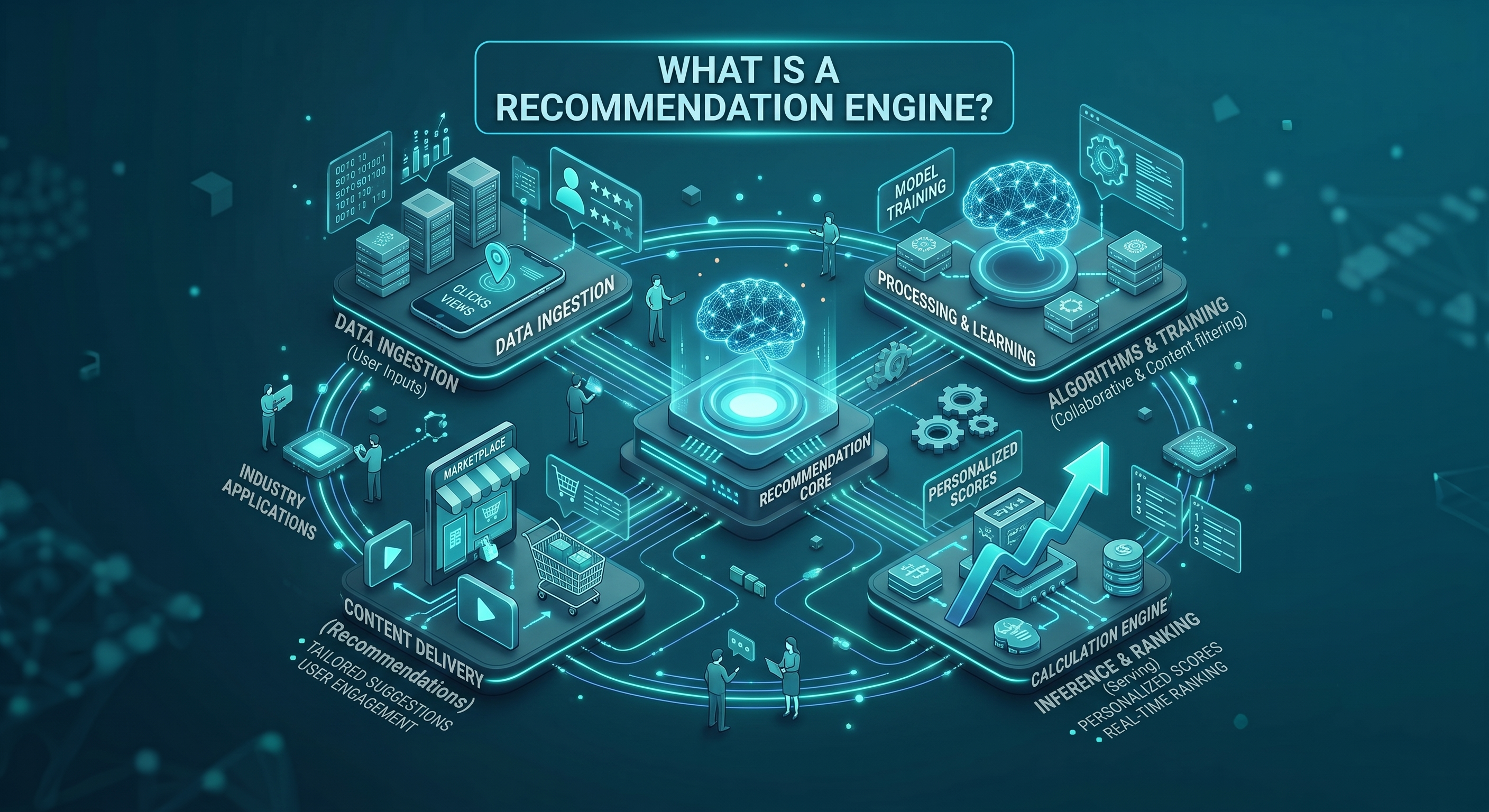
What is a Recommendation Engine?
A recommendation engine is a machine learning system that predicts which items - products, content, listings, courses - a specific user is most likely to find relevant or want to engage with, and surfaces those items proactively rather than waiting for the user to search for them explicitly.
It works by learning patterns from historical interaction data - purchases, clicks, views, ratings, time spent - and using those patterns to rank a catalogue of items specifically for each individual user, or for users similar to them.
Key Features of Our Recommendation Engine Development Services
Our recommendation engine development is built around the engineering details that separate a genuinely effective personalisation system from a generic similarity widget.
Hybrid recommendation architecture
Combining collaborative filtering, content-based signals, and contextual data so the system performs well across both established users and new visitors.
Real-time and session-aware personalisation
Recommendations adapt within a single browsing session based on what a user is actively viewing right now, not only their historical purchase pattern.
Cold-start handling for new users and new items
Dedicated logic for recommending to first-time visitors and surfacing newly added catalogue items that have no interaction history yet.
Multi-objective ranking
Recommendations are optimised against more than just predicted click probability, incorporating business objectives like margin, inventory levels, or strategic merchandising priorities.
A/B testing infrastructure built in
Every recommendation strategy is deployable as a testable variant, so the actual business impact on conversion or engagement is measured rigorously rather than assumed.
Diversity and serendipity controls
Tunable parameters to prevent recommendations from narrowing into an overly repetitive "filter bubble," which over time can actually suppress catalogue discovery and revenue.
Explainable recommendation surfacing
"Because you viewed X" or "customers who bought X also bought Y" style explanations that increase user trust and click-through compared to unexplained suggestions.
Scalable real-time serving infrastructure
Architected to return personalised rankings within milliseconds at the traffic volumes high-growth platforms actually experience, not just in a small-scale proof of concept.
Superior Prediction Accuracy
Human judgment, while valuable, is subject to cognitive biases, fatigue, and information limitations. Deep learning models that are properly trained on comprehensive historical data consistently outperform human expert judgment on structured prediction tasks — whether forecasting sales, identifying at-risk patients, or predicting equipment failures.
Real-Time Decision Intelligence
In domains like fraud detection, dynamic pricing, or real-time personalization, decisions need to be made in milliseconds. Deep learning inference systems can evaluate thousands of features and return a prediction in under 50 milliseconds, enabling decision intelligence at speeds and scales that are humanly impossible.
Personalization at Scale
Deep learning enables every customer interaction to be personalized based on individual behavior, preferences, and context — across millions of customers simultaneously. This level of personalization, previously achievable only for VIP segments, drives measurable improvements in engagement, satisfaction, and lifetime value.
Proactive Risk Management
Predictive DL models identify risks before they materialize — whether that is a customer about to churn, a machine about to fail, a fraudulent transaction about to execute, or a safety incident about to occur. This shift from reactive to proactive management fundamentally changes business outcomes.
Competitive Differentiation
Organizations that successfully operationalize recommendation engine create structural competitive advantages that are difficult for competitors to replicate — because those advantages are embedded in proprietary data assets and learned models that become more accurate over time.

Why Businesses Need Recommendation Engine Development
The default recommendation widgets bundled into most e-commerce, CMS, and SaaS platforms are intentionally generic - built to work passably across thousands of different businesses rather than well for any single one. They typically rely on simple co-occurrence statistics ("customers who bought X also bought Y") without accounting for a business's specific catalogue structure, margin priorities, seasonality, or the actual behavioural patterns of its particular customer base.
This generality has a real cost. A platform-default recommendation widget cannot incorporate business-specific objectives like prioritising higher-margin items, cannot adapt its diversity settings to a business's specific catalogue breadth, and typically handles the cold-start problem for new users and new items poorly, since it was not designed around that business's specific traffic and catalogue turnover patterns. Custom recommendation engine development closes precisely these gaps, tuning the system to the actual shape of a business's data and the actual commercial outcomes it needs to drive.
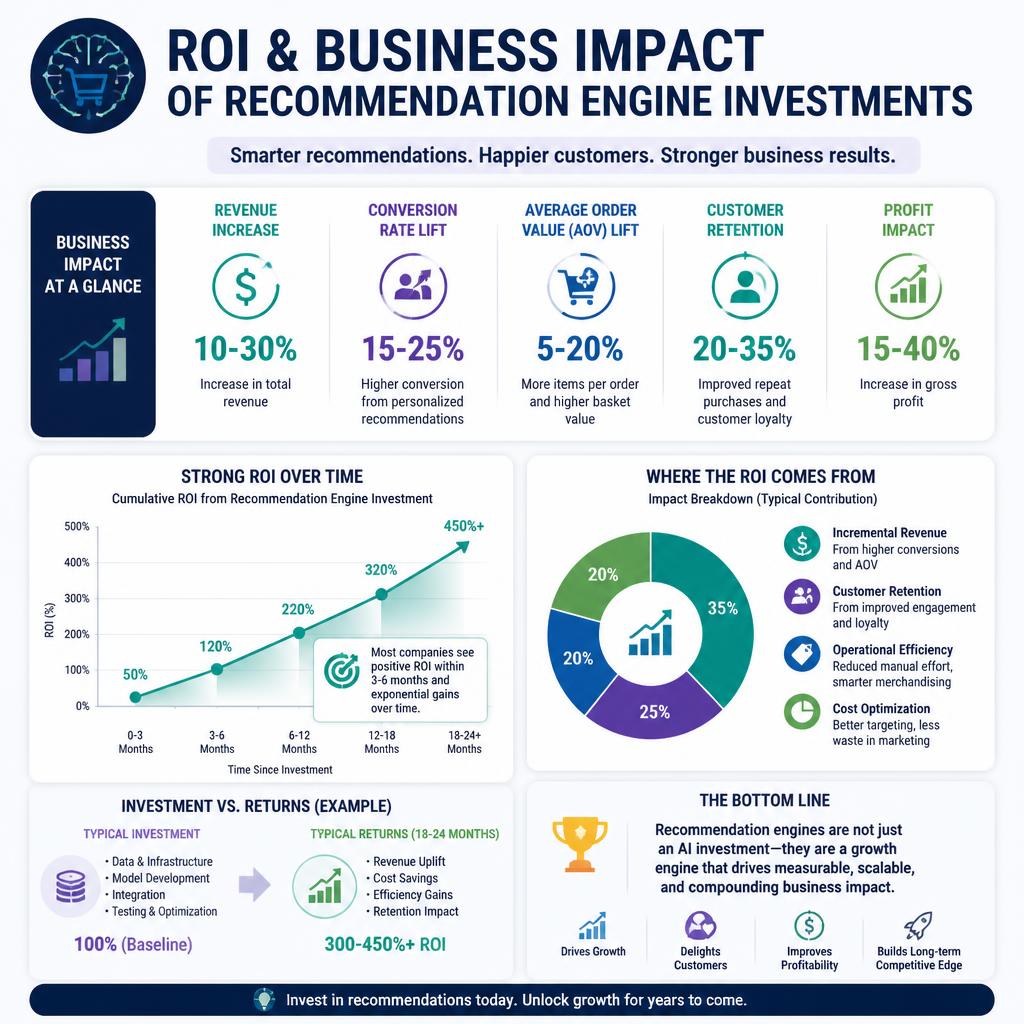
There is also a clear, well-documented commercial case. Personalisation and recommendation capability is consistently cited across e-commerce and media industry research as one of the highest-impact applications of machine learning on revenue metrics, with platforms investing seriously in recommendation infrastructure reporting meaningfully higher conversion rates and customer engagement than those relying on generic, undifferentiated product or content displays. For any platform with a catalogue larger than a few dozen items and meaningful repeat traffic, the question is generally not whether personalisation is worth pursuing, but how quickly a properly engineered system can be built and validated.

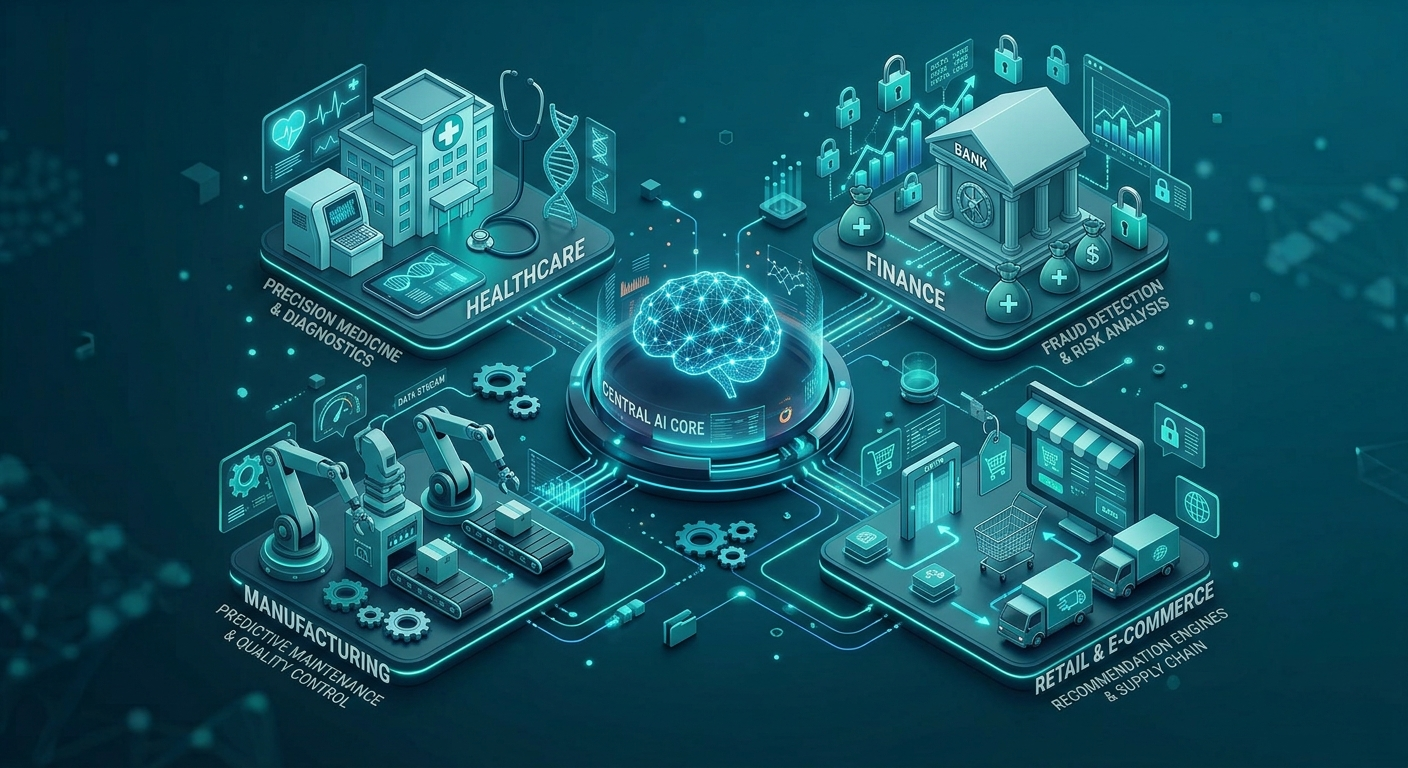
Industries We Serve with Recommendation Engine Solutions
Recommendation engines are most valuable wherever a platform has both a meaningful catalogue of items and a meaningful volume of user interaction data to learn from.
E-commerce & Retail
Product recommendations, cross-sell/upsell, personalised homepage merchandising
Media & Streaming
Content recommendations, next-episode suggestions, personalised content discovery
SaaS & Technology Platforms
Feature and module recommendations, in-app content surfacing, onboarding personalisation
Travel & Hospitality
Destination, accommodation, and activity recommendations based on traveller profile
EdTech & Online Learning
Course and content recommendations based on learning history and goals
Marketplaces
Listing recommendations for buyers, personalised search ranking
Food Delivery & Quick Commerce
Restaurant and item recommendations based on order history and time of day
Why Choose Us as Your Recommendation Engine Development Services Partner
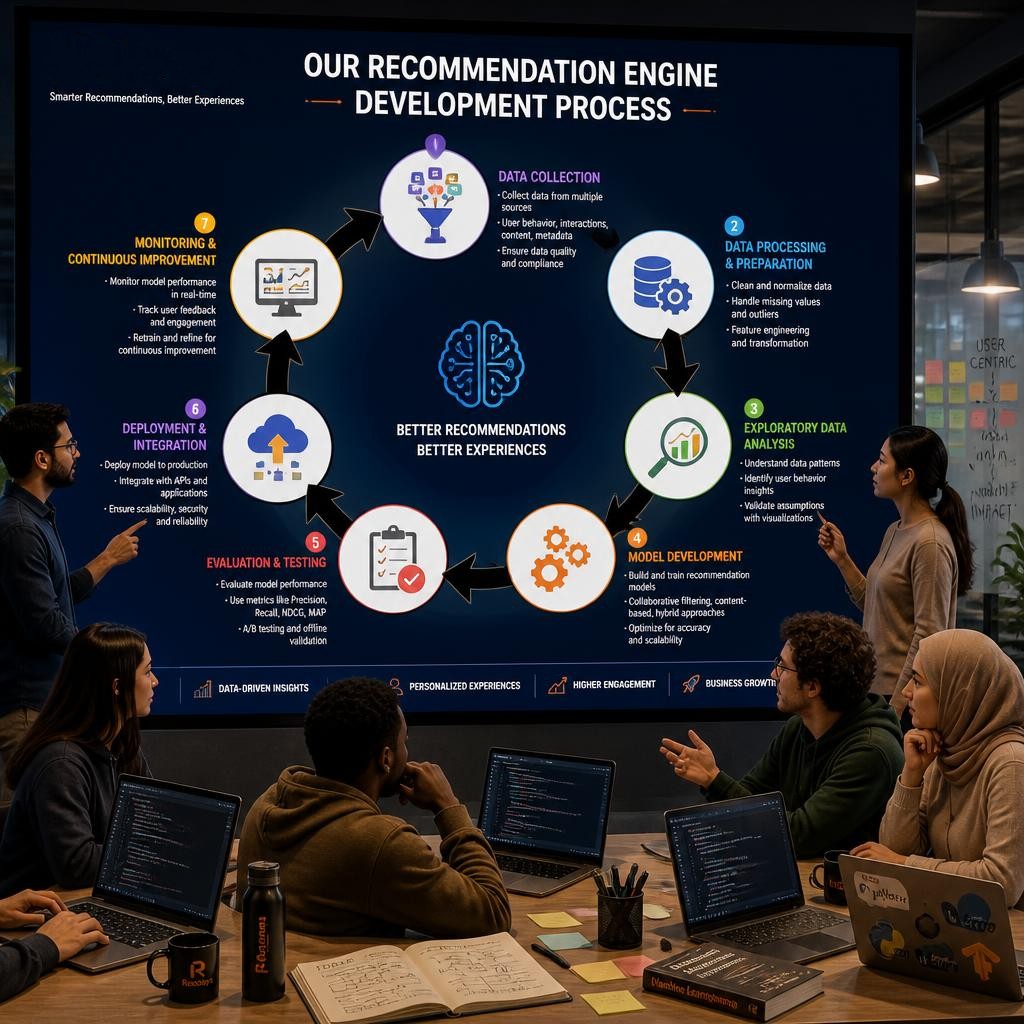
There is no shortage of companies claiming recommendation engine capabilities. Here is what genuinely differentiates our engineering-first approach:

Frequently Asked Questions About Recommendation Engine Development Services
1. What is the difference between collaborative filtering and content-based recommendations?
Collaborative filtering recommends items based on patterns across many users with similar behaviour, while content-based filtering recommends items similar in attributes to what a specific user has already engaged with - most production systems combine both into a hybrid approach for stronger overall performance.
2. How much interaction data do we need before a recommendation engine is worthwhile?
There is no fixed minimum, but platforms with at least a few months of consistent user interaction data (clicks, purchases, or views) across a reasonably sized catalogue typically have enough signal for a collaborative filtering approach to add meaningful value, with content-based approaches able to function with less historical data.
3. How do you solve the cold-start problem for new users with no history?
We use content-based and contextual signals - such as browsing behaviour within the current session, demographic or referral context, and popularity-weighted fallbacks - to generate relevant recommendations for new users before sufficient personal interaction history has accumulated.
4. Can a recommendation engine work for a small catalogue with only a few hundred items?
Yes, though the approach differs - smaller catalogues often benefit more from content-based and attribute-driven recommendations than from collaborative filtering, which generally performs best with larger catalogues and substantial interaction volume.
5. How long does it take to build and deploy a custom recommendation engine?
A first production deployment, validated through live A/B testing, typically takes 8-14 weeks depending on data readiness and the complexity of the chosen hybrid approach, with expansion to additional surfaces moving faster once core infrastructure is established.
6. How do you measure whether a recommendation engine is actually working?
We measure impact primarily through controlled A/B testing against the existing recommendation approach or no personalisation at all, tracking metrics like click-through rate, conversion rate, and average order value on live traffic rather than relying solely on offline model accuracy scores.
7. Will a recommendation engine make our platform feel repetitive or narrow user discovery?
It can, if built without deliberate diversity controls - we build tunable diversity and serendipity parameters into our ranking models specifically to prevent recommendations from narrowing into an overly repetitive pattern over time.
8. Can recommendation engines incorporate business priorities like margin or inventory levels?
Yes. We build multi-objective ranking models that can incorporate business-specific priorities such as margin or stock levels alongside predicted user relevance, rather than optimising purely for predicted click probability.
9. Do recommendation engines work for SaaS products, or only e-commerce and media?
Yes, increasingly so. SaaS platforms apply the same underlying personalisation techniques to recommend relevant features, content, or next actions within the product, supporting onboarding and engagement objectives rather than purely transactional catalogue browsing.
10. How real-time do recommendation systems need to be?
This depends on the use case - product page and homepage recommendations typically need to update within milliseconds of a request, while email or batch-generated recommendation content can be computed on a scheduled basis without the same real-time latency requirement.
11. Can we use generative AI together with a recommendation engine?
Yes. Generative AI is increasingly layered on top of recommendation outputs to produce natural-language explanations or personalised messaging around recommended items, improving user trust and engagement without replacing the underlying ranking model itself.
12. How do you prevent a recommendation engine from violating user privacy expectations or regulations?
We design recommendation pipelines with data minimisation and privacy-conscious architecture in mind, favouring first-party behavioural and contextual signals collected with appropriate consent over third-party tracking data, particularly important given evolving privacy regulation in India and globally.
13. What is vector search and why does it matter for recommendations?
Vector search allows fast similarity comparison across millions of items represented as embeddings, enabling content-based and hybrid recommendation systems to efficiently find the most relevant items for a user at scale - a foundational piece of modern large-scale recommendation infrastructure.
14. Do you offer recommendation engine development to clients outside India?
Yes. While headquartered in Chennai with delivery presence across Bangalore, Hyderabad, and Mumbai, we serve enterprise clients internationally across North America, the UK, and the Middle East, with engagement processes built for distributed, asynchronous collaboration.
15. What is the first step to starting a recommendation engine project with InfiniteTech AI?
The first step is a catalogue and interaction data audit, typically completed within one to two weeks, where we assess your existing data and traffic patterns and recommend the right initial approach before any commercial commitment to a full build.