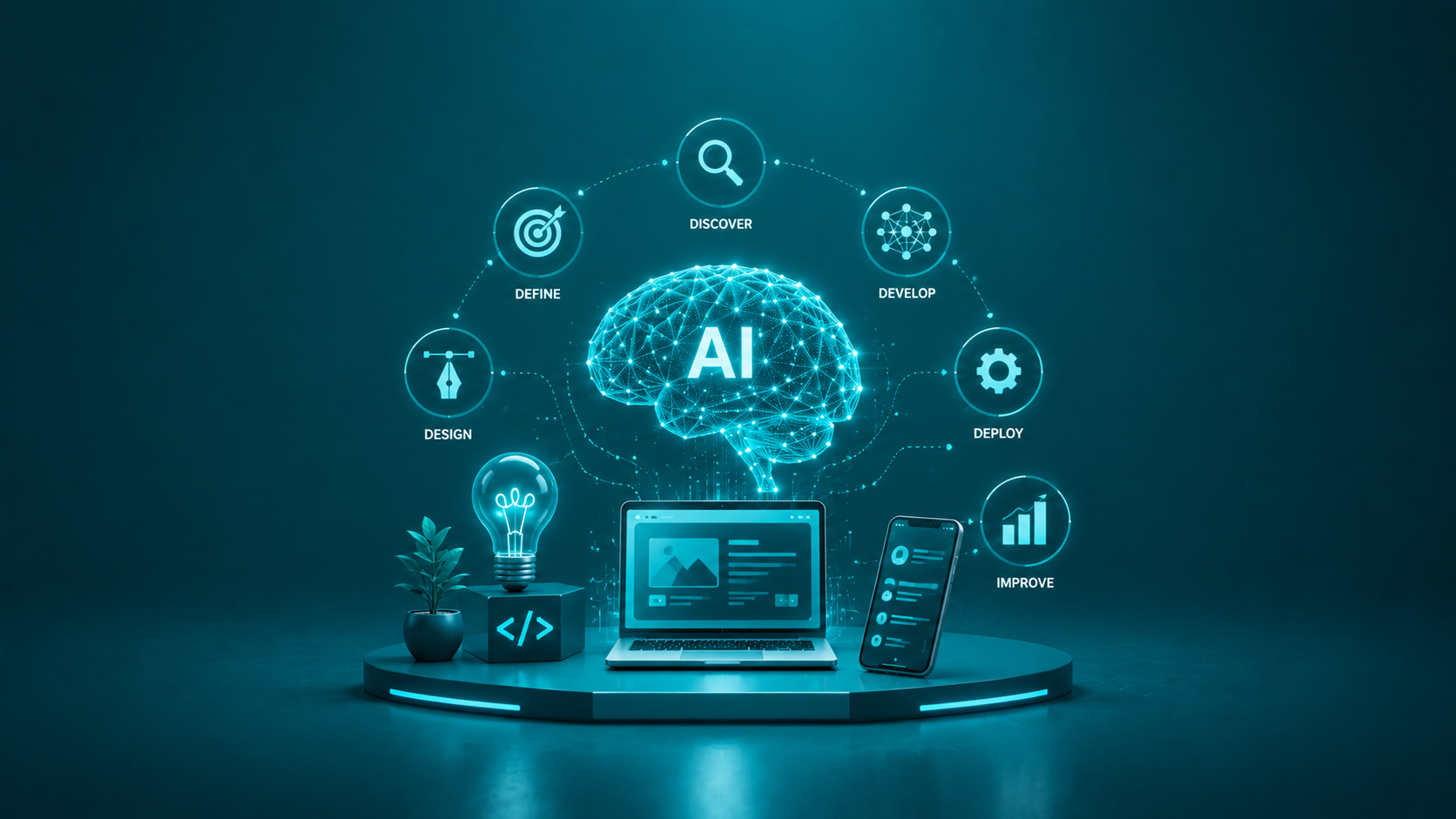
What Is AI Product Development?
AI product development is the engineering discipline of designing, building, training, deploying, and maintaining software systems that can perceive their environment, learn from data, reason about complex inputs, and take actions — with or without constant human intervention.
This is fundamentally different from conventional software development. Traditional software follows deterministic rules: given input A, it always produces output B. AI software, by contrast, is probabilistic and adaptive. It improves with exposure to data, surfaces patterns invisible to human analysts, and generates outputs — predictions, recommendations, classifications, content, decisions — that evolve as conditions change.
The Core Dimensions of AI Product Development
A well-executed AI product can autonomously learn from data, recognize patterns, make predictions, generate content, automate decisions, and adapt its behaviour over time — capabilities that are fundamentally impossible with conventional rule-based software.
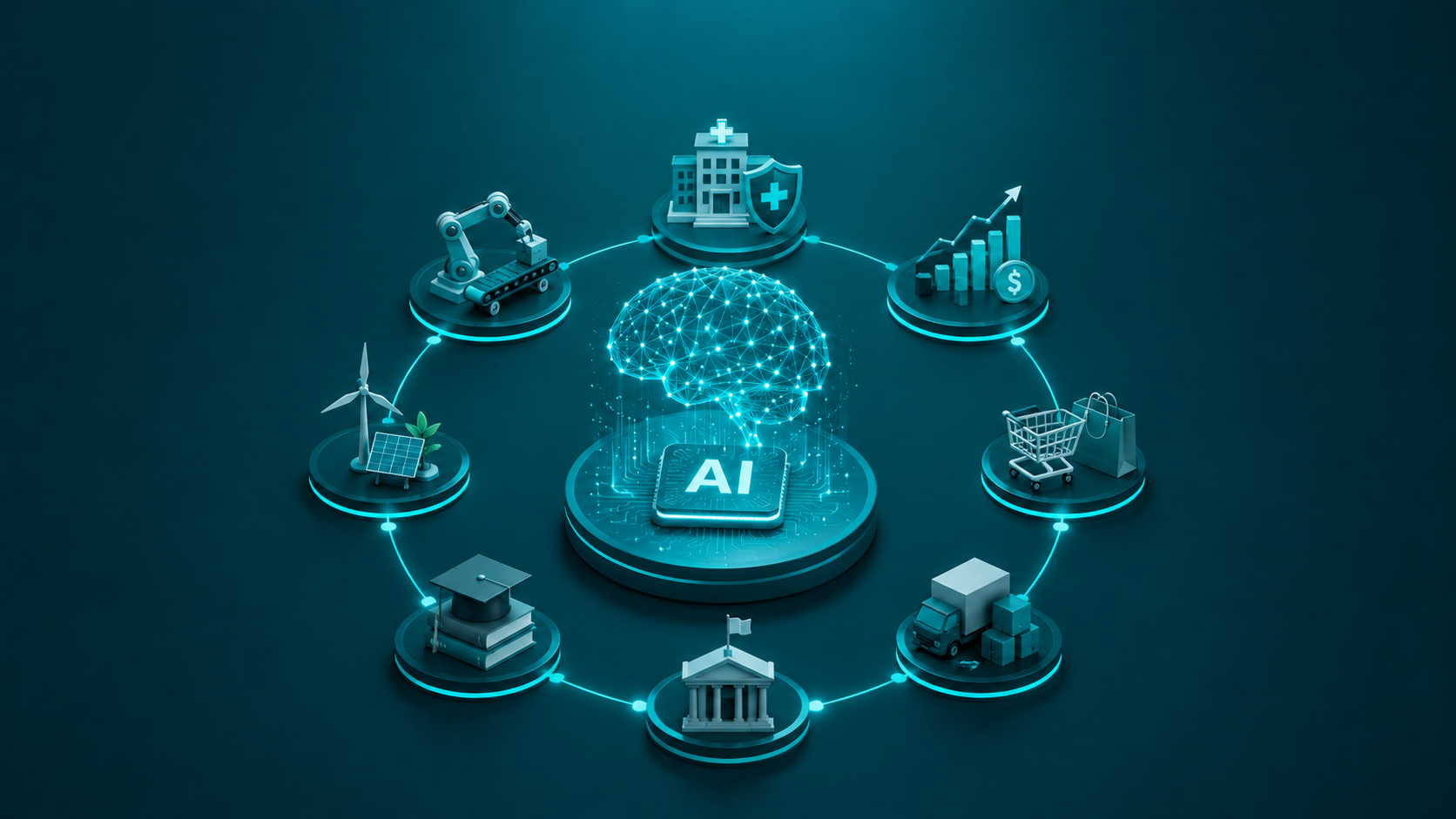
Industries Leveraging AI Product Development
AI product development is not sector-specific — it is a universal capability multiplier. However, the applications, regulatory requirements, and value drivers vary significantly by vertical.
Financial Services & Fintech
Primary AI Product Applications:
Credit scoring, fraud detection, algorithmic trading, AI-powered robo-advisors, AML compliance engines
Key Business Outcome: ↓ 40% fraud losses, ↑ 25% credit approval efficiency
Healthcare & Life Sciences
Primary AI Product Applications:
Clinical decision support, medical imaging AI, drug discovery, patient risk stratification, AI-powered EHR summarization
Key Business Outcome: ↓ 30% diagnostic errors, ↑ 20% clinician productivity
Retail & E-Commerce
Primary AI Product Applications:
AI recommendation engines, dynamic pricing, inventory forecasting, visual search, conversational commerce
Key Business Outcome: ↑ 28% basket size, ↑ 35% customer retention
Manufacturing & Industry 4.0
Primary AI Product Applications:
Predictive maintenance, visual quality inspection, supply chain optimization, AI-powered SCADA systems
Key Business Outcome: ↓ 45% unplanned downtime, ↑ 18% OEE
Legal & Compliance
Primary AI Product Applications:
Contract intelligence, legal research AI, regulatory change monitoring, e-discovery automation
Key Business Outcome: ↓ 70% document review time, ↑ 50% compliance accuracy
Education & EdTech
Primary AI Product Applications:
Adaptive learning platforms, AI tutoring, automated grading, learning analytics, content generation
Key Business Outcome: ↑ 40% learning outcomes, ↓ 60% content production cost
Real Estate & PropTech
Primary AI Product Applications:
Property valuation AI, tenant screening, predictive maintenance, document automation, market intelligence
Key Business Outcome: ↑ 22% valuation accuracy, ↓ 50% admin overhead
Human Resources & HRTech
Primary AI Product Applications:
AI talent acquisition, candidate screening, people analytics, performance prediction, skills gap analysis
Key Business Outcome: ↓ 60% time-to-hire, ↑ 35% quality-of-hire
Our AI Product Development Process
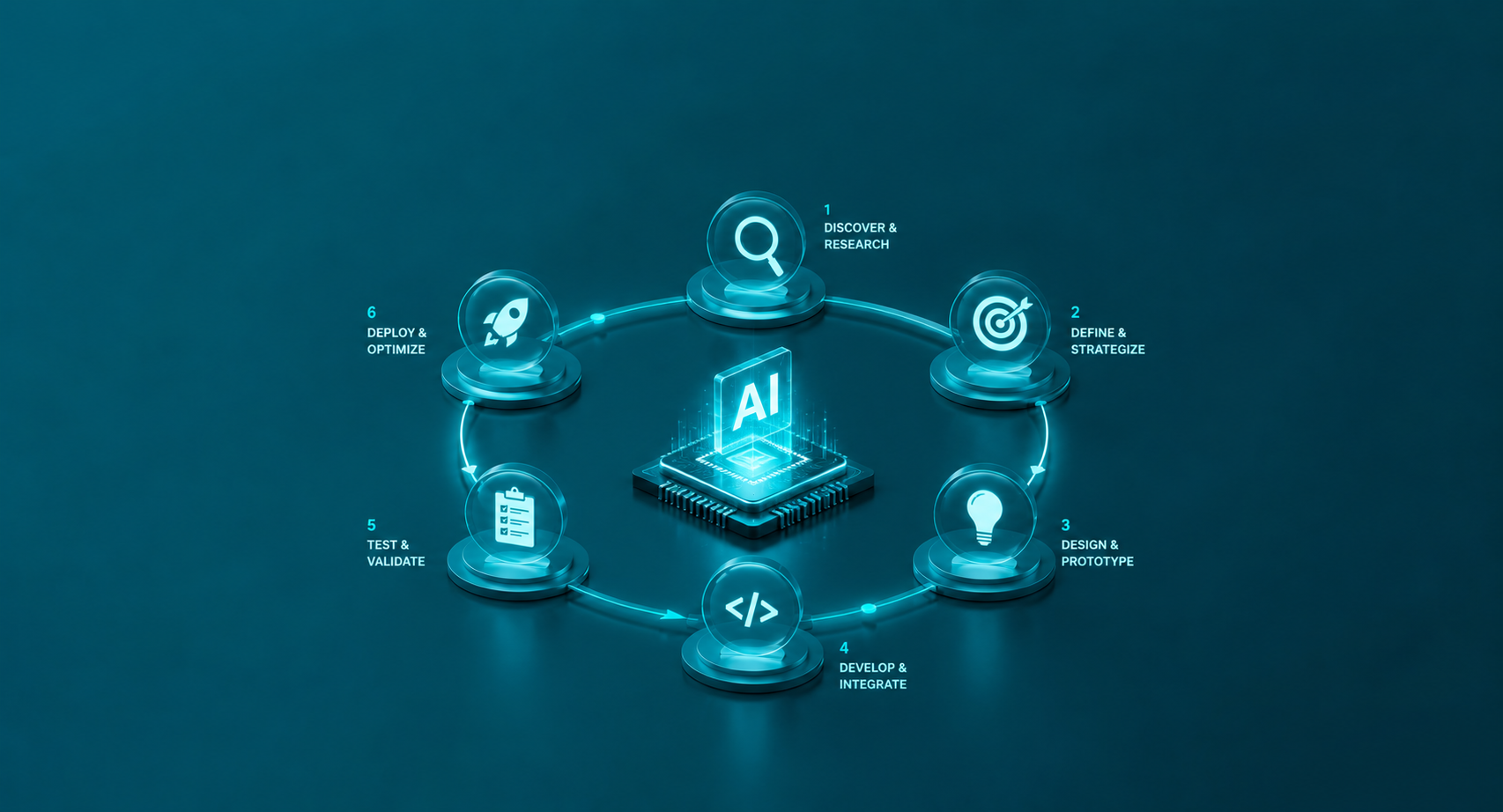
Our AI product development lifecycle is a proven, iterative methodology that reduces technical risk, accelerates value delivery, and ensures alignment between business outcomes and AI capabilities at every stage.
Phase 1: AI Product Discovery & Strategy (Weeks 1–2)
We begin with a structured discovery engagement that maps your business objectives to AI capabilities, assesses your data landscape, and defines the technical and commercial architecture of your AI product.
- Stakeholder workshops to define AI product vision and success metrics
- Data audit: availability, quality, volume, and regulatory classification
- Competitive AI landscape analysis and opportunity mapping
- Technical feasibility assessment and risk identification
- AI product roadmap creation with milestone-based delivery plan
- Commercial model design (SaaS tiers, usage-based pricing, API monetization)
Phase 2: Data Engineering & Foundation (Weeks 2–5)
Intelligent products are only as good as the data that powers them. Our data engineering team builds the pipelines, stores, and quality frameworks that create reliable AI fuel.
- Data collection, ingestion, and integration from all relevant sources
- Automated data quality validation and anomaly detection
- Feature engineering and feature store design
- Training and validation dataset construction with version control
- Privacy-preserving techniques (anonymisation, synthetic data generation) where required
- Real-time data pipeline architecture for online model inference
Phase 3: AI Model Development & Training (Weeks 4–10)
With clean, structured data in place, our ML engineers and AI researchers design and train the models that will power your product's intelligence layer.
- Algorithm selection and architecture design aligned with use case requirements
- Baseline model development and benchmark establishment
- Iterative model training with experiment tracking (MLflow / W&B)
- Hyperparameter optimisation and neural architecture search where applicable
- Model fine-tuning on domain-specific data (for LLM-based products)
- RAG pipeline development for knowledge-grounded AI applications
- Multi-model ensemble design for improved accuracy and robustness
- Model evaluation against business KPIs — not just technical metrics
Phase 4: Product Engineering & Integration (Weeks 8–16)
AI models alone do not constitute a product. Our full-stack engineering team builds the product layer that makes your AI accessible, usable, and enterprise-ready.
- RESTful / GraphQL / gRPC API development for model serving
- Frontend product development (React,Next.js, Vue, React Native)
- Model integration into existing products via SDK or microservice
- Authentication, authorization, and multi-tenancy architecture
- Prompt management systems and AI configuration dashboards
- Feedback collection mechanisms for continuous learning loops
Phase 5: Testing, Security & Compliance (Weeks 14–18)
AI products require a multi-layered testing strategy that validates model accuracy, product reliability, adversarial robustness, and regulatory compliance.
- Functional and regression testing across all product layers
- Model accuracy, precision, recall, and F1 validation
- Adversarial testing: prompt injection, data poisoning, model inversion
- Security penetration testing of API and inference endpoints
- GDPR / DPDP Act / HIPAA / PCI-DSS compliance validation
- Load and stress testing at 10x projected production traffic
- User acceptance testing (UAT) with representative end-user groups
- AI ethics and bias audit using Fairlearn and IBM AI Fairness 360
Phase 6: Deployment & MLOps Setup (Weeks 17–20)
Production deployment of an AI product is fundamentally different from traditional software release. Our MLOps engineers ensure your AI product is deployed with the infrastructure to remain accurate, reliable, and observable in production.
- Containerised model packaging with Docker and Kubernetes orchestration
- Blue-green and canary deployment strategies for zero-downtime releases
- Auto-scaling inference infrastructure with GPU/CPU optimisation
- Comprehensive ML monitoring: data drift, concept drift, model performance degradation
- Automated retraining pipelines triggered by performance thresholds
- Model version management and rollback capabilities
- SLA-backed infrastructure with 99.9% uptime guarantees
Phase 7: Post-Launch Optimization & Continuous Improvement
The launch of your AI product is the beginning — not the end. Our post-launch engagement ensures your product continuously improves, scales with demand, and evolves with your business.
- Monthly model performance reviews and optimization sprints
- New data integration and model retraining cycles
- Feature expansion based on usage analytics and user feedback
- Cost optimization of inference infrastructure
- Emerging AI technology integration (new models, new modalities)
- Strategic product roadmap refinement every quarter
Benefits of AI Product Development for Your Business
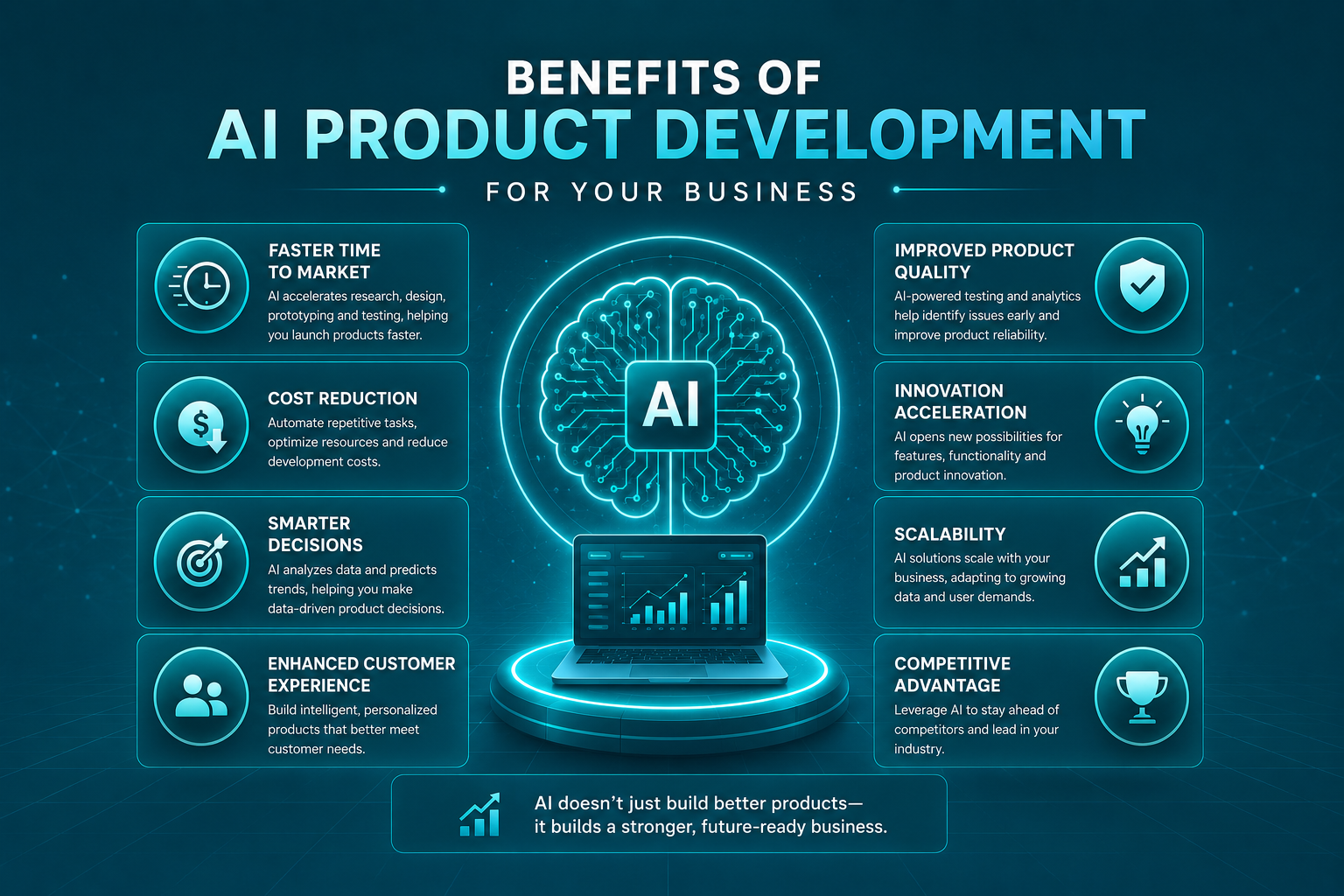
Investing in AI product development delivers compounding returns across every dimension of your business — from operational efficiency to market positioning to customer experience.
1. Unlock New Revenue Streams
AI-powered products open entirely new monetization pathways. Subscription-based AI SaaS, usage-based API products, AI-enhanced premium tiers, and autonomous agent services are generating billions in new ARR for early movers. A custom AI product built around proprietary data becomes a defensible moat competitors cannot easily replicate.
2. Dramatically Accelerate Decision Intelligence
Traditional analytics tells you what happened. AI products tell you what will happen and prescribe what to do next. By embedding predictive and prescriptive intelligence directly into your product, you empower every user — from frontline employees to C-suite executives — with real-time, AI-driven decision support.
3. Automate Complex, High-Value Workflows
AI products can automate workflows that were previously too nuanced for traditional automation — medical diagnosis support, contract review, code generation, fraud detection, and customer sentiment analysis. This delivers 60–80% cost reduction in targeted functions while freeing human talent for higher-order strategic work.
4. Deliver Hyper-Personalized User Experiences
AI-powered personalization engines analyse thousands of signals per user to deliver experiences that feel individually crafted — recommended content, adaptive pricing, personalized onboarding journeys, and context-aware support. Companies deploying AI personalization report 15–30% higher conversion rates and 20–40% improvements in customer retention.
5. Build Compounding Competitive Advantage
Unlike static software features, AI products improve over time as they ingest more data. Each interaction, each data point, and each feedback signal makes the model smarter — creating a virtuous cycle that grows your competitive moat with every passing month.
💡 ROI Benchmark: McKinsey's 2024 State of AI report found that organizations deploying AI across product lines saw average EBITDA improvements of 15–25%, with top quartile performers achieving 45%+ margin expansion from AI-driven products.
Case Study: AI Product Development in Action
Case Study 1: AI-Powered Contract Intelligence Platform for a Legal Technology Company

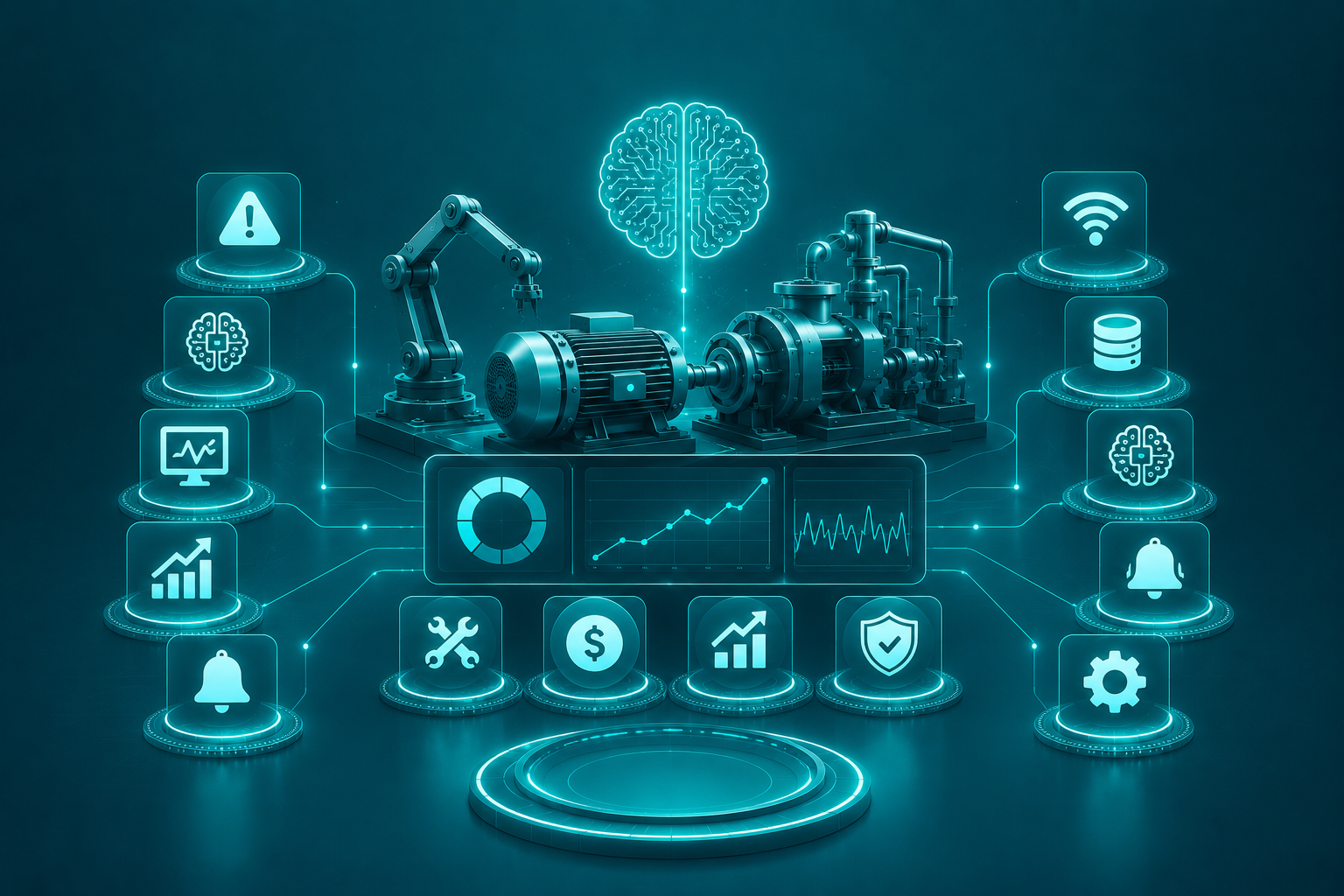
Case Study 2: Predictive Maintenance AI Product for a Manufacturing Enterprise
ROI & Business Impact of AI Product Development
Quantifying the return on AI product development investment is critical for business case construction and board-level approval. Here is a framework that distils the economic value across the most common impact categories.
📈 ROI Timeline: Most enterprises see positive ROI from AI product investments within 9–14 months of production launch. SaaS companies typically see faster returns (6–9 months) due to the compounding effect of AI features on subscription growth and churn reduction.
People Also Ask: AI Product Development
What is the difference between AI product development and AI consulting?
AI consulting focuses on strategy, assessment, and roadmap creation — advising organizations on where and how to deploy AI. AI product development is the hands-on engineering engagement that actually builds, trains, deploys, and operates the AI system. The best engagements combine both: strategic consulting anchored by technical delivery accountability.
How long does it take to develop an AI product?
Timelines vary by product complexity. A focused AI MVP (e.g., a document classification tool or chatbot) can be delivered in 6–10 weeks. A full-featured, production-grade AI SaaS platform with multi-model architecture, MLOps infrastructure, and enterprise security typically requires 16–24 weeks from discovery to launch.
What data do I need to build an AI product?
Data requirements depend on your AI approach. For supervised ML models, you typically need 5,000–100,000 labelled examples. For LLM-based products using RAG, you need structured knowledge sources (documents, databases, APIs) rather than large labelled datasets. For fine-tuning foundation models, 500–5,000 high-quality examples can be sufficient. We conduct a data readiness assessment before every engagement.
How much does AI product development cost in India?
AI product development costs in India vary from ₹25 lakhs for a focused AI MVP to ₹2–10 crores for enterprise-grade AI platforms. The primary cost drivers are model complexity, data engineering scope, infrastructure architecture, and the number of product features. India-based AI development offers 40–60% cost savings versus equivalent teams in the US or UK without compromising engineering quality.
Can you integrate AI into our existing software product?
Yes — AI feature integration into existing products is one of our most common engagement types. We have pre-built integration patterns for major tech stacks (React, Node.js, Python, Java, .NET) and can add AI capabilities via microservice APIs, SDK integration, or direct model embedding — minimising disruption to your existing product architecture.
What is RAG and why is it important for AI products?
Retrieval-Augmented Generation (RAG) is an architecture that combines a large language model with a real-time retrieval system connected to your organization's knowledge base. Instead of relying on a model's static training data, RAG enables the AI to retrieve up-to-date, organization-specific information before generating responses — dramatically reducing hallucinations and ensuring domain relevance. RAG is now the standard architecture for enterprise AI products that need to work with proprietary data.
How do you ensure data privacy and security in AI products?
We implement multiple layers of data protection: end-to-end encryption (AES-256 at rest, TLS 1.3 in transit), role-based access control, data anonymisation and pseudonymisation, privacy-preserving ML techniques (federated learning, differential privacy), and comprehensive audit logging. We ensure compliance with GDPR, India's DPDP Act 2023, HIPAA, and PCI-DSS as applicable to each client's context.
What is model drift and how do you prevent it?
Model drift occurs when an AI model's predictive accuracy degrades over time because the real-world data distribution diverges from the training data distribution. We prevent drift through automated monitoring using tools like Evidently AI and WhyLabs, which detect statistical shifts in input data and model output distributions. When drift thresholds are breached, automated retraining pipelines are triggered to update the model with fresh data.
Do you provide ongoing support after the AI product is launched?
Yes — we offer post-launch AI product support and evolution packages ranging from basic model monitoring to comprehensive AI product management. Our most popular post-launch package includes monthly model performance reviews, quarterly model retraining, a dedicated ML engineer for on-call support, and two feature development sprints per quarter.
What makes an AI product different from traditional software?
Traditional software follows deterministic, rule-based logic — the same input always produces the same output. AI products are probabilistic, learning-based systems that improve with data exposure and can handle inputs and scenarios that were never explicitly programmed. AI products also require ongoing maintenance (model retraining, drift monitoring) that has no equivalent in conventional software maintenance.
Can small businesses benefit from AI product development?
Absolutely. While enterprise AI products receive more coverage, small and medium businesses often achieve some of the highest ROI from AI development. AI products for SMBs are increasingly affordable due to API-based LLM access, cloud-based ML infrastructure, and pre-trained foundation models that reduce custom training costs. A well-targeted AI product can help an SMB compete with companies 10x their size.