
What is AI API Development
AI API development is the process of designing and building application programming interfaces (APIs) that allow other software, websites, or applications to access and use the capabilities of an artificial intelligence or machine learning model, such as natural language processing, computer vision, predictive analytics, or generative AI, over a standard protocol like REST, GraphQL, gRPC, or WebSockets.
In simpler terms, an AI API acts as a bridge. On one side sits a trained model, whether that is a large language model such as GPT or Claude, a custom-trained classifier, a recommendation engine, or a computer vision system. On the other side sits the application that wants to use that intelligence, such as a mobile app, an e-commerce platform, an internal CRM, or a third-party partner system. The API standardizes how requests go in and how predictions, completions, or insights come back out, regardless of what is happening under the hood.
This is fundamentally different from traditional API development because AI APIs introduce new variables that conventional CRUD APIs rarely deal with: non-deterministic outputs, variable response times depending on model complexity, token-based pricing models, GPU resource management, prompt engineering layers, and the need for continuous evaluation as models drift or get updated. A well-built AI API anticipates all of this from day one.
• In practice, the term covers several distinct categories of APIs, each with its own engineering considerations:
- Natural Language Processing (NLP) APIs: Power text classification, sentiment analysis, entity extraction, summarization, and translation, typically built on transformer-based models.
- Generative AI APIs: Expose large language models or diffusion models for tasks like content generation, conversational assistants, code generation, or image synthesis, and require careful prompt management and output validation.
- Computer Vision APIs: Handle image classification, object detection, OCR, and video analysis, often with strict latency requirements for real-time use cases.
- Predictive Analytics APIs: Serve outputs from regression, classification, or time-series forecasting models, commonly used for credit scoring, churn prediction, and demand forecasting.
- Recommendation & Personalization APIs: Return ranked suggestions based on user behavior, collaborative filtering, or embedding similarity, frequently used in e-commerce and media platforms.
Each of these categories shares the same core engineering backbone of authentication, rate limiting, and observability, but differs significantly in how inference is optimized, how outputs are validated, and how cost per request is managed. Part of our job as an AI API development partner is identifying which category, or combination of categories, your use case actually falls into before any architecture decisions are made.
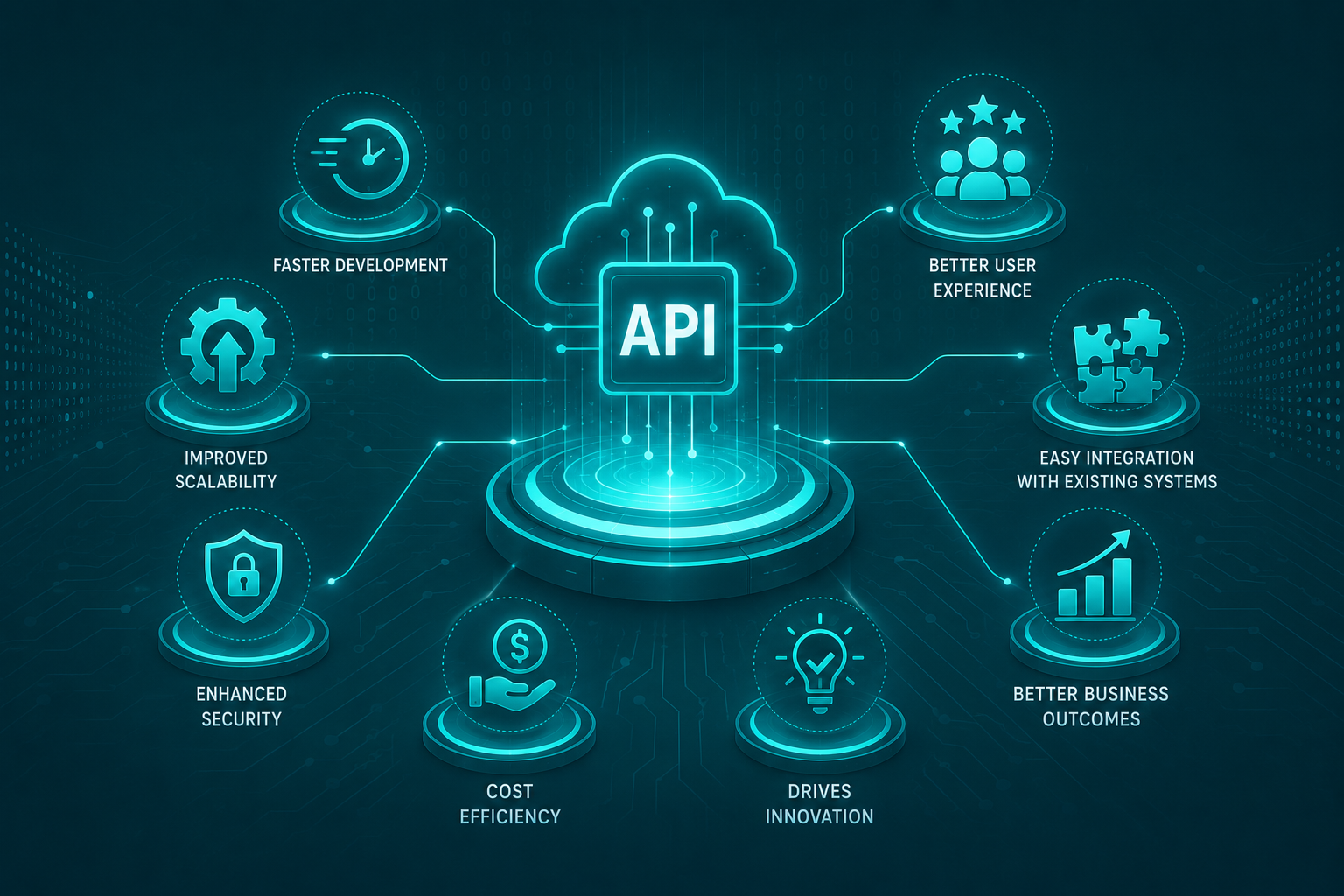
Benefits of AI API Development
When AI capabilities are exposed as well-designed APIs rather than buried inside a single application, the benefits compound across the entire organization:
Why Businesses Need AI API Development
Most organizations do not lack AI talent or even AI models. What they lack is a reliable way to operationalize those models across their technology stack. A predictive model that lives only in a data scientist's notebook delivers zero business value until it can be called, in real time, by the systems your customers and employees actually use.
AI API development solves this gap in three practical ways. First, it decouples your AI logic from your application logic, so your frontend and backend teams can move independently of your data science team. Second, it creates a single, governed entry point for AI capabilities, making it far easier to enforce compliance, monitor cost, and control access. Third, it future-proofs your architecture: as foundation models and AI frameworks evolve at a rapid pace, an API abstraction layer lets you upgrade the intelligence behind the API without forcing every downstream consumer to change their integration.
For startups, this often means the difference between an AI feature that stays a demo and one that becomes a shippable product. For enterprises, it usually means turning AI from a series of disconnected pilot projects into a reusable, governed capability that multiple business units can draw on.
There is also a build-versus-buy dimension worth addressing directly. Many teams start by calling a foundation model provider's API directly from their application code, which works fine for a prototype but tends to break down as soon as the product needs custom business logic, multi-model fallback, granular usage tracking, or compliance controls. At that point, what looked like a shortcut becomes technical debt scattered across the codebase. Building a dedicated AI API layer, even a thin one, early on tends to save significant rework later, because it gives you a single place to add caching, swap providers, enforce data handling policies, and track cost per customer or per feature.
Industries Using AI API Development
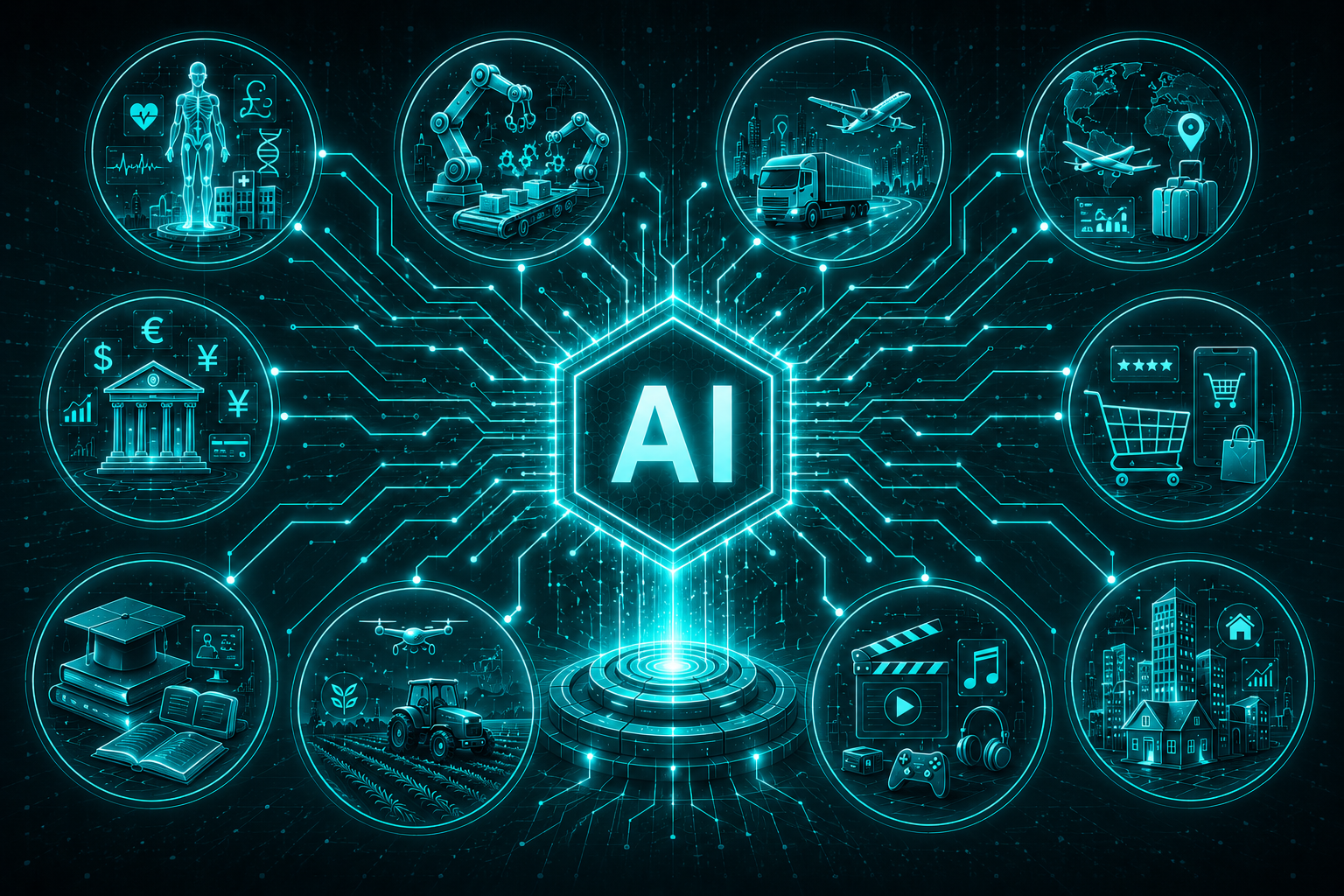
AI APIs have moved well beyond chatbots. Across the industries we serve, here is where AI API development is delivering measurable value today:
Fintech & Banking
Real-time fraud detection APIs, credit risk scoring engines, KYC document verification, and conversational banking assistants.
Healthcare & Life Sciences
Clinical decision-support APIs, medical image analysis, patient triage chatbots, and appointment-summary generation.
E-commerce & Retail
Product recommendation APIs, visual search, dynamic pricing engines, and AI-generated product descriptions.
Logistics & Supply Chain
Route optimization APIs, demand forecasting, warehouse automation, and predictive maintenance for fleets.
EdTech
Personalized learning path APIs, automated grading, and AI tutoring assistants embedded into learning platforms.
Real Estate & PropTech
Property valuation models, lead-scoring APIs, and AI-powered virtual property assistants.
Manufacturing & Industry 4.0
Predictive maintenance APIs, quality-control computer vision, and supply forecasting models.
Insurance
Automated claims triage APIs, fraud-pattern detection, and risk-pricing models embedded into quote engines.
Travel & Hospitality
Dynamic pricing, itinerary recommendation APIs, and AI-powered customer support assistants.
Media, SaaS & Entertainment
Content generation, summarization, moderation, and personalized content-ranking APIs.

Why Choose InfiniteTech AI
InfiniteTech AI is an AI consulting and software development company based in Chennai, working with clients across Bangalore, Hyderabad, Mumbai, and international markets. Here is what sets our AI API development practice apart:

ROI & Business Impact
AI APIs typically pay for themselves through a combination of operational savings and new revenue opportunities. The exact return depends heavily on use case, scale, and how deeply the API is embedded into your products, but the underlying drivers of ROI are consistent across most engagements:
Industry analysts broadly agree that enterprise investment in AI infrastructure, including APIs and model-serving layers, continues to accelerate year over year as organizations move from pilot projects to production deployment. The businesses capturing the most value tend to be the ones that treat AI as a reusable, API-first capability rather than a one-off feature bolted onto a single product.
In our experience, the single biggest lever for ROI is not the sophistication of the underlying model, it is whether the API around it is reliable enough that product teams trust it to build on. A highly accurate model wrapped in a fragile, undocumented endpoint gets used cautiously and sparingly. A solid, well-documented API, even around a simpler model, tends to get adopted across more teams and more features, which is ultimately what drives the cumulative return on the investment.

Frequently Asked Questions
What is the difference between AI MVP development and using a pre-built AI API?
Pre-built AI APIs provide general-purpose capabilities. Custom AI MVP development involves building or fine-tuning models specifically on your data and for your tasks — resulting in higher accuracy, lower inference cost at scale, full data ownership, and a defensible intellectual property asset that generic APIs cannot provide.
How long does it take to develop a custom AI model?
Timeline depends on data availability, problem complexity, and integration requirements. Simple predictive models can be production-ready in 6–10 weeks. Complex LLM fine-tuning or computer vision systems typically take 12–20 weeks from discovery to deployment.
What data do I need to start AI MVP development?
Requirements vary significantly by model type. Predictive models often need 10,000–100,000 labeled records. NLP models can leverage foundation models with smaller domain-specific datasets. Computer vision models typically require thousands to tens of thousands of annotated images.
Can you fine-tune an existing AI model on our proprietary data?
Yes — fine-tuning an open-source foundation model (LLaMA, Mistral, etc.) on your domain data is often the most cost-effective and highest-performing approach. We specialize in parameter-efficient fine-tuning techniques (LoRA, QLoRA) that achieve domain-specific performance with lower compute requirements.
How do you ensure AI model security and data privacy during development?
We implement strict data governance protocols including data anonymization, access controls, encrypted data transfer and storage, isolated training environments, and documented data handling procedures. We can work entirely within your infrastructure to ensure data never leaves your control.
What is MLOps and why does it matter for AI MVP development?
MLOps applies DevOps principles to machine learning model lifecycle management — including automated training pipelines, model versioning, deployment automation, and production monitoring. Without MLOps, even excellent AI models fail in production due to drift and infrastructure fragility.
How do you measure AI model performance?
Performance evaluation is task-specific. Classification models use accuracy, precision, recall, F1-score, AUC-ROC. Regression models use MAE, RMSE, MAPE. NLP models use BLEU, ROUGE, BERTScore. Computer vision models use mAP and IoU. We define success metrics in discovery and report against them at every milestone.
Can AI models be deployed on-premise rather than in the cloud?
Yes. We support on-premise deployment, private cloud, hybrid architectures, and edge deployment. Many enterprise clients in regulated industries require full on-premise or private cloud deployment for data sovereignty reasons.
What industries have the highest ROI from custom AI MVP development?
Financial services (fraud detection, credit scoring), manufacturing (predictive maintenance, quality control), healthcare (clinical decision support, imaging analysis), retail (demand forecasting, personalization), and logistics (route optimization) consistently show the highest and fastest ROI.
Do you provide ongoing support after model deployment?
Yes. We offer SLA-backed model monitoring, maintenance, and optimization retainers — including production monitoring dashboards, drift alerting, scheduled retraining cycles, quarterly performance reviews, and dedicated engineering support.