Unlock the Hidden Value Buried in Your Business Documents
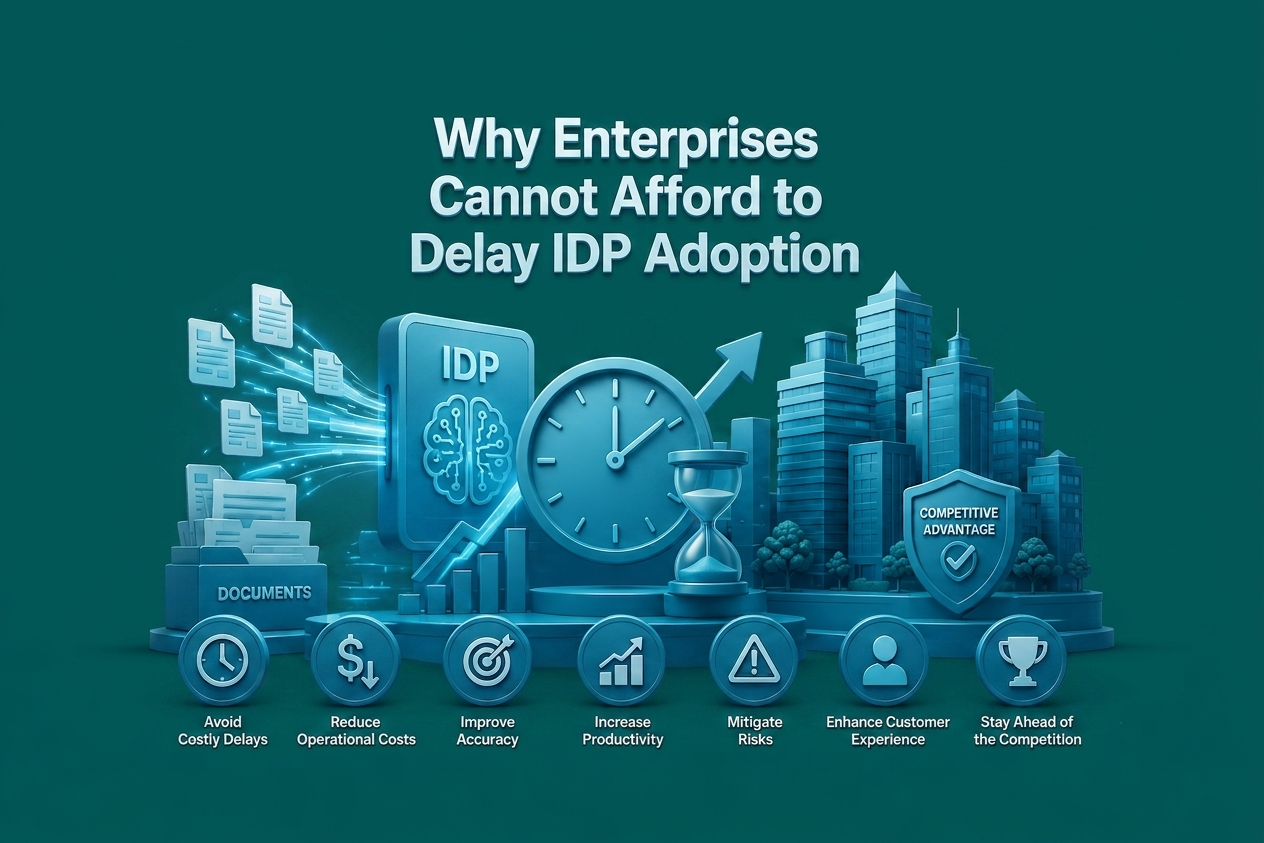
The global business environment is accelerating. Customer expectations are rising. Competitive margins are compressing. Talent costs are increasing. In this context, operational efficiency is no longer a back-office concern — it is a strategic imperative that directly determines competitive advantage.
Research consistently shows that manual, paper-based, and spreadsheet-driven processes are extraordinarily expensive:
Early adopters of process automation are creating competitive moats that are increasingly difficult to close. Organizations that automate today benefit from compounding advantages: lower operational costs generate investment capacity for further automation and innovation, creating a virtuous cycle of efficiency and growth.
The question for business leaders is no longer whether to invest in process automation services — it is how quickly to move and which processes to prioritize for maximum impact.
According to Deloitte's Global RPA Survey, 78% of organizations that have implemented RPA expect to significantly increase their automation investment over the next three years. Of those already live with automation, 86% report that RPA has met or exceeded their expectations for benefits delivery.
%20(2).png)
Understanding the difference between legacy OCR and modern IDP is crucial for setting automation expectations.
| Capability | Traditional OCR | Intelligent Document Processing |
|---|---|---|
| Document Types Handled | Structured, fixed templates only | Structured, semi-structured, and unstructured |
| Data Understanding | Character recognition only — no context | Semantic understanding of field meaning and relationships |
| Handwriting Support | Very limited, low accuracy | Advanced handwriting recognition with deep learning |
| Multi-Language Support | Basic, often English-only | Multilingual including Hindi, Tamil, Telugu, Arabic, and 50+ languages |
| Learning Capability | Static — no improvement over time | Continuously learns from corrections and feedback |
| Exception Handling | High false-positive rates, no routing | Intelligent exception classification and human-in-loop routing |
| Integration | Output as text file requiring further processing | Direct API integration with ERP, CRM, RPA, and workflow systems |
| Validation | None — raw text output only | Rule-based and AI-driven validation against business logic and databases |
| Accuracy on Complex Docs | 50 to 75% on variable templates | 95 to 99.5% across varied document formats |
A fully capable IDP solution integrates multiple AI and automation technologies working in concert:
Our IDP solutions are engineered for the complexity, scale, and regulatory environment of enterprise document workflows. Here are the platform capabilities that our clients rely on:
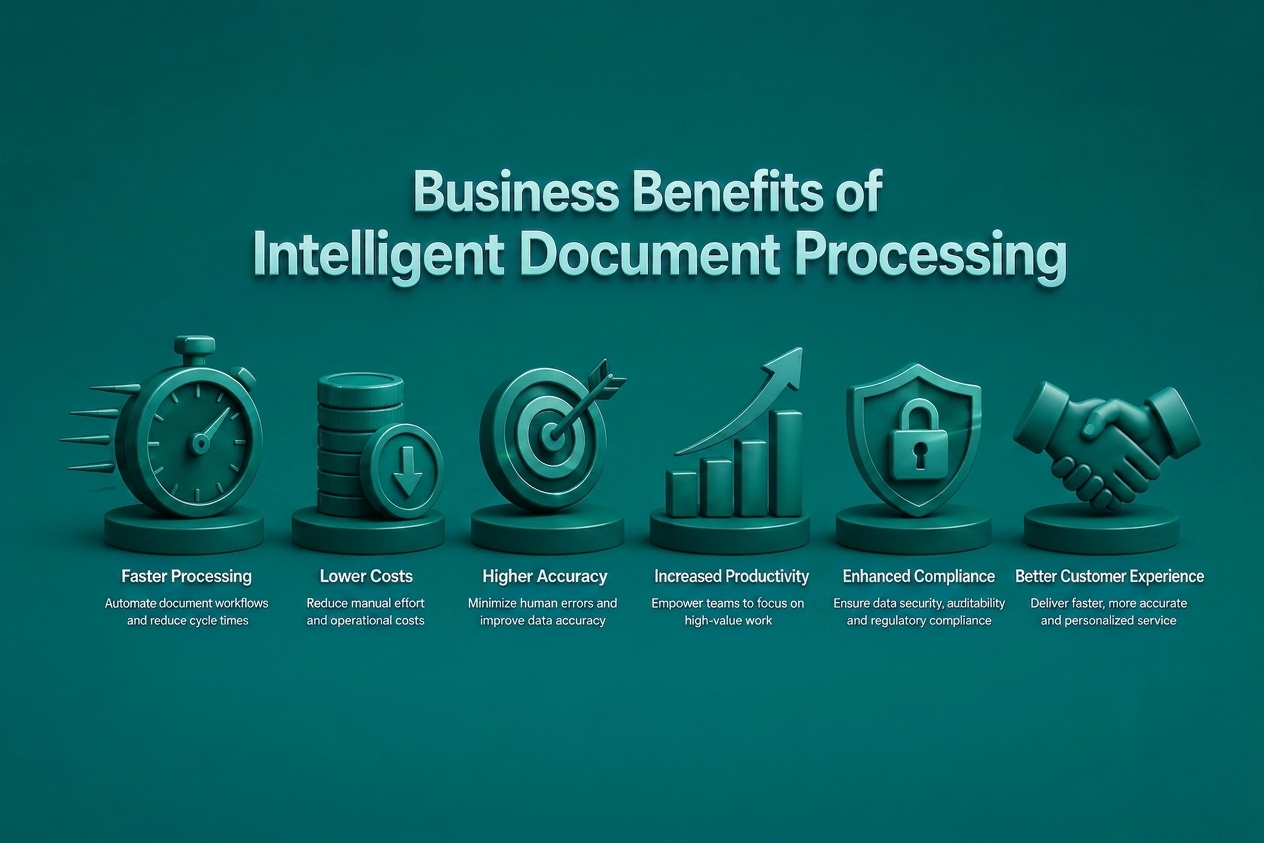
Our IDP platform accepts documents from virtually any source and in any format. Email attachments are automatically captured and routed from monitored inboxes. Scanner integration enables real-time digitization of physical documents. API-based ingestion connects vendor portals, customer-facing applications, and partner systems directly to the IDP pipeline. Support for over 40 file formats ensures no document falls outside the automation scope.
Where traditional tools fail on variable document formats, our AI extraction models excel. Whether processing invoices from 3,000 different vendors, contracts with varying clause structures, or handwritten application forms from field offices across India, our models adapt to format variation without requiring rigid template configuration. This template-free extraction is one of our most significant technical differentiators.
India's business environment demands multilingual document processing capability. Our IDP platform supports document extraction in English, Hindi, Tamil, Telugu, Kannada, Marathi, Gujarati, Bengali, and Malayalam — enabling automation of document workflows for pan-India enterprises, government agencies, and regional financial institutions without language barriers.
Complex financial documents — invoices, purchase orders, bills of lading, bank statements — contain line-item tables that must be accurately extracted at the row and column level. Our deep learning table detection and extraction models achieve over 96% accuracy on complex multi-page table extraction, capturing line descriptions, quantities, unit prices, tax codes, and totals with field-level precision.
Our pre-trained document classification models can identify over 200 standard business document types out of the box — no configuration required. For custom document types unique to your business, our low-code model training studio enables rapid creation of custom classifiers with as few as 50 to 100 sample documents.
Every extracted field carries a confidence score based on the model's certainty in its extraction. Our smart exception routing engine automatically identifies low-confidence extractions, assembles context-rich review packages for human validators, and routes them through a streamlined review interface that enables fast, accurate human correction with minimal cognitive effort.
Every document processed through our IDP platform generates a complete, immutable audit trail — document source, processing timestamp, extraction results, confidence scores, validation outcomes, human review actions, and final data delivered. This audit trail supports compliance with GST regulations, RBI guidelines, SEBI reporting, ISO 9001 quality standards, and international frameworks including GDPR and SOX.
Extracted, validated data delivers value only when it flows automatically into the systems where it is needed. Our IDP platform includes pre-built connectors for SAP S/4HANA, SAP Ariba, Oracle Fusion, Microsoft Dynamics 365, Tally ERP, Zoho Books, Salesforce, ServiceNow, and leading HRMS platforms — reducing integration development time from weeks to days.
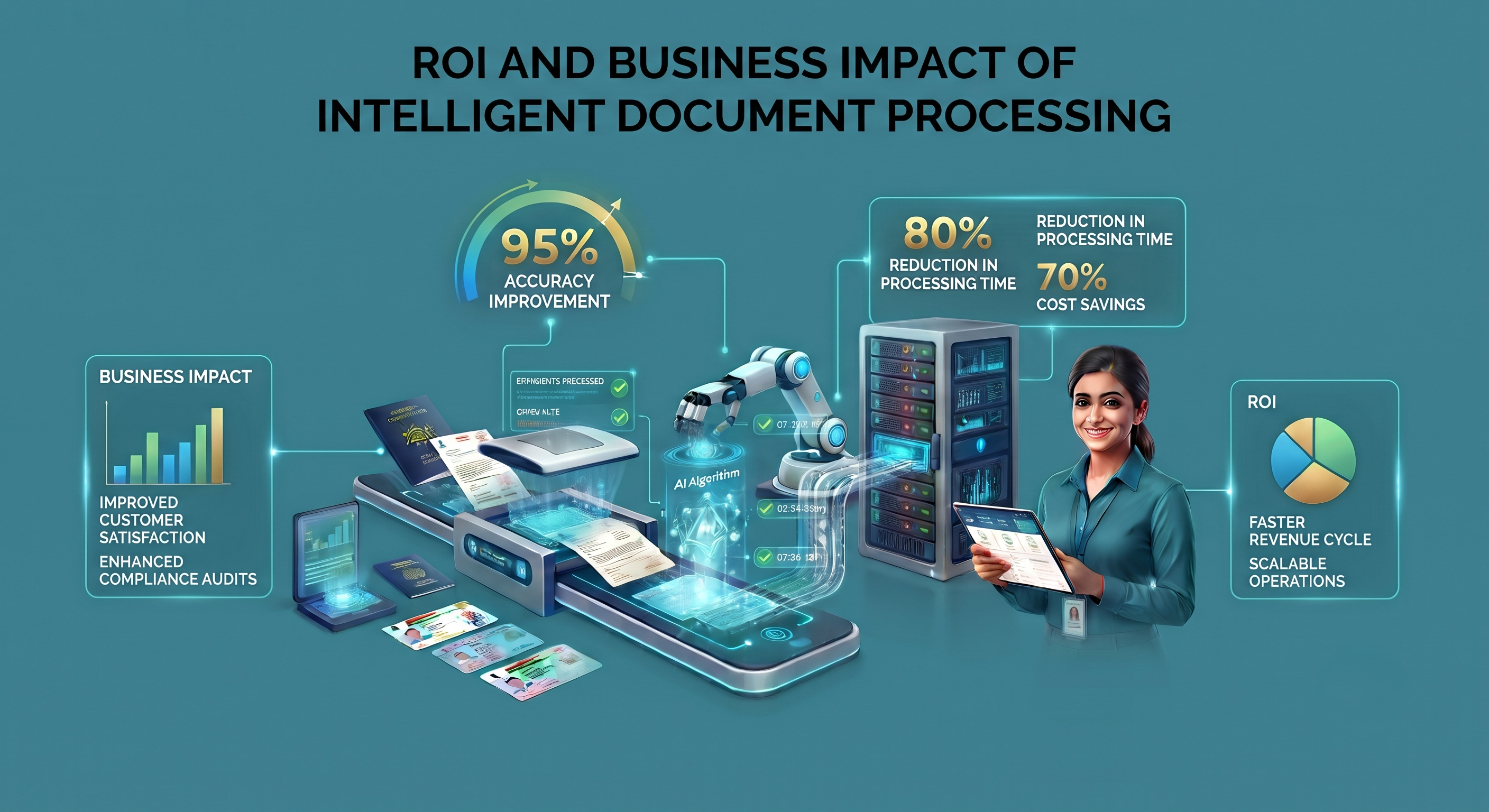
The business case for IDP is among the most compelling in the enterprise automation category. Here is what our clients consistently achieve after deploying our IDP solutions:
| Benefit Dimension | Typical Pre-IDP State | Post-IDP Achievement | Business Impact |
|---|---|---|---|
| Data Extraction Accuracy | 93 to 95% with experienced manual teams | 99.0 to 99.7% with AI extraction | 85% reduction in rework from data errors |
| Processing Speed | 5 to 15 minutes per document manually | 8 to 45 seconds per document with IDP | 10x to 50x throughput improvement |
| Processing Cost | INR 180 to 350 per document manually | INR 8 to 35 per document with IDP | 75 to 90% cost reduction |
| Processing Hours | 8 to 10 hours daily (business hours only) | 24x7 continuous processing | 3x effective daily capacity increase |
| Vendor Invoice Cycle Time | 8 to 20 days end-to-end | 1 to 3 days end-to-end | Early payment discount capture |
| Compliance Audit Readiness | Manual reconciliation, days of effort | Automated audit trail, instant reporting | 100% audit documentation coverage |
| Staff Productivity | 60 to 80% of time on data entry | Less than 10% on data review | 50 to 70% capacity freed for analysis |

The volume and complexity of business documents is not decreasing — it is accelerating. GST compliance requirements multiply invoice touchpoints. Supply chain complexity multiplies vendor documents. Customer expectations for digital-first interactions multiply the volume of digital forms and requests. Yet most organizations are still processing this growing document avalanche with manual teams using the same approaches they used twenty years ago.
The fully-loaded cost of manual document processing is almost always dramatically underestimated by finance and operations leaders. When you account for all cost dimensions, the true cost picture is sobering:
A Deloitte study found that large enterprises with high-volume document processing operations lose an average of 21.3% of total document processing investment to error-related rework, delays, and compliance remediation. IDP eliminates the root cause of this waste by achieving near-perfect extraction accuracy from the moment of ingestion.
India's evolving regulatory landscape is increasing documentation compliance requirements across every industry. GST e-invoicing mandates, SEBI reporting requirements, RBI KYC documentation standards, IRDAI claim documentation rules, and customs documentation requirements are all adding complexity and volume to enterprise document workflows. Manual processes struggle to keep pace with both volume growth and regulatory evolution — IDP provides the scalable, configurable foundation for compliant, auditable document processing at any scale.

Intelligent Document Processing delivers transformational value across every document-intensive industry. Our deployment experience spans the following verticals with proven, production-grade results:
No industry processes a higher volume or greater diversity of critical documents than BFSI. Our IDP solutions address the full spectrum of financial document workflows:
Accounts payable is the single most common IDP deployment use case globally — and for good reason. The combination of high invoice volumes, multi-vendor format variability, strict payment timing requirements, and complex three-way matching logic makes AP automation a natural and high-ROI IDP application.
Our AP IDP solutions process invoices from any vendor in any format, automatically validate against PO and GR data in SAP or Oracle, route exceptions with full context to AP reviewers, and post approved invoices directly to the ERP — transforming a 14-day manual AP cycle into a 24-hour automated process.
Legal departments and law firms manage extraordinary volumes of contracts, agreements, court filings, and regulatory documents. Our IDP solutions enable:
The logistics industry generates enormous volumes of shipping documents, customs declarations, bills of lading, waybills, and regulatory certificates. Manual processing creates bottlenecks that delay shipments, trigger demurrage charges, and create customs compliance risk. Our IDP solutions process shipping documentation packages in minutes, automatically validating consignee information, HS codes, declared values, and customs requirements.
Government agencies in India are increasingly digitizing document-intensive citizen services. Our IDP solutions support automated processing of land records, permit applications, subsidy claim forms, tender documentation, and citizen grievance submissions — enabling faster service delivery and more efficient public administration.
.png)
Successful IDP deployment is not simply a technology installation — it is a disciplined process of understanding your document landscape, designing intelligent extraction pipelines, training AI models on your specific document types, and integrating validated data into your business systems. Here is our proven eight-stage implementation methodology:
We conduct a thorough audit of your document processing environment — cataloguing document types, sources, volumes, variability, languages, and downstream system requirements. This assessment identifies IDP candidates, prioritizes high-impact deployment targets, and establishes baseline metrics against which success will be measured.
We collect representative samples of each target document type — ideally 200 to 500 samples per document class — covering the full range of format variations, quality levels, and language variants your organization encounters. Thorough sample analysis informs model training strategy and identifies edge cases requiring special handling.
Based on your document landscape, volume requirements, integration environment, and budget parameters, our architects design the optimal IDP architecture — selecting appropriate platforms, designing processing pipelines, specifying validation rules, defining HITL workflows, and planning system integration patterns.
Our AI team annotates document samples, trains classification and extraction models, tunes confidence thresholds, and validates model performance against held-out test sets. We target accuracy benchmarks agreed with your team before advancing to integration development. For custom document types, we typically achieve 95%+ field-level accuracy within three to four training iterations.
We configure the validation layer with your business rules — mathematical checks, cross-field consistency rules, format validation, master data lookups, and threshold-based exception triggers. This configuration is co-designed with your finance, operations, and compliance teams to ensure validation logic captures your actual business requirements.
Our integration team builds and tests the connectors between the IDP platform and your downstream systems — ERP posting routines, RPA bot handoffs, workflow system triggers, and analytics data feeds. Integration testing validates end-to-end data integrity from document ingestion through to system posting.
We facilitate structured UAT with your AP, finance, operations, and compliance teams — processing real documents through the live IDP pipeline and validating results against manual benchmarks. HITL reviewers receive platform training and validation procedure documentation.
Production go-live is supported by a structured parallel processing period during which automated and manual processing run simultaneously for comparison. Our hypercare team provides intensive support for the first 30 days — monitoring accuracy metrics, resolving edge cases, and implementing model refinements to accelerate the accuracy improvement curve.
.png)
Our Intelligent Document Processing practice stands out in a competitive market for concrete, demonstrable reasons — not marketing promises:
Many IDP vendors still rely on template-based extraction that requires manual template creation for each vendor or document format variation. We have invested heavily in template-free AI extraction models that handle format variability as a native capability — meaning your IDP solution works on the first invoice from a new vendor, not after a template has been manually configured.
Our models are trained on Indian business document datasets — including GST invoices, Aadhaar-linked KYC documents, NACH mandates, Indian court filings, SEBI regulatory forms, Indian bank statements across PSU and private banks, and regional language documents. This Indian document expertise is not something global IDP vendors typically offer and represents a genuine technical advantage for India-based operations.
Our IDP platform handles extraction from documents in 12 Indian languages plus 50 international languages — with field-level language detection that handles mixed-language documents, regional dialect variations, and transliterated content within a single extraction pipeline.
We commit to documented accuracy SLA targets for each document type and field — with financial penalty provisions for sustained underperformance. This outcome accountability is unusual in the IDP market and reflects our confidence in our model development capabilities.
We offer IDP deployment under multiple commercial models: project-based implementation with ongoing support subscription, per-page transaction pricing (paying only for documents processed), platform licensing with unlimited volume, and fully managed IDP service where we operate the platform on your behalf. This flexibility ensures the commercial model aligns with your document volumes and investment parameters.
IDP accuracy does not plateau at deployment — it improves continuously. Our managed model improvement program schedules regular retraining cycles using accumulated human correction data, incorporating new document format variants, and applying advances in AI model architecture. Clients on our managed service program have consistently seen extraction accuracy improve by three to seven percentage points over the twelve months following initial deployment.
A prominent private sector bank headquartered in Chennai with over 800 branches across South India was processing more than 45,000 KYC document sets monthly through a team of 180 back-office verification staff. The KYC process involved manual extraction of customer data from Aadhaar cards, PAN cards, passports, driving licenses, voter ID cards, and utility bills — followed by manual cross-verification against CKYC registry and CIBIL data.
Our team designed and deployed a comprehensive IDP solution specifically optimized for Indian identity document processing:
| KPI | Before IDP | After IDP | Improvement |
|---|---|---|---|
| Monthly KYC Sets Processed | 45,000 | 45,000 + 60% surge capacity | Unlimited scalability |
| Average KYC Processing Time | 22 minutes per set | 4.2 minutes end-to-end | 81% reduction |
| Data Extraction Error Rate | 4.8% | 0.4% | 92% reduction |
| CKYC Upload Rejection Rate | 6.2% | 0.6% | 90% reduction |
| KYC Completion Time (doc to activation) | 14 days | 2.1 days | 85% reduction |
| KYC Processing Headcount | 180 staff (two shifts) | 38 staff (exception review only) | 79% headcount optimization |
| Annual Processing Cost | INR 18.4 Crore | INR 5.2 Crore | 72% cost reduction |
| First-Year Net Savings | Baseline | INR 13.2 Crore | ROI of 380% |
Beyond the internal operational metrics, the reduction in KYC completion time from 14 days to 2.1 days had a measurable impact on customer conversion rates. The bank reported a 23% improvement in new account activation completion rates — directly attributable to customers no longer abandoning the process during the extended wait period.
.png)
The ROI profile of IDP investments is among the most compelling in enterprise automation. Here is a structured framework for understanding and quantifying the business impact:
| Cost Component | Formula | Typical Saving Range |
|---|---|---|
| Labor Cost Displacement | FTEs Automated x Fully-Loaded Annual Cost | INR 6 to 15 Lakhs per FTE annually |
| Error Reduction Savings | Current Error Rate x Volume x Cost per Error | INR 50,000 to 5 Lakhs per 10,000 documents |
| Early Payment Discounts | Discount Rate x Invoice Value x Additional Discount Capture % | 0.5 to 2% of invoice value captured |
| Compliance Penalty Avoidance | Penalty Risk x Probability Reduction | Varies by regulatory environment |
| Audit Preparation Cost | Hours Saved x Hourly Rate x Audit Frequency | INR 5 to 50 Lakhs annually |
Most IDP implementations achieve financial payback within four to twelve months. The payback timeline is primarily driven by the volume of documents processed and the current cost per document. High-volume deployments (50,000+ documents per month) commonly achieve payback within four to six months. Mid-volume deployments (10,000 to 50,000 documents per month) typically reach payback in six to ten months. Lower-volume but high-complexity deployments (such as contract review or regulatory filings) typically achieve payback in ten to eighteen months through a combination of cost and risk reduction.

The Challenge: Documents collected from field offices, physical mail, or aging photocopiers often arrive with low resolution, skewing, staining, or fading that degrades OCR accuracy.
Our document pre-processing pipeline applies AI-powered image enhancement — including super-resolution upscaling, adaptive thresholding, deskewing, and noise removal — that significantly improves extraction accuracy on low-quality inputs. We benchmark extraction accuracy across full quality ranges during pilot processing to establish realistic accuracy expectations.
The Challenge: Organizations with thousands of vendors or international document sources encounter hundreds or thousands of unique document templates, making template-based approaches unworkable.
Our AI extraction models are purpose-built for zero-shot and few-shot extraction — capable of accurately extracting key fields from document types they have never encountered before, using semantic understanding of field labels and document structure rather than positional template logic.
The Challenge: Many Indian enterprises run ERP systems that lack modern API capabilities, making direct integration technically challenging.
Our integration team has deep expertise in legacy system integration — including RPA-mediated integration for systems without APIs, database-level integration via JDBC/ODBC connections, flat-file and EDI integration for batch-oriented systems, and middleware adapters for AS/400 and mainframe environments.
The Challenge: Organizations accustomed to 100% manual review struggle to trust AI extraction decisions, leading to over-routing to human review that eliminates efficiency gains.
Our change management program includes a structured confidence calibration phase — during which automated and human results are compared side by side to build team confidence in AI extraction accuracy. We typically recommend starting with a 70% automation rate and progressively increasing the automation threshold as confidence builds, reaching 90%+ automation within three to four months of go-live.
Intelligent Document Processing (IDP) is an AI-powered automation technology that extracts, classifies, validates, and routes data from business documents — invoices, contracts, forms, identity documents, and more — without manual data entry. IDP works by combining computer vision to digitize document images, OCR and handwriting recognition to extract text, deep learning classifiers to identify document types, named entity recognition to identify and extract specific fields, validation engines to check extracted data against business rules and reference data, and integration layers to deliver validated data to downstream business systems.
Modern AI-powered document processing consistently outperforms manual data entry in accuracy. Experienced manual data entry teams typically achieve 93 to 97% accuracy on complex document types — and accuracy degrades further during peak periods, shift changes, and with fatigued staff. Well-trained IDP models achieve 97 to 99.7% extraction accuracy on standard document types, with accuracy continuing to improve over time through machine learning from human corrections. The economic significance of this accuracy gap is substantial: at 50,000 documents per month, a three-percentage-point accuracy improvement from 96% to 99% eliminates 1,500 error-containing documents monthly — each potentially requiring costly rework.
Modern IDP platforms can process virtually any business document type. Common deployments include accounts payable invoices and purchase orders, KYC and identity documents (Aadhaar, PAN, passport, driving license), loan application packages, insurance claim forms and supporting documents, bank statements (multiple formats and banks), contracts and legal agreements, medical records and clinical documents, shipping and customs documentation, HR onboarding forms, tax filings and GST documents, and government regulatory submissions. The latest LLM-augmented IDP systems are also capable of processing narrative documents like legal opinions, medical notes, and analyst reports that traditional extraction tools could not handle.
IDP implementation timelines depend on document type complexity, volume, and integration requirements. A focused single-document-type IDP implementation (such as a standard invoice processing automation) can be production-ready in six to ten weeks. A multi-document-type deployment covering five to ten document classes with ERP integration typically requires ten to sixteen weeks. Complex enterprise-wide IDP programs covering diverse document portfolios and multiple system integrations are typically structured as phased programs spanning four to eight months, with each phase delivering incremental automation coverage.
Yes. Modern IDP platforms include Handwriting Text Recognition (HTR) models built on deep learning architectures that achieve significantly higher accuracy on handwritten content than traditional OCR. Our HTR models are effective on printed handwriting, cursive writing, and mixed handwritten/printed documents — with multilingual handwriting support for Hindi Devanagari, Tamil, Telugu, and other Indian scripts in addition to English. Accuracy on handwriting is typically lower than on printed text — typically 88 to 95% depending on handwriting quality — with lower-confidence handwritten fields routed to human review for validation.
IDP platforms integrate with ERP systems through multiple technical approaches. For modern ERPs with REST or SOAP API support (SAP S/4HANA, Oracle Fusion, Microsoft Dynamics 365), direct API integration provides real-time, high-reliability data transfer. For older ERP systems, IDP platforms can integrate through RPA bot intermediaries that navigate ERP user interfaces to post extracted data, database-level JDBC or ODBC connections for direct data insertion, file-based integration via CSV, XML, or EDIFACT formats processed by ERP batch import routines, and pre-built certified connectors provided by major IDP platform vendors for common ERP combinations.
Yes, and this is one area where our IDP solutions have invested particularly heavily. Our platform supports accurate extraction from documents in English, Hindi, Tamil, Telugu, Kannada, Malayalam, Marathi, Gujarati, Bengali, Odia, Punjabi, and Urdu — covering the primary languages of Indian business. We have trained custom OCR models on Indian language document datasets to achieve accuracy levels comparable to English-language processing. We also handle mixed-language documents (common in India where English field labels accompany regional language content values) and documents that mix printed and handwritten content across language boundaries.
Document security is a critical consideration in IDP design, particularly for sensitive financial, medical, and identity documents. Our IDP solutions implement comprehensive security controls: documents are transmitted and stored using AES-256 encryption in transit and at rest, access to document processing systems is governed by role-based access controls with multi-factor authentication, document retention policies are configurable to meet your specific compliance requirements including right-to-erasure provisions, all document processing activities are captured in tamper-evident audit logs. Aadhaar document processing complies with UIDAI guidelines including mandatory masking of the first eight digits of the Aadhaar number.
Stop experimenting with prototypes and start deploying production-ready AI software. Book a 60-minute strategy session with our senior AI architects. We will assess your data, identify high-ROI use cases, and map out a technical blueprint for your organization.
Schedule Your Free Session Now