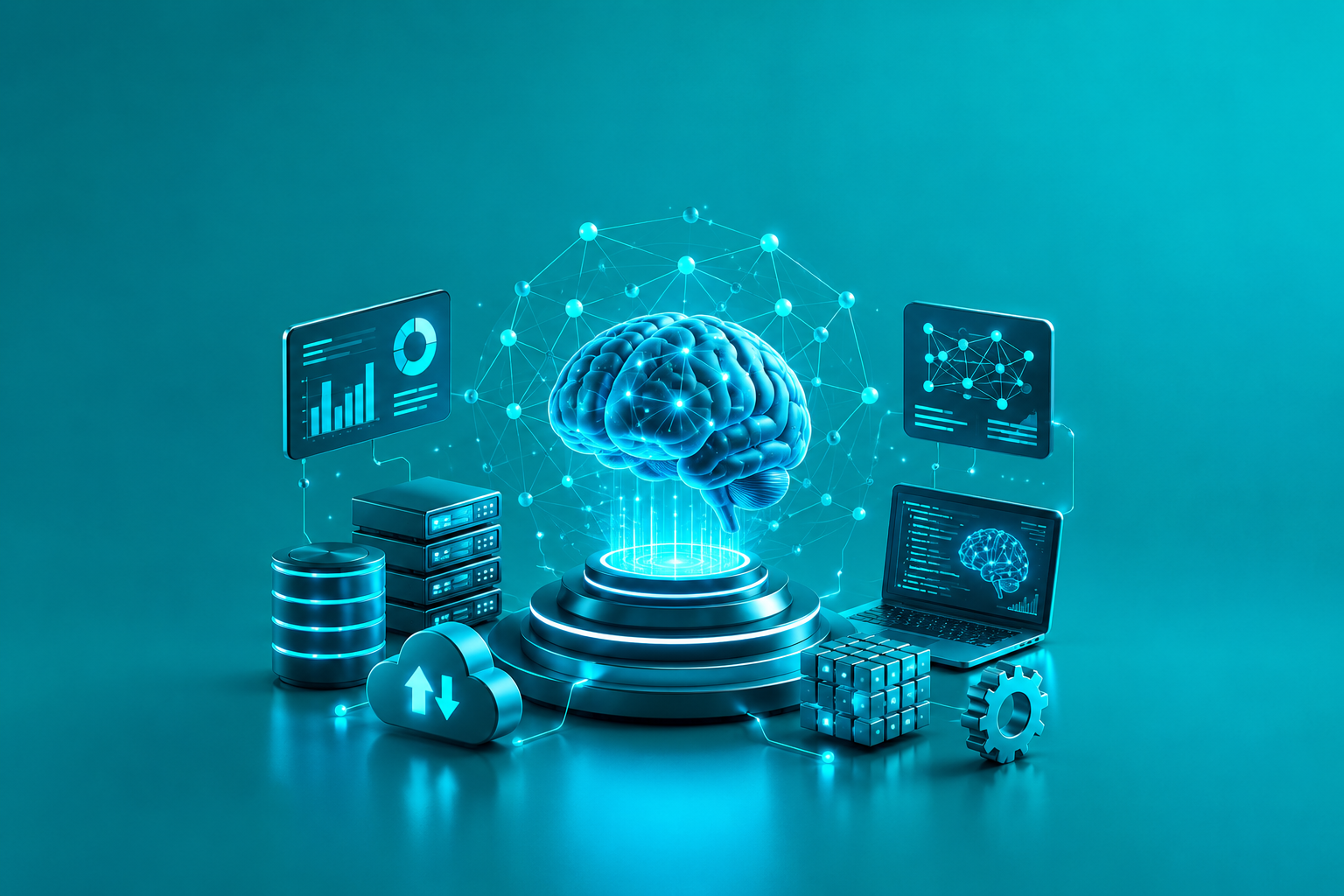
What Are Deep Learning Services?
Deep learning has quietly become the engine behind some of the most important decisions a modern enterprise makes. At InfiniteTech AI, our deep learning services take that engine out of research papers and put it to work inside real business systems, with real accountability for outcomes.
We are a Chennai-headquartered AI development company serving enterprises across India and global markets. Our team builds custom neural network architectures—not generic off-the-shelf models—tuned precisely to your data, infrastructure, and regulatory environment.
Whether you are a CTO scoping a computer vision pipeline or a product leader exploring generative AI, this guide provides a direct, no-fluff breakdown of the features, delivery process, and realistic ROI you can expect from our production-grade deep learning systems.
Multi-Layered Networks
Uses artificial neural networks with multiple layers to learn complex patterns and representations automatically.
Raw Data Learning
Learns representations directly from raw data, completely bypassing the need for manual human engineering.
Hierarchical Abstraction
Early layers detect basic edges and textures, while deeper layers identify entire complex objects and scenes.
Automatic Feature Extraction
Eliminates the need for engineers to hand-craft specific rules or features, learning them naturally from data.
Subtle Pattern Discovery
Discovers hidden visual cues and complex correlations that strict human specifications would often miss.
Unstructured Data Mastery
The absolute ideal solution for complex data like images, audio, video frames, free-form text, and sensor streams.
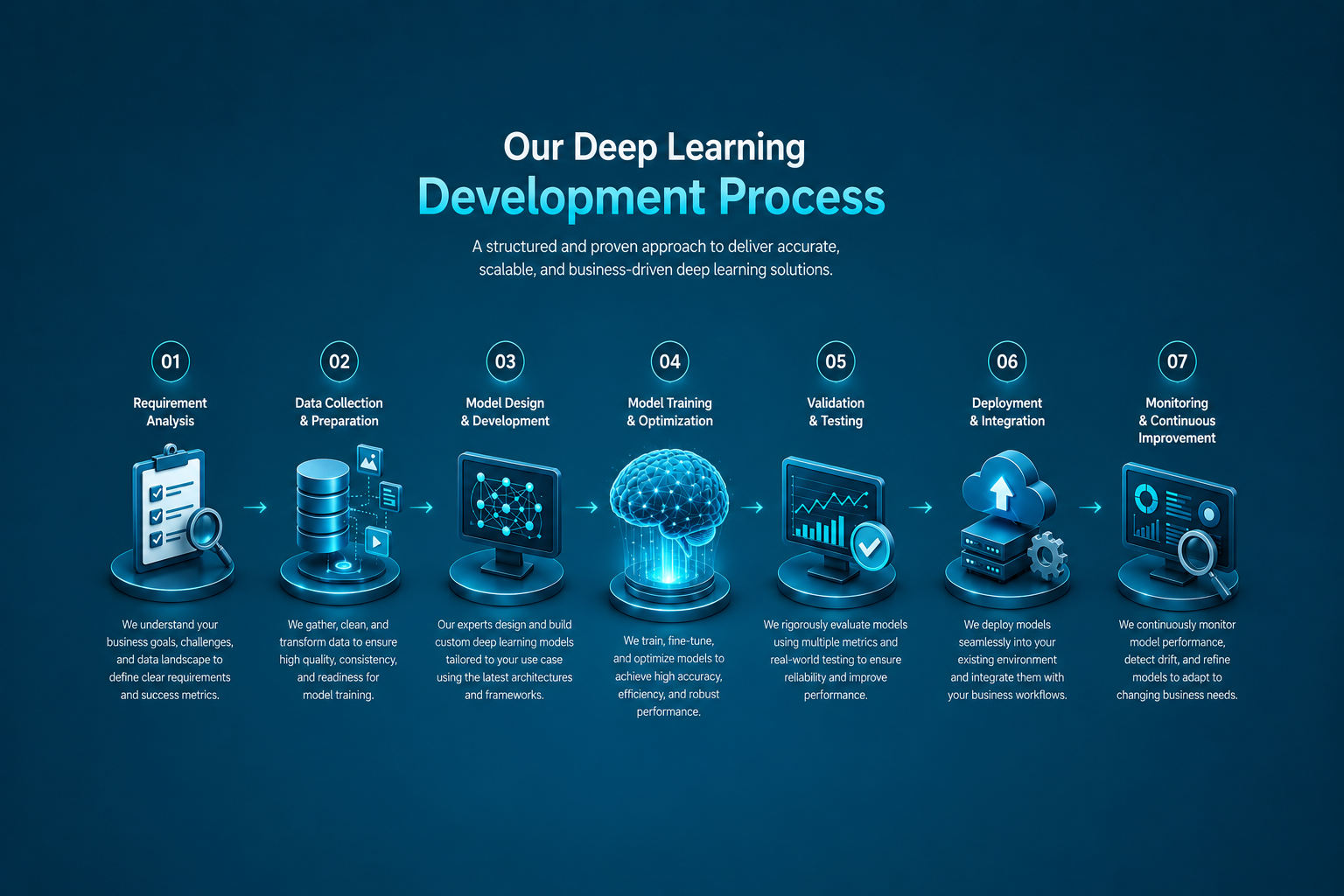
Monitoring & Retraining
deployed models are monitored for drift and retrained as data distributions evolve
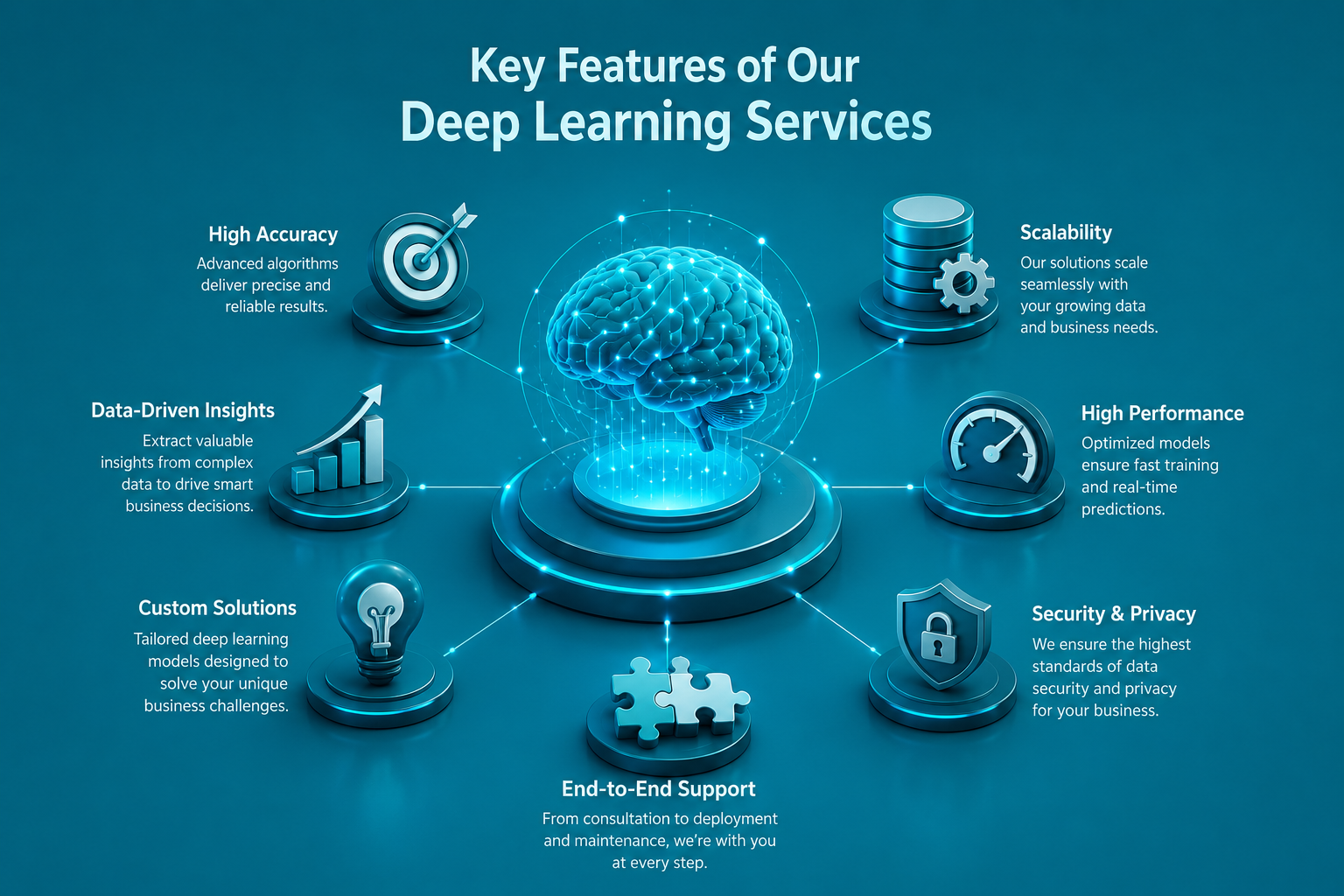
Key Features of Our Deep Learning Services
Our deep learning development services are built around a set of non-negotiable engineering principles, not just modelling tricks.
Custom architecture design
We design network architectures matched to your actual data shape and volume, rather than forcing your problem into a pre-built template.
Transfer learning acceleration
We fine-tune pretrained foundation models (vision and language) wherever possible to cut training time and data requirements by months, not just days.
Production-grade MLOps from day one
Every model we build ships with versioning, monitoring, and automated retraining pipelines, not just a Jupyter notebook.
Explainability built in
We integrate interpretability tooling (SHAP, Grad-CAM, attention visualisation) so stakeholders can see why a model made a decision, which matters enormously in regulated industries.
Edge and on-device deployment
We optimise models through quantisation, pruning, and distillation so they can run on edge devices, mobile hardware, or constrained on-premise servers where cloud inference is not viable.
Multi-modal capability
We build systems that combine vision, text, and tabular signals into a single decisioning pipeline, which is increasingly where the real business value sits.
Data-efficient training
Through synthetic data generation, augmentation, and active learning, we reduce the volume of expensive labelled data needed to reach production accuracy.
Continuous evaluation against drift
We instrument every deployed model with drift detection so accuracy degradation is caught before it affects business outcomes, not after.
Superior Prediction Accuracy
Human judgment, while valuable, is subject to cognitive biases, fatigue, and information limitations. Deep learning models that are properly trained on comprehensive historical data consistently outperform human expert judgment on structured prediction tasks — whether forecasting sales, identifying at-risk patients, or predicting equipment failures.
Real-Time Decision Intelligence
In domains like fraud detection, dynamic pricing, or real-time personalization, decisions need to be made in milliseconds. Deep learning inference systems can evaluate thousands of features and return a prediction in under 50 milliseconds, enabling decision intelligence at speeds and scales that are humanly impossible.
Personalization at Scale
Deep learning enables every customer interaction to be personalized based on individual behavior, preferences, and context — across millions of customers simultaneously. This level of personalization, previously achievable only for VIP segments, drives measurable improvements in engagement, satisfaction, and lifetime value.
Proactive Risk Management
Predictive DL models identify risks before they materialize — whether that is a customer about to churn, a machine about to fail, a fraudulent transaction about to execute, or a safety incident about to occur. This shift from reactive to proactive management fundamentally changes business outcomes.
Competitive Differentiation
Organizations that successfully operationalize deep learning create structural competitive advantages that are difficult for competitors to replicate — because those advantages are embedded in proprietary data assets and learned models that become more accurate over time.
Why Businesses Need Deep Learning Services in 2025 and Beyond
Most enterprises do not lack data; they lack the specialised engineering capability to turn that data into a working, reliable, production-deployed model. Deep learning sits at the intersection of advanced mathematics, distributed systems engineering, and domain knowledge - a combination that is genuinely rare to find as an in-house hire, let alone an entire team.
Most enterprises don't lack data; they lack the specialized engineering capability to build reliable, production-deployed deep learning models.
Building this internally means competing in a tough talent market and absorbing months of costly trial-and-error mistakes.
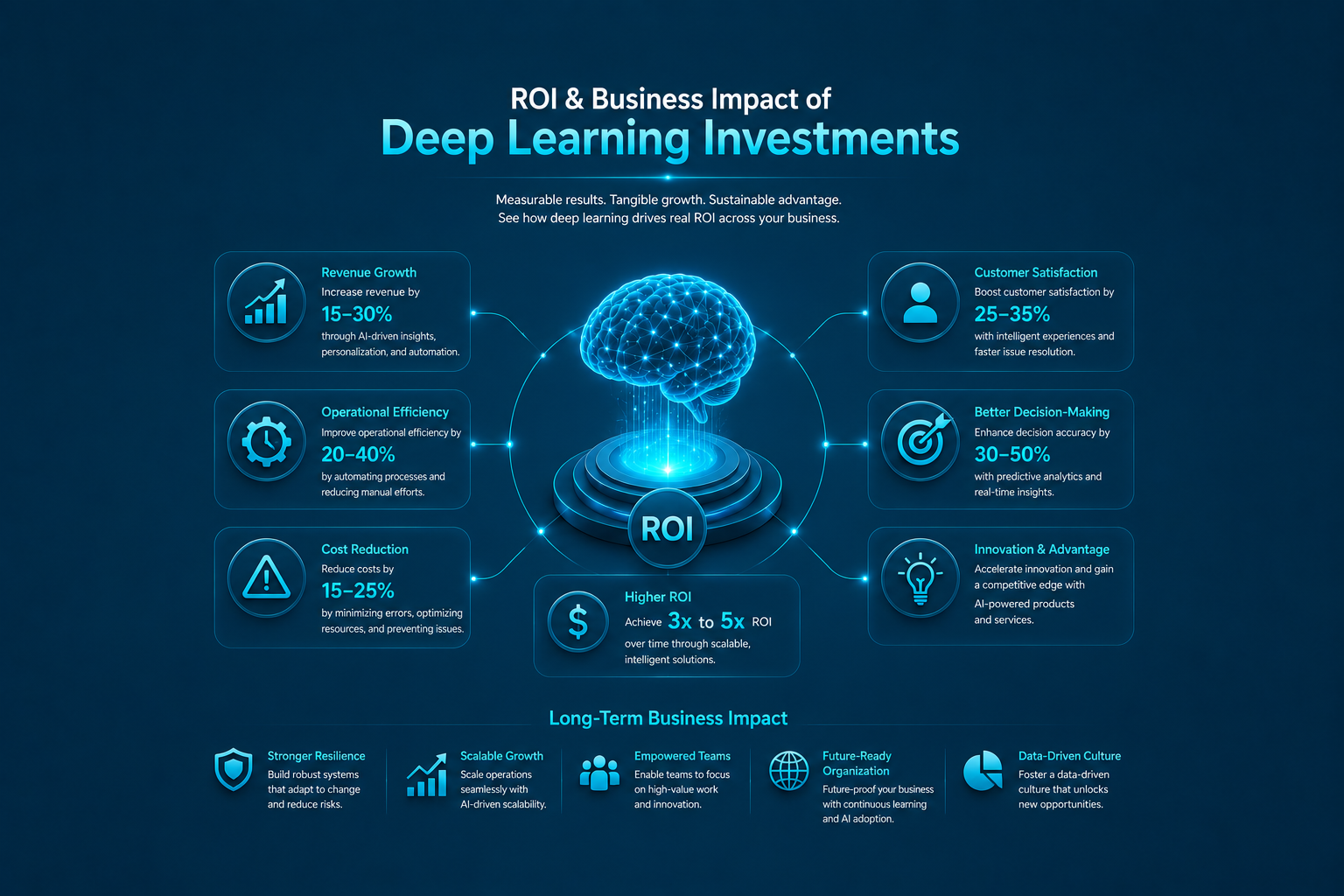
Deep learning is rapidly becoming table stakes. Organizations with mature AI capabilities report meaningfully higher revenue growth and cost efficiency.
The smartest path in 2026 is to partner first. InfiniteTech AI offers de-risked, milestone-based delivery to help you ship a pilot fast and prove real ROI.
The window for competitive differentiation through DL adoption is still open — but it is closing. Organizations that build DL capabilities now establish compounding advantages through proprietary data assets, organizational learning, and technical infrastructure that become increasingly difficult for latecomers to replicate.
.png "Deep Learning Solutions")
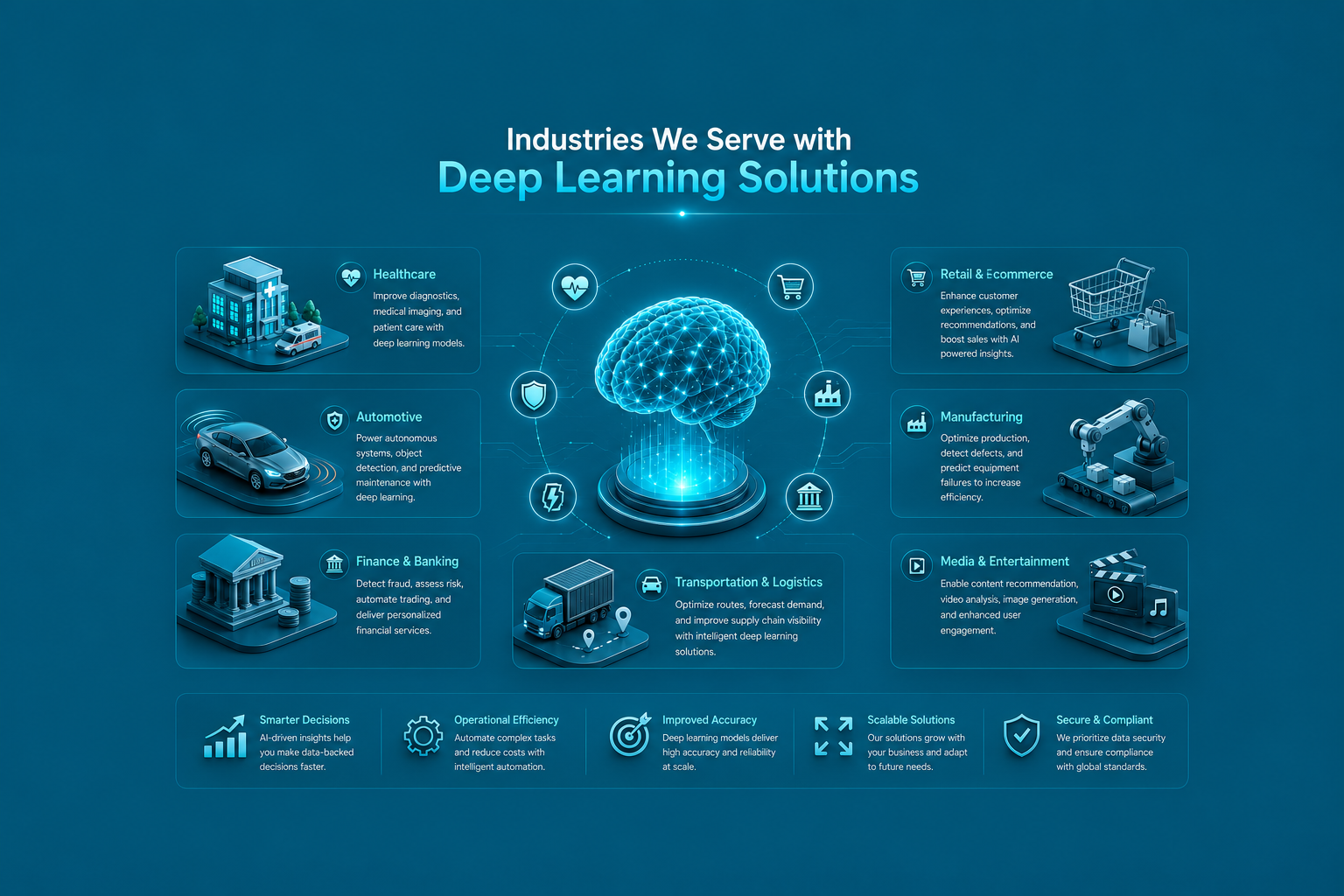
Industries We Serve with Deep Learning Solutions
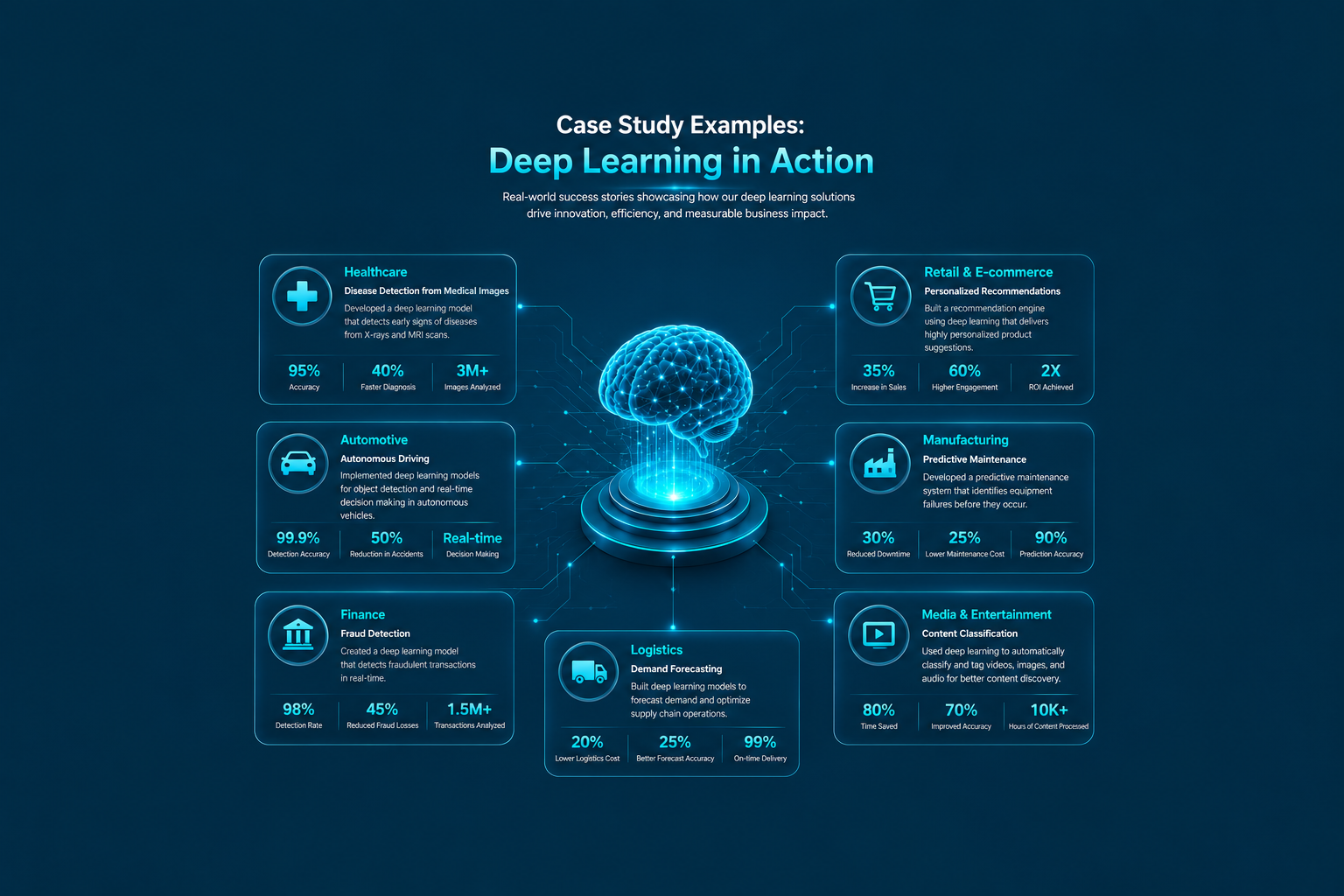
Deep learning is no longer confined to technology companies. We have delivered deep learning solutions across the following sectors, each with a distinct data profile and risk tolerance.
Banking, Financial Services & Insurance (BFSI)
Financial services is arguably the most data-rich and DL-mature industry vertical. We build credit scoring models that improve loan approval accuracy while reducing default rates, fraud detection systems that identify anomalous transactions in real time with sub-100ms latency, anti-money laundering pattern recognition, algorithmic trading signal generation, insurance underwriting automation, and claims fraud detection systems. Our BFSI DL solutions are built with full compliance with RBI guidelines, SEBI regulations, and global standards like GDPR and Basel III model risk management requirements. We implement model explainability frameworks that satisfy both business stakeholders and regulatory examiners.
Healthcare & Life Sciences
Healthcare DL applications carry life-or-death consequences — which is why clinical rigor, explainability, and validation matter more in this vertical than perhaps any other. We develop clinical decision support systems, medical image analysis (radiology, pathology, ophthalmology), patient readmission prediction, drug discovery acceleration using molecular property prediction, clinical trial optimization, and hospital resource forecasting. All our healthcare DL systems are developed in compliance with applicable regulations including HIPAA data handling requirements and adhere to the FDA's framework for AI-based Software as a Medical Device (SaMD) where applicable.
Manufacturing & Industrial
Predictive maintenance is the most compelling DL application in manufacturing — reducing unplanned downtime by 30-50% and extending equipment life. We also build quality control vision systems that detect defects at line speed, demand forecasting systems that optimize raw material procurement, and supply chain DL that improves logistics efficiency and reduces carrying costs.
Retail & E-Commerce
Retail DL applications directly drive top-line revenue. We build product recommendation engines that increase average order value, dynamic pricing systems that optimize margins, inventory forecasting that reduces stockouts and overstock, customer lifetime value prediction, and visual search capabilities that improve product discovery. Retail clients typically see 15-35% revenue uplift on DL-instrumented product pages.
Telecommunications
Telcos sit on vast behavioral data assets that, when properly modeled, enable powerful customer intelligence capabilities. We build churn prediction systems that enable proactive retention interventions, network anomaly detection for quality management, customer lifetime value segmentation for marketing optimization, and predictive capacity planning for network infrastructure.
Logistics & Supply Chain
Logistics optimization is a natural fit for DL — the combination of high-dimensional variables, dynamic real-world constraints, and massive cost implications makes it an ideal domain for learned optimization approaches. We build route optimization DL systems, demand forecasting for logistics planning, last-mile delivery prediction, and freight pricing models.
Real Estate & PropTech
Automated valuation models (AVMs), rental price prediction, demand forecasting for property markets, tenant screening, and investment risk assessment are transforming how real estate businesses operate. Our DL solutions have been deployed by property platforms across India and Southeast Asia.
Why Choose Us as Your Deep Learning Services Partner
There is no shortage of companies claiming deep learning capabilities. Here is what genuinely differentiates our DL services:
Frequently Asked Questions About Deep Learning Services
What exactly is the difference between deep learning and machine learning?
Machine learning is the broader field of algorithms that learn patterns from data; deep learning is a specific subset that uses multi-layered neural networks and is particularly strong on unstructured data like images, audio, and text, where it typically outperforms classical machine learning techniques.
How much labelled data do we need before a deep learning project is feasible?
There is no fixed universal number - it depends on the complexity of the task and whether transfer learning from a pretrained model is viable. Some computer vision tasks can start showing useful results with a few thousand labelled images when fine-tuning a pretrained model, while building a model entirely from scratch typically needs significantly more.
How long does a typical deep learning project take to reach production?
Most of our engagements reach a first production deployment within 8-16 weeks, depending on data readiness, integration complexity, and whether the use case requires a fully custom architecture or can be solved with a fine-tuned pretrained model.
Can deep learning models run without expensive GPU infrastructure?
Yes, for many use cases. Through model optimisation techniques like quantisation and pruning, we routinely deploy deep learning models on standard CPU servers or even edge devices, reserving GPU infrastructure primarily for the training phase rather than every inference call.
How do you make a deep learning model explainable to non-technical stakeholders?
We integrate interpretability tooling such as SHAP values for tabular contributions and Grad-CAM or attention visualisation for image and text models, translating model behaviour into visual, business-readable explanations rather than raw mathematical output.
What happens if the model's accuracy degrades after deployment?
Every model we deploy includes drift monitoring that tracks input data distribution and prediction confidence over time, with automated alerts and a defined retraining cadence so degradation is caught and corrected before it meaningfully impacts business outcomes.
Is deep learning suitable for small and mid-sized businesses, or only large enterprises?
Deep learning is increasingly accessible to mid-sized businesses, especially with transfer learning reducing data and compute requirements. The right starting point is usually a tightly scoped pilot on a single high-value use case rather than an enterprise-wide rollout.
How do you handle data privacy and compliance for sensitive industries like healthcare and finance?
We design data pipelines with anonymisation, access controls, and on-premise or private-cloud deployment options where required, and structure model architecture decisions around the specific compliance regime applicable to the client's jurisdiction and industry.
What is transfer learning and why does it matter for cost?
Transfer learning means starting from a model already trained on a large general dataset and fine-tuning it on your specific data, rather than training an architecture from zero. It dramatically reduces the data, compute, and time required to reach production-grade accuracy.
Do you build deep learning models from scratch or use existing foundation models?
Both, depending on the problem. We default to fine-tuning strong pretrained foundation models wherever feasible because it is faster and cheaper, and reserve fully custom architecture design for problems where existing models genuinely fall short.
How do you measure the success of a deep learning project?
Success is measured against a predefined business metric agreed before development begins - such as defect detection rate, fraud capture rate, or processing time reduction - not solely against an abstract model accuracy score.
Can deep learning systems integrate with our existing software and databases?
Yes. Our deep learning engagements include the API, middleware, and integration engineering needed to connect model outputs directly into existing enterprise systems, dashboards, and workflows.
What industries benefit most from deep learning right now?
Manufacturing, banking and financial services, healthcare, retail, insurance, and logistics currently show the strongest and most measurable ROI from deep learning adoption, largely because each generates large volumes of image, document, or transactional data well suited to neural network analysis.
Do you offer deep learning services to clients outside India?
Yes. While we are headquartered in Chennai with strong delivery presence across Bangalore, Hyderabad, and Mumbai, we actively serve enterprise clients internationally across North America, the UK, and the Middle East, with delivery processes built for distributed, asynchronous collaboration.
What is the first step to starting a deep learning project with InfiniteTech AI?
The first step is a discovery and feasibility assessment, typically completed within one to two weeks, where we review your available data and target outcome and provide an honest, evidence-based recommendation before any commercial commitment to a full build.