What Is AI Model Development?
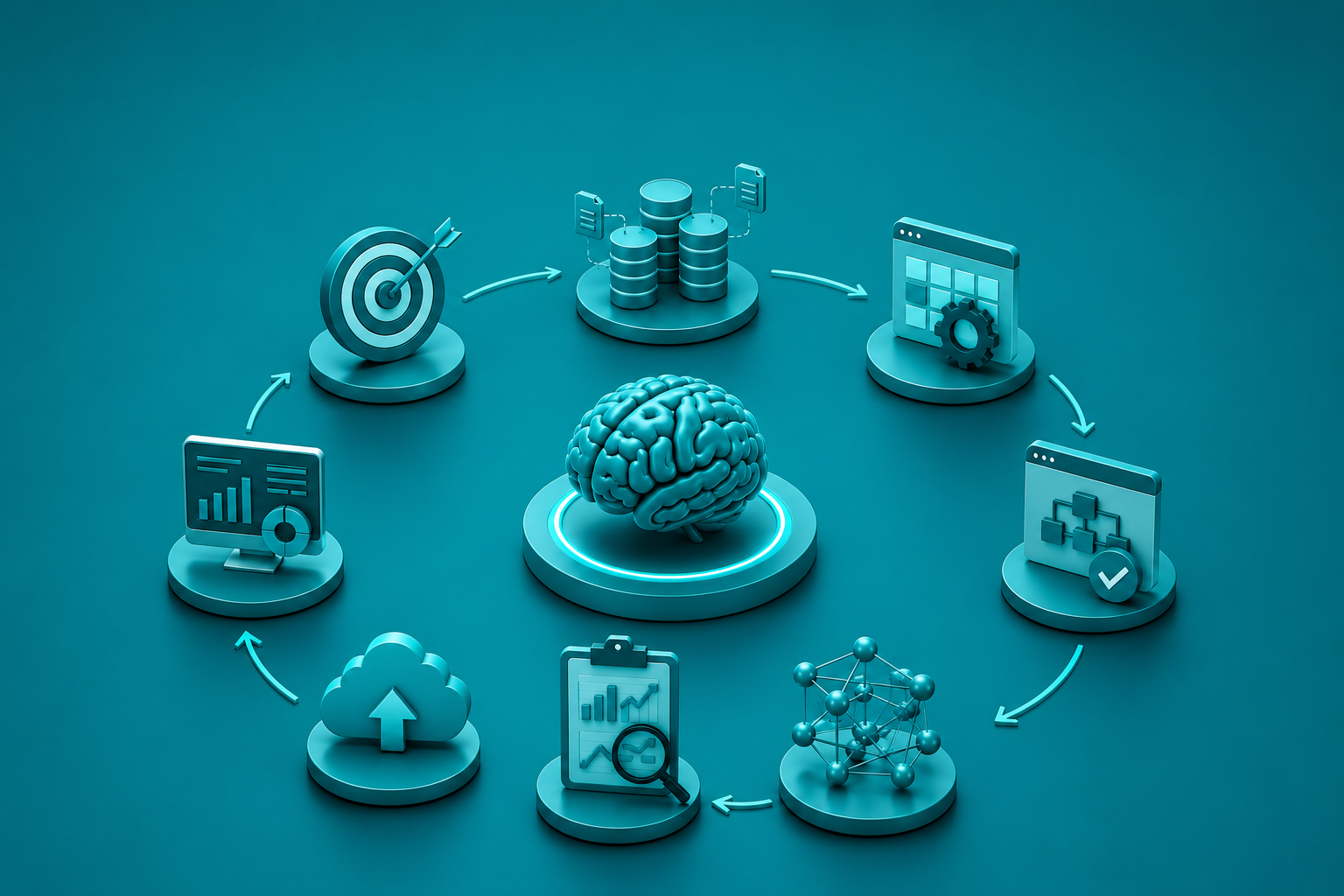
AI model development is the end-to-end process of designing, building, training, validating, and deploying machine learning or deep learning models that can perform intelligent tasks — from understanding human language and recognizing images to forecasting outcomes and generating content.
Unlike off-the-shelf AI tools or SaaS platforms, custom AI model development begins with your business problem and ends with a solution that is uniquely calibrated to your data, your domain, and your success metrics.
At its core, AI model development encompasses:
A well-executed AI model can autonomously learn from data, recognize patterns, make predictions, generate content, automate decisions, and adapt its behaviour over time — capabilities that are fundamentally impossible with conventional rule-based software.
The State of AI Model Development in 2025 — Why This Moment Matters
The AI landscape has undergone a fundamental transformation. The question organizations asked in 2021 — ‘Should we adopt AI?’ — has been replaced by a far more pressing one: ‘How do we build AI that actually drives measurable business outcomes?’
Global AI Market by 2030
Growing at a CAGR of over 37% (Grand View Research, 2024). Custom models report up to 3.5x greater ROI vs API-only approaches.
Enterprise AI Projects That Fail
Due to poor data quality, misaligned model objectives, or inadequate MLOps infrastructure — not because AI doesn’t work (Gartner).
GenAI Enterprise Adoption Growth
Growth between 2023 and 2025, yet fewer than 40% of those implementations are production-grade.
Market Intelligence
The global AI market is projected to surpass $1.8 trillion by 2030, growing at a CAGR of over 37% (Grand View Research, 2024). Companies that deploy custom-built AI models report up to 3.5x greater ROI compared to organizations relying solely on pre-trained APIs (McKinsey Global AI Report, 2024).
Key Data Points
- 85% of enterprise AI failures trace to poor data quality, misaligned objectives, or inadequate MLOps — not AI capability (Gartner)
- Custom-built models deliver up to 3.5x greater ROI vs. pre-trained API-only approaches (McKinsey, 2024)
- GenAI enterprise adoption grew 270% between 2023–2025, but under 40% of implementations are production-grade
- India is emerging as a primary AI innovation hub across Bangalore, Hyderabad, Chennai, Mumbai, and Pune
Industries Leveraging AI Model Development
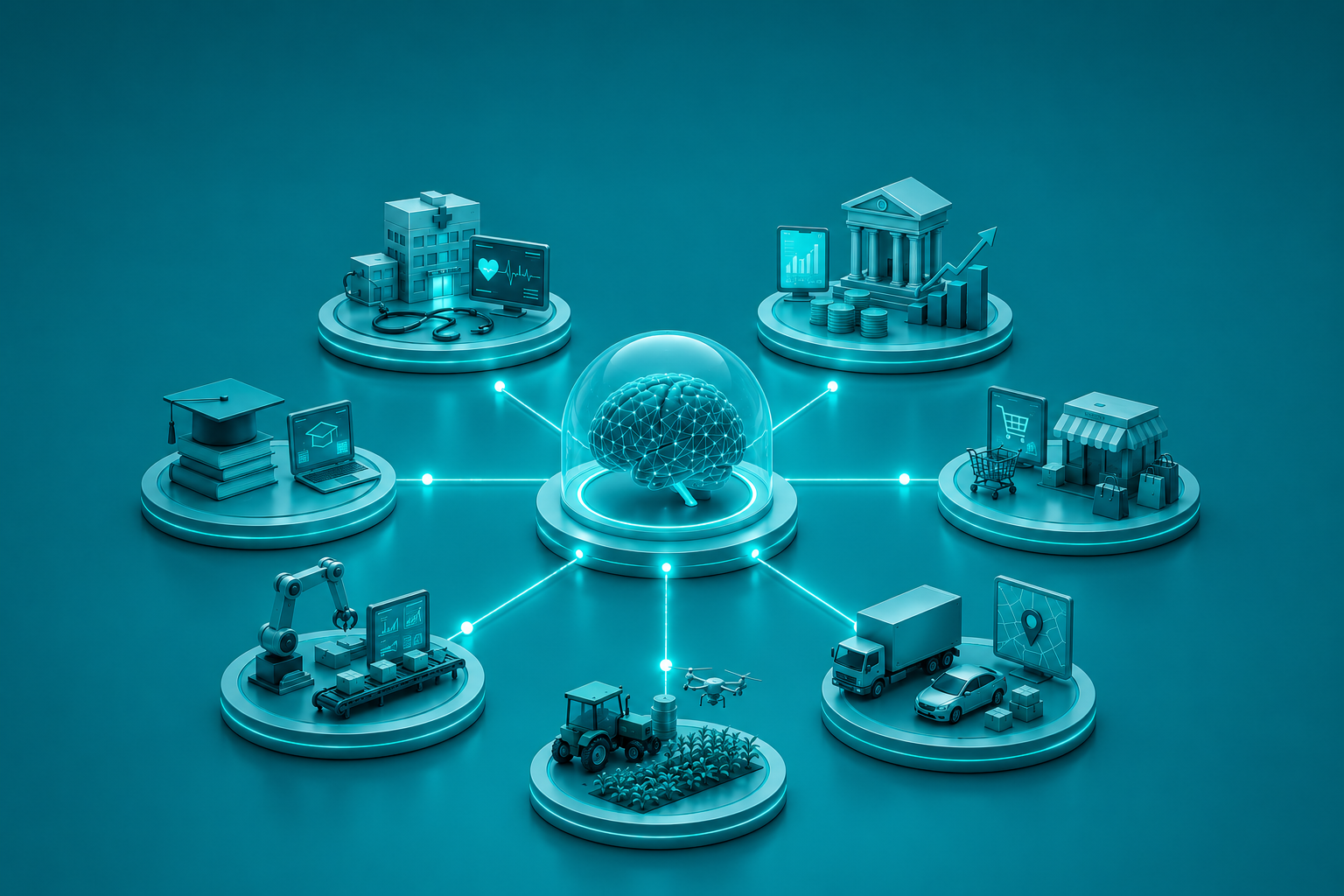
AI model development is not sector-specific — it is a universal capability multiplier. However, the applications, regulatory requirements, and value drivers vary significantly by vertical.
Healthcare & Life Sciences
Clinical decision support, medical imaging analysis, patient risk stratification, drug discovery, EHR data extraction
BFSI
Credit scoring, fraud detection, AML transaction monitoring, algorithmic trading, insurance underwriting
Manufacturing & Industrial
Predictive maintenance, quality control vision, defect detection, energy optimization, digital twin integration
Retail & E-Commerce
Personalization engines, demand forecasting, dynamic pricing, customer churn prediction, visual search
Logistics & Supply Chain
Route optimization, inventory management, demand sensing, supplier risk scoring, last-mile delivery AI
Legal & Compliance
Contract analysis, regulatory change detection, e-discovery automation, compliance monitoring, legal document summarization
EdTech & HR
Adaptive learning systems, resume screening, employee sentiment analysis, skills gap identification, attrition prediction
Government & Public Sector
Smart city analytics, traffic prediction, welfare eligibility scoring, public health surveillance, document intelligence
Our AI Model Development Process
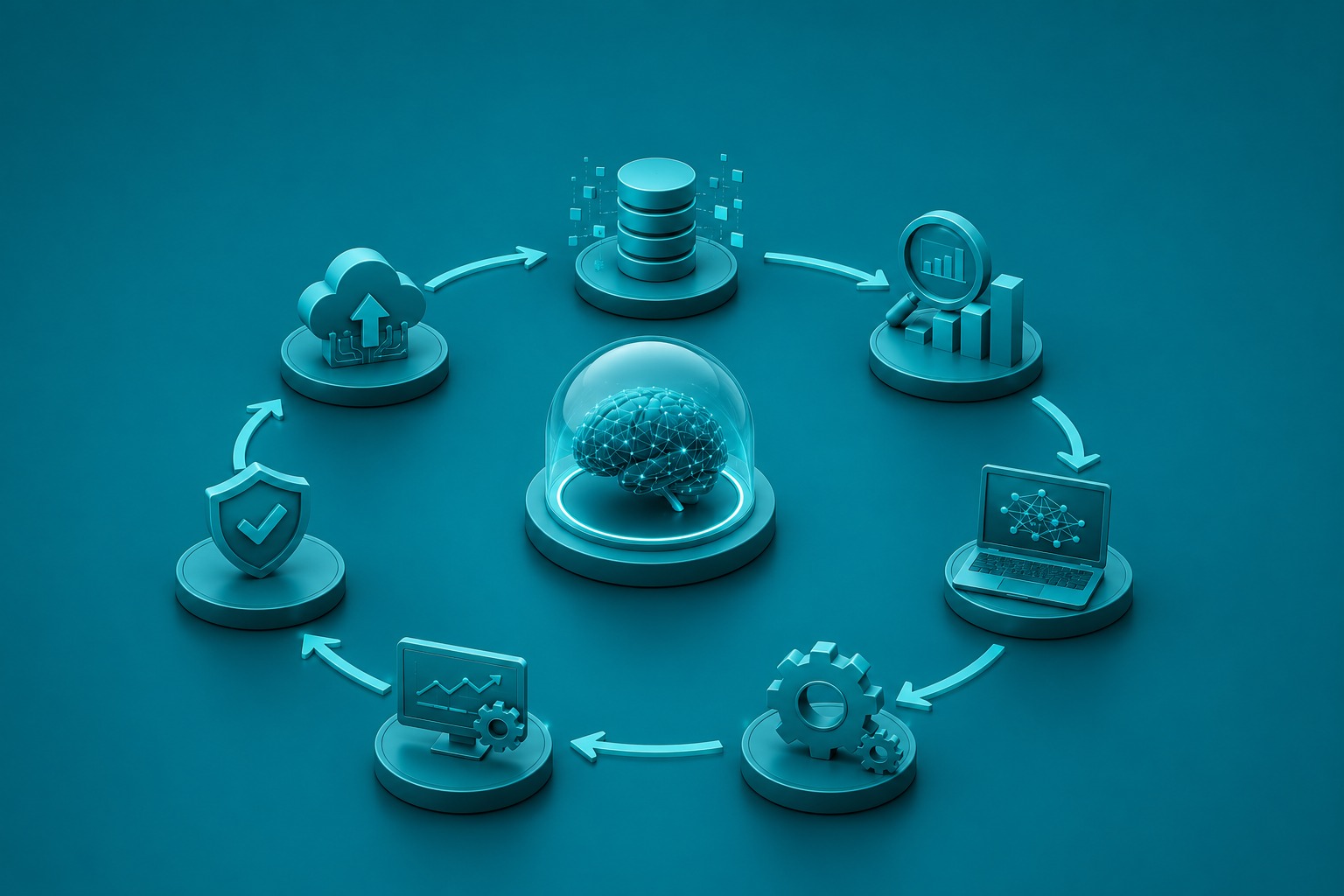
Our development lifecycle is structured, iterative, and transparent — designed for enterprise environments where accountability, milestone tracking, and risk management are non-negotiable.
Phase 1: Discovery and Problem Framing (Weeks 1–2)
Every engagement begins with deep discovery. Our AI architects, data scientists, and domain experts work with your team to define the business problem, audit data assets, identify regulatory constraints, and produce a Technical Feasibility Report.
Deliverable: AI Model Blueprint and Technical Feasibility Report
Phase 2: Data Engineering and Preparation (Weeks 2–6)
Our data engineering team designs and executes data collection, labeling, and annotation pipelines; applies data augmentation; engineers features; and documents data provenance, lineage, and quality metrics.
Deliverable: Cleaned, versioned training dataset and feature engineering pipeline
Phase 3: Model Architecture Design and Baseline (Weeks 4–8)
We design the model architecture, establish baselines, run initial training experiments with systematic hyperparameter exploration, and implement evaluation harnesses against agreed success metrics.
Deliverable: Baseline model with architecture documentation and evaluation framework
Phase 4: Training, Fine-Tuning, and Optimization (Weeks 6–14)
Full-scale model training on GPU/TPU infrastructure, iterative fine-tuning cycles, Bayesian hyperparameter optimization, model compression techniques (quantization, pruning, distillation), and RLHF cycles for generative models.
Deliverable: Production candidate model with evaluation report
Phase 5: Validation, Testing, and Red-Teaming (Weeks 12–16)
Holdout dataset evaluation, adversarial robustness testing, fairness and bias evaluation, red-teaming for generative models, and domain expert review of model outputs on representative samples.
Deliverable: Model Validation Report and Go/No-Go recommendation
Phase 6: Deployment and Integration (Weeks 14–18)
Model packaging and containerization, API development, integration with client application stack, load testing, scalability validation, and monitoring dashboard configuration.
Deliverable: Production-deployed model with API documentation and monitoring dashboards
Phase 7: Monitoring, Maintenance, and Retraining (Ongoing)
Continuous drift monitoring, automated retraining pipeline triggers, quarterly model reviews, and capacity planning and infrastructure scaling support.
Deliverable: SLA-backed model monitoring and maintenance retainer
Case Study: AI Model Development in Action
ROI & Business Impact Of AI Model Development
Quantifying the return on AI product development investment is critical for business case construction and board-level approval. Here is a framework that distils the economic value across the most common impact categories.
| Application Area | Typical ROI Timeline | Average Annual Value Created |
|---|---|---|
| Predictive Maintenance | 8–14 months | 15–35% reduction in downtime costs |
| Fraud Detection | 6–10 months | 40–70% reduction in fraud losses |
| Demand Forecasting | 6–12 months | 10–20% reduction in inventory costs |
| Customer Churn | 4–8 months | 15–30% reduction in churn rate |
| Document Intelligence | 3–6 months | 60–80% reduction in manual processing |
People Also Ask: AI Model Development
What is the difference between AI model development and using a pre-built AI API?
Pre-built AI APIs provide general-purpose capabilities. Custom AI model development involves building or fine-tuning models specifically on your data and for your tasks — resulting in higher accuracy, lower inference cost at scale, full data ownership, and a defensible intellectual property asset that generic APIs cannot provide.
How long does it take to develop a custom AI model?
Timeline depends on data availability, problem complexity, and integration requirements. Simple predictive models can be production-ready in 6–10 weeks. Complex LLM fine-tuning or computer vision systems typically take 12–20 weeks from discovery to deployment.
What data do I need to start AI model development?
Requirements vary significantly by model type. Predictive models often need 10,000–100,000 labeled records. NLP models can leverage foundation models with smaller domain-specific datasets. Computer vision models typically require thousands to tens of thousands of annotated images.
Can you fine-tune an existing AI model on our proprietary data?
Yes — fine-tuning an open-source foundation model (LLaMA, Mistral, etc.) on your domain data is often the most cost-effective and highest-performing approach. We specialize in parameter-efficient fine-tuning techniques (LoRA, QLoRA) that achieve domain-specific performance with lower compute requirements.
How do you ensure AI model security and data privacy during development?
We implement strict data governance protocols including data anonymization, access controls, encrypted data transfer and storage, isolated training environments, and documented data handling procedures. We can work entirely within your infrastructure to ensure data never leaves your control.
What is MLOps and why does it matter for AI model development?
MLOps applies DevOps principles to machine learning model lifecycle management — including automated training pipelines, model versioning, deployment automation, and production monitoring. Without MLOps, even excellent AI models fail in production due to drift and infrastructure fragility.
How do you measure AI model performance?
Performance evaluation is task-specific. Classification models use accuracy, precision, recall, F1-score, AUC-ROC. Regression models use MAE, RMSE, MAPE. NLP models use BLEU, ROUGE, BERTScore. Computer vision models use mAP and IoU. We define success metrics in discovery and report against them at every milestone.
Can AI models be deployed on-premise rather than in the cloud?
Yes. We support on-premise deployment, private cloud, hybrid architectures, and edge deployment. Many enterprise clients in regulated industries require full on-premise or private cloud deployment for data sovereignty reasons.
What industries have the highest ROI from custom AI model development?
Financial services (fraud detection, credit scoring), manufacturing (predictive maintenance, quality control), healthcare (clinical decision support, imaging analysis), retail (demand forecasting, personalization), and logistics (route optimization) consistently show the highest and fastest ROI.
Do you provide ongoing support after model deployment?
Yes. We offer SLA-backed model monitoring, maintenance, and optimization retainers — including production monitoring dashboards, drift alerting, scheduled retraining cycles, quarterly performance reviews, and dedicated engineering support.