Enterprise AI Solutions
Engineering Intelligent Systems That Scale With Your Business
What is Enterprise AI Solutions?
Enterprise AI Solutions refer to the design, development, deployment, and ongoing management of artificial intelligence systems purpose-built for large-scale business operations rather than isolated experiments. Unlike off-the-shelf AI tools, enterprise AI solutions are custom-engineered to integrate with an organization's existing technology stack, data infrastructure, security policies, and workflow logic.
At their core, enterprise AI solutions combine several disciplines: machine learning model development, generative AI and large language model (LLM) integration, natural language processing, computer vision, predictive analytics, robotic process automation, and data engineering — all orchestrated through a governed MLOps pipeline that ensures models remain accurate, secure, and compliant over time.
A genuine enterprise AI solution typically includes:
- •A data architecture capable of ingesting structured and unstructured data from CRMs, ERPs, data warehouses, IoT devices, and third-party APIs
- •Custom or fine-tuned machine learning and generative AI models trained on proprietary business data
- •Secure deployment infrastructure, whether on private cloud, hybrid cloud, or on-premise environments
- •Monitoring, retraining, and governance frameworks that prevent model drift and ensure regulatory compliance
- •Integration layers that connect AI outputs directly into business applications, dashboards, and decision workflows
In short, enterprise AI solutions are not a single product — they are a complete operating layer of intelligence woven through an organization's core business processes.
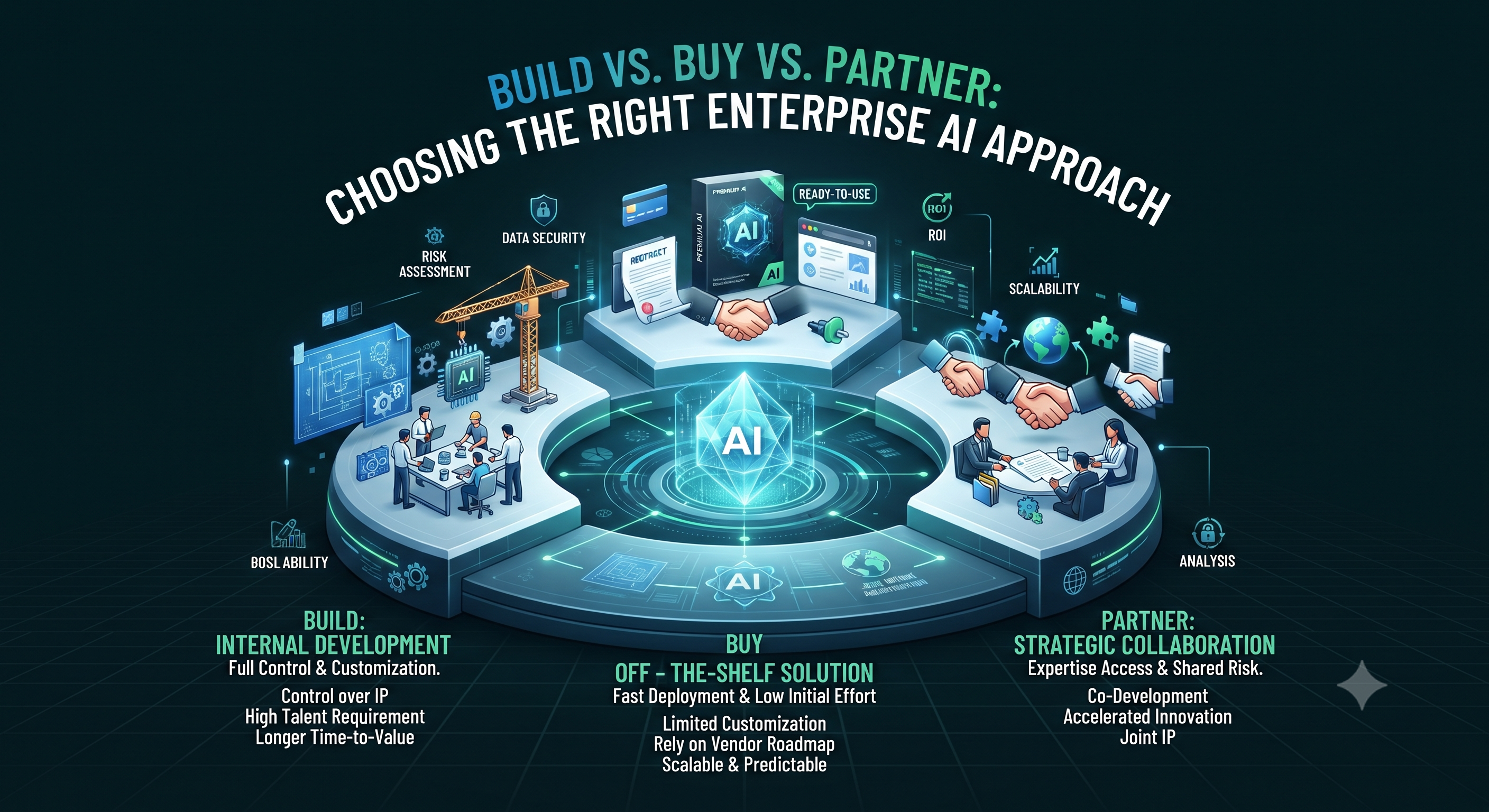
Build vs. Buy vs. Partner: Choosing the Right Enterprise AI Approach
One of the earliest strategic decisions every enterprise faces is how to source its AI capability. Broadly, there are three paths: building an in-house AI team from scratch, buying off-the-shelf AI SaaS tools, or partnering with a specialized AI development company.
| Approach | Speed to Value | Customization | Long-Term Cost | Data Ownership | Best For |
|---|---|---|---|---|---|
| In-House Build | Slow (6–18 months) | Highest | High (salaries, infra) | Full | Enterprises with AI as core IP |
| Off-the-Shelf SaaS | Fast | Low | Low upfront, recurring | Limited | Simple, generic use cases |
| Specialized AI Partner | Moderate to Fast | High | Moderate, scoped to project | Full | Most mid-to-large enterprises |

Key Features of Enterprise AI Solutions
Our IDP solutions are engineered for the complexity, scale, and regulatory environment of enterprise document workflows. Here are the platform capabilities that our clients rely on:
1. Custom Model Development
We build and fine-tune models on your proprietary data, giving you a defensible competitive advantage that off-the-shelf tools cannot replicate.
2. Seamless System Integration
Our solutions integrate natively with SAP, Salesforce, Oracle, Microsoft Dynamics, Workday, and custom-built enterprise systems through secure APIs and middleware.
3. Enterprise-Grade Security
Role-based access control, data encryption at rest and in transit, private VPC deployment, and audit logging are built into every solution from day one.
4. Scalable Cloud-Native Architecture
Built on Kubernetes, microservices, and serverless patterns so the system scales elastically with demand without re-architecture.
5. Explainability and Governance
Model decisions are traceable and explainable, satisfying internal risk committees and external regulators alike.
6. Real-Time and Batch Processing
Support for both real-time inference (sub-second latency) and large-scale batch processing (nightly forecasting pipelines).
7. Multi-Modal AI Capability
Text, voice, image, video, and structured data can all be processed within a unified intelligence layer.
8. Continuous Learning Loops
Feedback mechanisms that allow models to improve over time as new data and business outcomes flow back into the system.
9. Multi-Cloud and Hybrid Deployment
Solutions are portable across AWS, Azure, Google Cloud, and private data centers, avoiding vendor lock-in.
10. Human-in-the-Loop Workflows
Critical decisions retain human oversight checkpoints, balancing automation speed with accountability.

Benefits of Enterprise AI Solutions
Organizations that successfully operationalize enterprise AI consistently report measurable gains across cost, speed, accuracy, and customer experience. The benefits typically fall into five categories.
| Benefit Area | Impact Description |
|---|---|
| Operational Efficiency | Automating repetitive, rules-based, and judgment-based tasks reduces manual processing time dramatically. |
| Cost Reduction | By automating workflows across finance, HR, supply chain, and customer service, enterprises reduce operational overhead. |
| Faster, Better Decision-Making | Predictive analytics and real-time dashboards give leadership teams forward-looking visibility. |
| Enhanced Customer Experience | AI-powered personalization, intelligent chatbots, and recommendation engines create more relevant interactions. |
| Competitive Differentiation | Enterprises that embed proprietary AI into their core products create defensible moats that competitors using generic tools cannot replicate. |
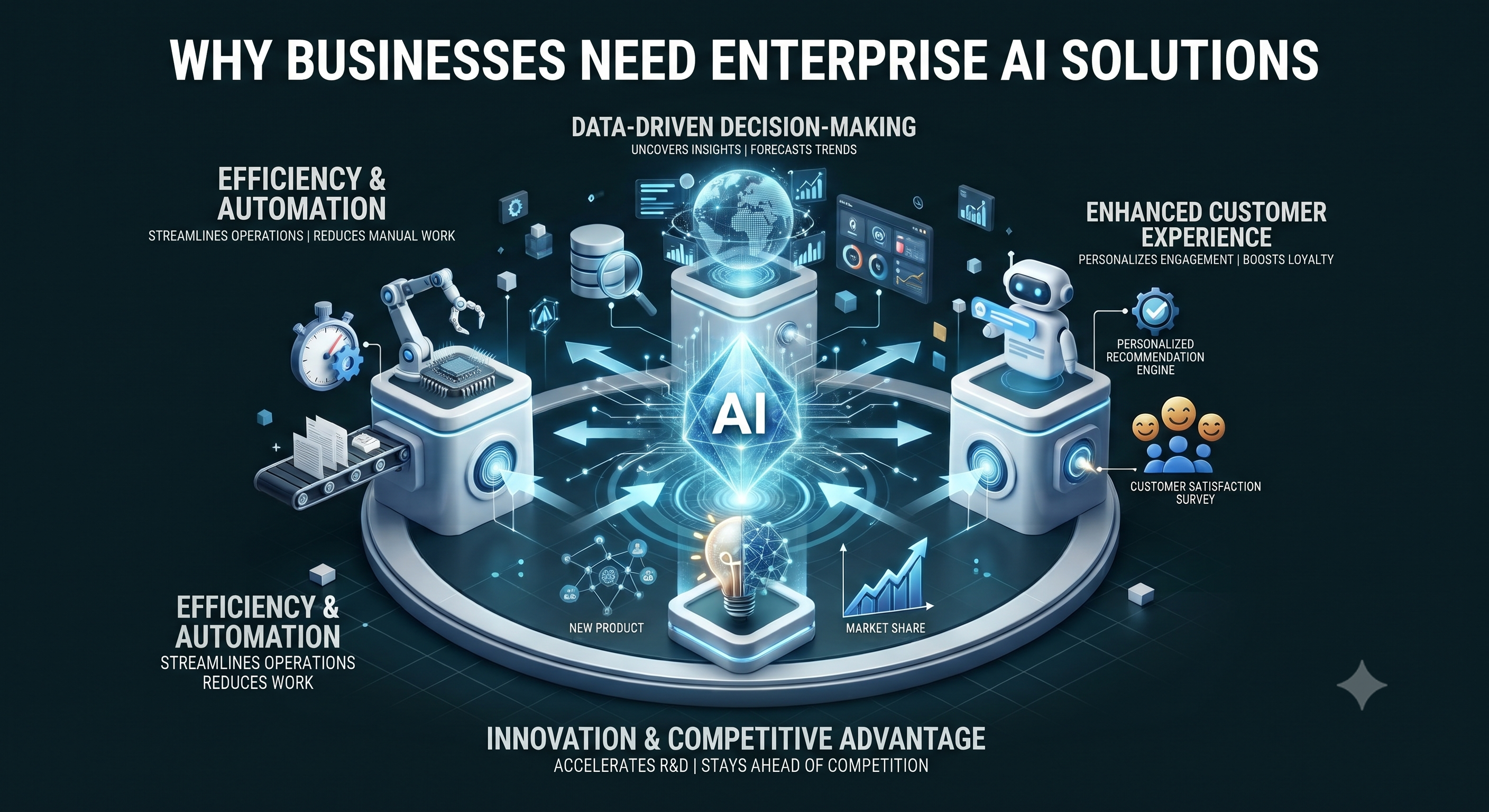
Why Businesses Need Enterprise AI Solutions
- •Scalability:
AI models can process millions of data points simultaneously, enabling organizations to scale operations without a proportional increase in headcount.
- •Cost Reduction:
Automating complex, time-consuming workflows directly reduces operational costs and minimizes expensive human errors.
- •Data-Driven Decision Making:
Enterprise AI extracts actionable insights from unstructured data (documents, emails, sensor logs) that traditional analytics tools miss.
- •Competitive Advantage:
Early adopters of AI-driven personalization, dynamic pricing, and predictive maintenance consistently outperform competitors relying on legacy systems.
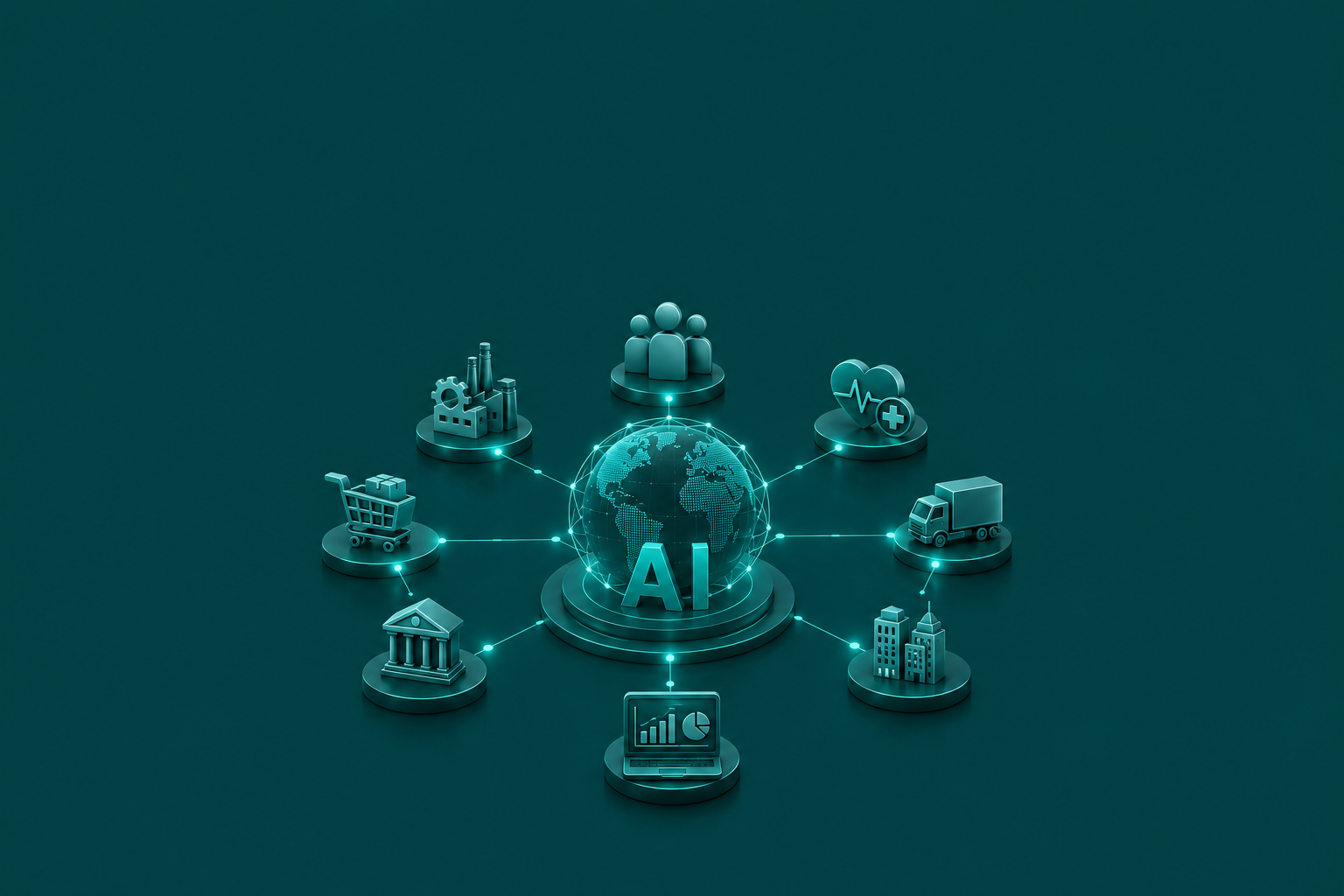
Industries Using Enterprise AI Solutions
Banking & Financial Services
Fraud detection, credit risk scoring, algorithmic trading support, AML monitoring, robo-advisory
Healthcare & Life Sciences
Clinical decision support, medical imaging analysis, patient triage automation, drug discovery acceleration
Retail & E-Commerce
Demand forecasting, dynamic pricing, personalized recommendations, inventory optimization
Manufacturing
Predictive maintenance, quality inspection via computer vision, supply chain optimization
Logistics & Supply Chain
Route optimization, warehouse automation, real-time fleet tracking and forecasting
Insurance
Automated claims processing, underwriting risk models, fraud detection
Telecom
Network anomaly detection, customer churn prediction, intelligent customer support
Real Estate & PropTech
Property valuation models, lead scoring, document automation
Education & EdTech
Adaptive learning systems, automated grading, student engagement analytics
Energy & Utilities
Demand forecasting, predictive grid maintenance, anomaly detection
This breadth illustrates a core truth about enterprise AI: the underlying technology stack is similar across industries, but the business logic, compliance requirements, and data sensitivity differ significantly — which is why domain-specific engineering expertise matters as much as raw AI capability.
Technologies & Tools Used
 Python
 Java
Java C++
C++ TensorFlow
 PyTorch
 Scikit-Learn
 OpenAI
 LangChain
 AWSPythonJavaC++TensorFlowPyTorchScikit-LearnOpenAILangChainAWS
 Google Cloud
 Azure
Azure Apache Spark
 Snowflake
 Kubernetes
 Docker
 MLflow
 RayGoogle CloudAzureApache SparkSnowflakeKubernetesDockerMLflowRay
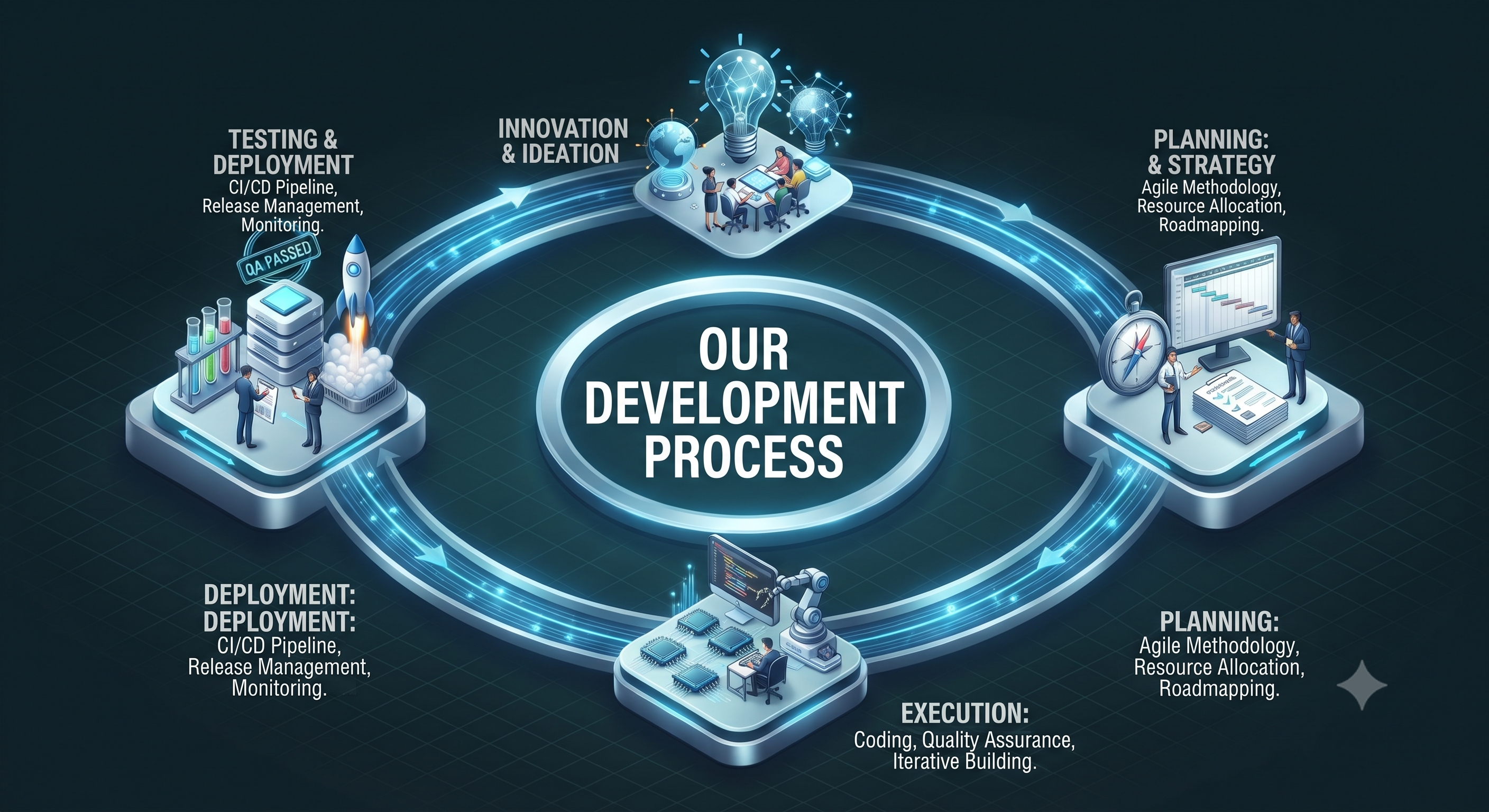
Our Development Process
We follow a structured, transparent lifecycle for every enterprise AI engagement, ensuring predictable timelines and measurable milestones.
Step 1: Discovery & AI Readiness Assessment
We audit your existing data infrastructure, business processes, and strategic priorities to identify the highest-ROI AI opportunities and assess technical feasibility.
Step 2: Solution Architecture & Roadmap Design
Our architects design a technical blueprint covering data pipelines, model selection, integration points, security architecture, and a phased rollout roadmap.
Step 3: Data Engineering & Pipeline Development
We build robust, governed data pipelines that clean, transform, and prepare data for model training — the foundation most AI projects underestimate.
Step 4: Model Development & Fine-Tuning
Our data scientists build, train, and rigorously validate machine learning or generative AI models against your specific business objectives and accuracy benchmarks.
Step 5: Integration & System Connectivity
The AI layer is integrated into existing enterprise systems — CRMs, ERPs, internal dashboards — ensuring outputs reach the people and processes that need them.
Step 6: Testing, Security Audit & Compliance Validation
Comprehensive testing covers model accuracy, load performance, security penetration testing, and compliance checks against relevant regulatory frameworks.
Step 7: Deployment & Change Management
We manage phased production rollout alongside user training and change management support to drive internal adoption.
Step 8: Monitoring, Retraining & Continuous Optimization
Post-launch, we monitor model performance, retrain on new data, and continuously optimize for accuracy, cost, and evolving business needs.
This eight-step lifecycle typically spans eight to twenty weeks depending on solution complexity, with clear go/no-go checkpoints at each stage.
Why Choose Our Company
Our Intelligent Document Processing practice stands out in a competitive market for concrete, demonstrable reasons — not marketing promises:
Enterprise-First Engineering Discipline
We do not build demos. Every solution is engineered from day one for production scale, security, and long-term maintainability.
Deep Domain Expertise
Our teams include engineers with hands-on experience across banking, healthcare, retail, and manufacturing — meaning we understand your compliance and operational constraints, not just the algorithms.
Transparent, Outcome-Based Engagement
We define measurable success metrics upfront — accuracy thresholds, cost savings, processing time reductions — and report against them throughout the engagement.
Security & Compliance Built In
Our development practices align with SOC 2, ISO 27001, HIPAA, GDPR, and India's IT Act and DPDP Act requirements as applicable to your industry.
Vendor-Neutral Technology Approach
We are not locked into a single cloud provider or model vendor, allowing us to recommend what is genuinely best for your architecture and budget.
Post-Deployment Partnership
Our relationship does not end at go-live. We offer ongoing model monitoring, retraining, and optimization retainers to ensure long-term performance.
Proven Delivery Across Indian and Global Markets
Our teams have delivered enterprise AI engagements for organizations across Chennai, Bangalore, Hyderabad, and Mumbai, alongside global clients, giving us a rare blend of global engineering standards and local market understanding.
Case Study: Mid-Sized NBFC Automating Loan Underwriting
Scenario: Mid-Sized NBFC Automating Loan Underwriting
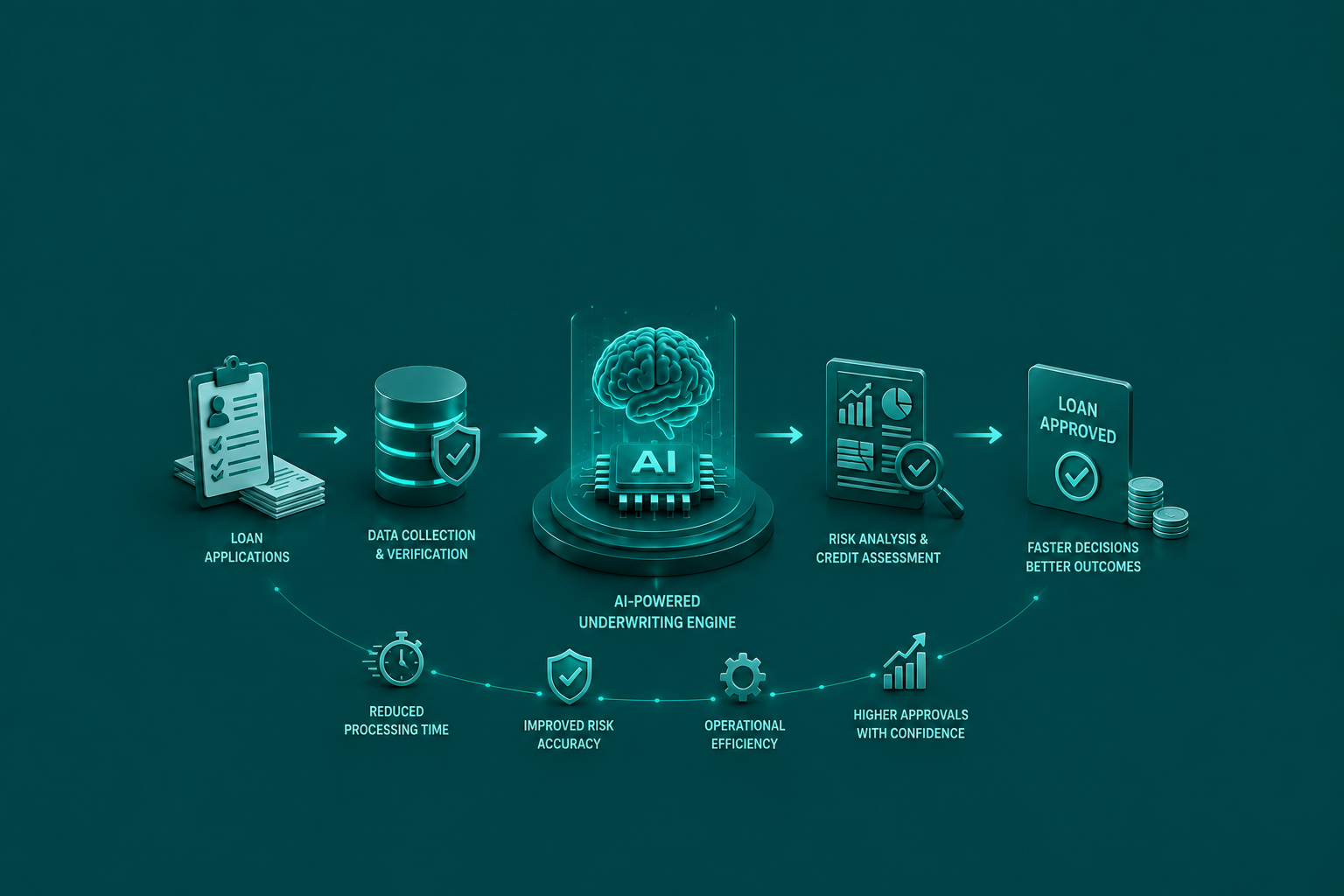
A non-banking financial company processing thousands of loan applications monthly was relying on manual document verification and credit assessment, resulting in average turnaround times of several days per application and inconsistent risk scoring across branches.
Our Approach:
We designed an end-to-end intelligent underwriting pipeline combining optical character recognition for document extraction, a custom credit risk scoring model trained on the company's historical lending data, and a rules-based compliance layer to flag applications requiring human review.
Implementation Highlights:
- Built a document intelligence layer to extract and validate data from bank statements, salary slips, and identity documents
- Trained a gradient-boosted risk model benchmarked against the company's existing underwriting outcomes
- Integrated the model directly into the existing loan management system via secure API
- Implemented a human-in-the-loop review queue for borderline risk scores
Outcome:
Average loan processing time dropped from days to hours, manual document review workload was significantly reduced, and risk scoring consistency improved across all branches, giving the credit team a unified, auditable decision framework.
This type of engagement illustrates a broader pattern we see repeatedly: the highest-ROI enterprise AI projects are rarely the most exotic. They are the workflows that are high-volume, rules-heavy, and currently bottlenecked by manual human review.
It is also worth noting what made this particular engagement succeed where similar internal attempts had previously struggled. The NBFC's internal team had tried building a scoring model a year earlier using a generic, off-the-shelf risk API, but found that it could not be tuned to the company's specific lending criteria or regional risk patterns, and it offered no clear explanation for individual decisions — a serious problem when applicants or regulators asked why an application had been declined. By building a custom model trained specifically on the company's own historical lending outcomes, and pairing it with an explainability layer that surfaced the key factors behind each score, we were able to deliver both better accuracy and the auditability the compliance team required. This distinction — generic API versus custom-trained, explainable model — is frequently the deciding factor between an AI pilot that gets shelved and one that becomes a permanent part of core operations.
ROI & Business Impact
Enterprise AI investment decisions ultimately come down to one question: what is the return? While outcomes vary by use case and industry, several patterns hold consistently across well-executed enterprise AI deployments.
Process Automation Use Cases (document processing, claims handling, data entry) typically deliver the fastest payback period, often within the first six to twelve months, because they directly reduce labor hours on measurable, repetitive tasks.
Predictive Analytics Use Cases (demand forecasting, churn prediction, maintenance scheduling) deliver compounding value over time as models improve with more data, with ROI accelerating in years two and three of deployment.
Customer-Facing AI (personalization engines, intelligent support) tends to show ROI through indirect metrics — improved conversion rates, reduced support costs, and higher customer retention — which require slightly longer measurement windows but often yield the largest long-term revenue impact.
Industry research from Gartner and MIT Sloan Management Review consistently finds that the organizations capturing the greatest financial return from AI are not necessarily those spending the most, but those that align AI initiatives tightly with specific, measurable business outcomes rather than pursuing AI for its own sake. This is precisely why our engagement model begins with outcome definition before any model is built.

Challenges & Solutions
Challenge: Poor Data Quality and Fragmentation
The Challenge: Most enterprises underestimate how much of an AI project's effort goes into data cleaning and integration rather than modeling itself.
Our Solution
We begin every engagement with a data audit and build governed pipelines before any model training begins, preventing the 'garbage in, garbage out' failure mode.
Challenge: Integration With Legacy Systems
The Challenge: Decades-old ERP and core banking systems often lack modern APIs.
Our Solution
We build custom middleware and connector layers that bridge legacy systems with modern AI infrastructure without requiring a full system replacement.
Challenge: Lack of Internal AI Governance
The Challenge: Many organizations deploy models without clear ownership, monitoring, or accountability structures.
Our Solution
We establish governance frameworks, including model documentation, bias auditing, and clear escalation paths for model-driven decisions.
Challenge: Employee Resistance to Automation
The Challenge: AI adoption often stalls due to internal fear of job displacement or distrust of automated decisions.
Our Solution
We design human-in-the-loop workflows and run structured change management programs that position AI as augmentation rather than replacement.
Challenge: Regulatory Uncertainty
The Challenge: Evolving AI regulations create compliance ambiguity, particularly in finance and healthcare.
Our Solution
Our solutions are built with explainability and audit trails by default, positioning clients to adapt to emerging regulatory requirements rather than retrofit compliance later.
Frequently Asked Questions: Enterprise AI Solutions
Q: What exactly does an Enterprise AI Solutions company do?
An enterprise AI solutions company designs, builds, and deploys custom artificial intelligence systems — including machine learning models, generative AI applications, and automation pipelines — that integrate directly with a company's existing technology stack and business processes.
Q: How long does it take to implement an enterprise AI solution?
Most enterprise AI engagements take between eight and twenty weeks from discovery to production deployment, depending on data readiness, integration complexity, and the scope of the use case.
Q: How much does enterprise AI development cost?
Costs vary widely based on scope, ranging from focused single-workflow automation projects to multi-phase, organization-wide AI transformation programs. We provide detailed, scope-based estimates after an initial discovery assessment.
Q: Do we need clean data before starting an AI project?
Not necessarily — data cleaning and pipeline engineering is typically part of the project itself. However, having a general sense of where your data lives and how accessible it is significantly speeds up the discovery phase.
Q: Can enterprise AI solutions integrate with our existing ERP or CRM?
Yes. Our solutions are specifically engineered to integrate with platforms like SAP, Salesforce, Oracle, and Microsoft Dynamics through secure APIs and custom middleware where needed.
Q: Is generative AI suitable for enterprise use, or only for consumer applications?
Generative AI is increasingly enterprise-ready when deployed with proper guardrails — retrieval-augmented generation, access controls, and human review checkpoints — particularly for document drafting, customer support, and internal knowledge management.
Q: How do you ensure AI models remain accurate over time?
We implement continuous monitoring for model drift, along with scheduled retraining pipelines that incorporate new data, ensuring model performance does not degrade as business conditions evolve.
Q: What industries do you have the most experience in?
We have deep experience across banking and financial services, healthcare, retail, manufacturing, and logistics, with engineering teams that understand the specific compliance and operational requirements of each sector.
Q: How do you handle data security and compliance?
Security is built into our development process from the start, including encryption, role-based access control, and alignment with frameworks such as SOC 2, HIPAA, GDPR, and India's DPDP Act, depending on applicable jurisdiction.
Q: Can you work with our in-house data science or engineering team?
Yes. We frequently work in an augmented model alongside internal teams, providing specialized expertise in MLOps, generative AI, and enterprise architecture while your team retains ownership of strategic direction.
Ready to Build AI That Delivers Real Business Value?
Stop experimenting with prototypes and start deploying production-ready AI software. Book a 60-minute strategy session with our senior AI architects. We will assess your data, identify high-ROI use cases, and map out a technical blueprint for your organization.
Schedule Your Free Session Now