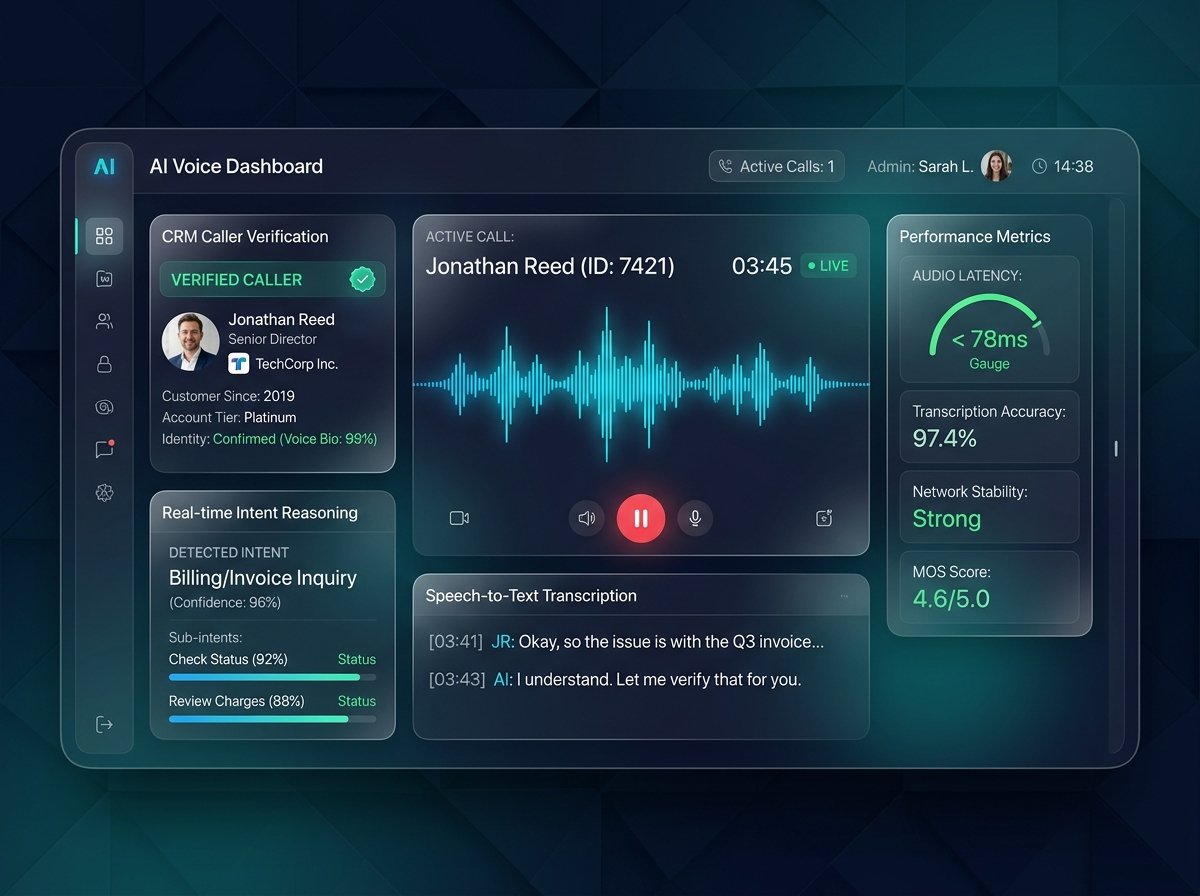
What Is Voice AI?
Voice AI is a technology system that enables software to conduct spoken conversations with people — understanding what they say, reasoning about how to respond, taking action in connected business systems, and replying in natural speech.
It combines several distinct components into one working system:
This isn’t a script-based phone tree. It’s an enterprise conversational system that listens, reasons, acts, and speaks back — built around your telephony setup and the calls your business actually receives.
Why Businesses Need Voice AI
Phone conversations remain one of the most common ways customers reach a business, and one of the most expensive to scale. As highlighted by Deloitte in their customer experience and automation industry insights, Voice AI absorbs the structured, repetitive share of calls so human agents can focus on complex interactions.
Voice AI Development Services
InfinitetechAI designs and builds Voice AI systems end to end — conversation design, telephony connectivity, model selection, enterprise integration, and testing before deployment.
Every voice engagement includes:
From first greeting through unscripted turn-taking, task completion in CRM/ERP, and graceful context-preserved human escalation when required.
AI Voice Agent Development
Custom-built conversational agents designed around a specific business use case, capable of understanding unscripted speech, holding multi-turn context, and executing business actions.
Voice Assistant Development
Voice-driven assistants for internal employee productivity or customer-facing apps — handling account lookups, status checks, and guided workflows through spoken dialogue.
AI Calling Agent Development
Agents built specifically for outbound calling workflows — prospect qualification, reminders, and customer follow-ups — with pacing and interruption logic designed for phone outreach.
Inbound Voice Automation
Systems that answer incoming calls, identify intent, look up customer records in CRM/ERP, and either resolve the inquiry or route with full context to live teams.
Outbound Voice Automation
Automated outbound call campaigns that initiate calls on schedule, conduct structured conversational interactions, and log outcomes directly into business systems.
Voice Customer Service
First-line support agents answering order status, account queries, and service requests 24/7 with zero hold times and seamless live agent escalation.
Voice Sales Agents
Qualify inbound sales enquiries, reach out to new leads instantly, capture qualification criteria, and transfer warm prospects directly to account executives.
Appointment Scheduling Agents
Direct calendar read/write integration to check availability, book, reschedule, or cancel appointments and dispatch instant SMS/email confirmations.
Lead Qualification Agents
Standardized qualifying question flows assessing budget, authority, need, and timeline (BANT) before scoring and updating CRM records.
Healthcare Voice Assistants
Clinic appointment triage, pre-visit reminders, and general informational routing under strict privacy guardrails with immediate human handoff for clinical queries.
Enterprise Voice Automation
Multi-departmental voice deployments across contact centers, IT helpdesks, and HR operations with enterprise-grade telephony routing and compliance.
Multilingual Voice AI
Natural spoken conversations across global and regional languages, engineered to switch dynamically based on caller speech.
Voice Workflow Automation
Automating downstream operational actions triggered during a call — generating helpdesk tickets, sending follow-up links, and triggering ERP workflows as part of our AI automation services.
Inbound vs. Outbound Voice AI
Voice AI handles both sides of business telephony: answering customer calls instantly, and executing scheduled outbound outreach.
Inbound Voice AI
Answers incoming calls, understands intent, checks connected systems, and resolves requests without waiting queues.
Goal: Resolve repeatable calls immediately; escalate complex cases cleanly.
Outbound Voice AI
Initiates calls automatically on schedule or event triggers, carrying structured conversations and logging outcomes.
Built with strict compliance, consent management, and time-zone rules.
Voice AI for Customer Service
Designed to sit alongside your support team — absorbing calls that do not require human judgment:
Resolves routine support queries instantly with smooth live escalation.
Sales & Lead Qualification
Ensuring inbound leads are contacted within seconds while sales reps focus on closing:
Real-Time Appointment Scheduling
Inherently structured conversations executed through live API read/write integration:
Voice Telephony & SIP Integration
Connecting conversational intelligence directly into your existing phone carrier setup:
Enterprise Voice AI Features
Core capabilities engineered for human-like conversational fluidity and enterprise reliability.
Production Voice AI Architecture
A high-concurrency, sub-second latency pipeline built in decoupled layers for bulletproof reliability:


Enterprise Voice AI Use Cases
Direct mapping from operational bottleneck to Voice AI resolution and quantifiable business impact.
| Business Problem | Voice AI Solution | Operational Business Value |
|---|---|---|
| High volume of order status calls | Inbound agent with order-system lookup | Faster resolution, reduced agent load |
| Slow lead follow-up | Outbound qualification agent | Faster, more consistent lead contact |
| Manual appointment booking | Scheduling agent with calendar integration | Fewer scheduling calls handled manually |
| After-hours enquiries going unanswered | 24/7 inbound voice coverage | Extended availability without added staffing |
| High no-show rates | Outbound reminder calls | Fewer missed appointments |
| Repetitive account questions | Inbound agent with CRM lookup | Reduced repetitive workload for agents |
| Inconsistent lead qualification | Structured outbound qualification flow | Standardized qualifying questions on every call |
| Multilingual support gaps | Multilingual voice agent | Broader language coverage without added headcount |
Voice AI Across Industries
Tailored conversational voice use cases driving real operational efficiency across enterprise sectors.
Healthcare, Commerce & Financial Services
Spoken architectures engineered for high-frequency inquiries, strict security, and customer conversion:
Enterprise, SaaS & Industrial Operations
Spoken AI architectures powering internal knowledge retrieval, B2B sales outreach, and supply chains:
Voice AI Development Process
A disciplined 16-step engineering methodology moving from use-case discovery and conversation design through to telephony assessment, latency tuning, and continuous improvement.
Each stage feeds into the next, ensuring low latency, accurate system actions, and graceful human handoffs.
Start Your Voice AI Roadmap →Voice Use-Case Discovery
Identifying which call flows follow structured, repeatable patterns suited to automated resolution.
Conversation Design
Mapping out turn-taking, open-ended phrasing paths, fallback logic, and human transfer triggers.
Telephony Assessment
Evaluating existing phone infrastructure, SIP trunks, cloud PBX, and WebRTC audio connectivity.
ASR Engine Selection
Selecting speech recognition engines tuned for caller accents, languages, and telephony audio bandwidth.
AI Reasoning & Model Selection
Configuring foundation LLMs for ultra-fast, low-latency conversational intent reasoning.
Knowledge Base & RAG Integration
Connecting knowledge sources via RAG so the agent answers with verified, cited business truth.
Business System API Integration
Building connectors to CRM, ERP, calendar scheduling tools, and helpdesk ticketing platforms.
Voice Workflow Engineering
Implementing conversation state machines, context memory, and guardrails.
Neural TTS Configuration
Configuring natural-sounding voice synthesis with dynamic pacing and custom brand personas.
Conversational Scenario Testing
Validating the agent against unscripted speech, noisy audio, background chatter, and edge cases.
End-to-End Latency Optimization
Streaming audio buffers and caching LLM tokens to achieve sub-600ms conversational turnarounds.
Security & Compliance Validation
Reviewing caller authentication, encryption at rest/transit, and data retention policies.
Production Rollout
Deploying the voice agent to live customer call traffic with instant rollback safeguards.
Telemetry & Call Analytics
Tracking resolution rates, containment ratios, MOS audio scores, and average handling time.
Continuous Conversation Tuning
Refining prompts, updating knowledge bases, and expanding capabilities from real call transcripts.
Ongoing Maintenance & Optimization
Regular model updates, telephony carrier optimization, and workflow expansion over time.
Voice AI Challenges & Practical Solutions
Managing real-world phone acoustic and conversational complexities through deliberate engineering:
Voice AI Cost Factors
Pricing depends on operational scale and technical architecture choices:
Measurable ROI & Impact
Establish a baseline before deployment to measure genuine operational impact:
Comparative Analysis & Channel Scope
Understanding where Voice AI fits relative to AI Chatbots, ASR Transcription, and Legacy IVR phone trees:
Voice AI vs. AI Chatbot
AI Chatbots handle text-based interactions on websites and messaging channels without speech requirements. Voice AI conducts real-time spoken phone calls requiring low-latency ASR, speech synthesis, and telephony routing.
Voice AI vs. ASR Transcription
Automatic Speech Recognition (ASR) only transcribes audio to text. Voice AI is the complete interactive system that interprets intent, reasons via LLMs, queries CRM APIs, and responds in voice.
Voice AI vs. Traditional IVR ("Press 1 for Sales")
Legacy IVRs trap callers in rigid, frustrating numbered menus that break on unexpected phrasing. Modern Voice AI understands natural conversational language, tracks multi-turn context, executes database actions, and transfers to humans with full transcripts intact.
Illustrative Voice AI Use Cases
Representative operational scenarios demonstrating how custom Voice AI agents solve real contact-center, sales, and scheduling bottlenecks.
From clinic front desks to SaaS sales and logistics tracking, voice automation delivers measurable speed and deflection.
Explore Your Voice Use Case →Healthcare Appointment Voice Agent
SaaS Inbound Lead Qualification Agent
E-Commerce Order & Tracking Support Agent
Financial Service Routine Enquiry Agent
Logistics Delivery Rescheduling Agent
Why Choose InfinitetechAI for Voice AI?
Custom voice agents built to work within your real operating environment and telephony infrastructure.
Our Engineering Differentiators
Flexible Engagement Structures
Market Trends & Future of Voice AI
Tracking AI adoption, capability trends, and contact-center automation research from the Stanford HAI AI Index Report, McKinsey, and Gartner:
Established Capabilities (Available Today)
Emerging Capabilities (Developing)
People Also Ask & Frequently Asked Questions
Direct answers to key technical, architectural, and scoping questions about Voice AI.
What is Voice AI?
Voice AI is a system that lets software conduct spoken conversations — understanding speech, reasoning, taking action in connected systems, and replying naturally.
How does Voice AI work?
It works through a pipeline: speech is converted to text (ASR), a language model interprets intent, business logic and APIs handle actions, and the response is converted back to speech (TTS) for the caller.
What is an AI voice agent?
A system built for a specific conversational task capable of understanding open-ended speech, maintaining context, and taking real action in connected systems.
What is Voice AI used for?
Common uses include customer support calls, sales qualification, appointment scheduling, order status enquiries, and outbound reminder calls.
Can Voice AI make phone calls?
Yes. Outbound agents can initiate calls for use cases such as lead qualification, reminders, and follow-up outreach.
Can Voice AI answer customer calls?
Yes. Inbound agents can answer calls, understand requests, retrieve information, and resolve the request or safely escalate to a human agent.
Can Voice AI integrate with CRM?
Yes. Voice AI systems heavily rely on CRM integration to look up caller information and log precise call outcomes automatically.
What is the difference between Voice AI and AI chatbots?
Voice AI handles spoken conversation over the phone. AI chatbots handle text-based conversation, typically on a website, without speech components.
What is the difference between Voice AI and ASR?
ASR (Speech Recognition) only converts speech to text. Voice AI is the complete conversational system that reasons and responds.
Can Voice AI support multiple languages?
Yes. Agents can be built to support multiple languages seamlessly, depending entirely on the languages your customers use.
How much does Voice AI cost?
Cost depends on call volume, number of workflows, integrations, and infrastructure choices, scoped during initial technical discovery.
Can it automate appointment scheduling?
Yes. Voice AI can check real-time calendar availability, book, reschedule, and cancel appointments via API integration.
What is the difference between Voice AI and traditional IVR?
IVR relies on fixed menu numbers ('Press 1'). Modern Voice AI understands natural language, maintains context, and takes real actions.
Can Voice AI replace customer service agents?
It is best suited for structured, repetitive calls. Complex or judgment-based interactions are routed to human agents. It acts as a complement, not a total replacement.
How long does development typically take?
A single well-defined use case takes less time than a multi-workflow enterprise deployment; specific timelines are established during scoping.
Can it handle barge-in and interruptions?
Yes, robust Voice AI systems are explicitly designed to handle interruptions gracefully, stopping speech and listening when a caller talks over them.
How is caller data kept secure?
Measures include authentication before accessing data, strict API access controls, and compliance with data handling requirements for sensitive information.
Does it require a specific telephony provider?
Voice AI can generally be built around a business’s existing telephony setup via SIP or API integration, depending on what your system supports.
What happens if it doesn't understand a request?
The system relies on fallback handling, including asking clarifying questions and executing a defined human escalation path with full context.
Can an existing IVR be upgraded gradually?
Yes. A Voice AI agent can be introduced alongside or in place of specific IVR menu paths, allowing a phased, safe transition.
What determines the cost of a Voice AI project?
Cost is driven by factors including call volume, number of workflows, integration requirements, languages supported, and infrastructure needs.
What can an AI voice agent actually do beyond answering basic questions?
A well-built voice agent can retrieve live CRM records, book appointments, generate helpdesk tickets, and escalate calls with complete transcripts.
Can Voice AI connect to our existing CRM and scheduling tools?
Yes, provided those systems expose an API or supported webhook integration method, assessed during initial discovery.
How is ASR selected for a project?
ASR selection depends on languages, audio quality, and caller accent variation, tailored to fit the specific calling environment.
Can call analytics show us how the voice agent is actually performing?
Yes. Real-time dashboards track volume, resolution rate, escalation rate, and call outcomes to give ongoing visibility into performance.
Is Voice AI suitable for small/mid-sized businesses?
Yes. The right engagement model depends on call volume and the specific workflows involved, not company size alone.
What ongoing maintenance does a Voice AI deployment need?
Ongoing work includes monitoring call performance, refining prompts based on real call data, and updating API integrations as systems change.
How do we know if our business has enough call volume?
This is assessed by analyzing current call logs, the percentage of repetitive calls, and current contact-center staffing costs during discovery.
Ready to Build Your Enterprise Voice AI Agent?
If your business is fielding high call volumes, repetitive enquiries, or slow lead follow-up, a well-scoped Voice AI agent can take on the structured share of that work — connected directly to the systems you already use.