Document AI vs. Traditional OCR
| Feature | Traditional OCR | Document AI |
|---|---|---|
| Handles fixed templates only | Yes | Yes |
| Works with new/unseen document formats | No | Yes |
| Understands document context and meaning | No | Yes |
| Classifies document types automatically | No | Yes |
| Extracts relationships between data fields | No | Yes |
| Validates extracted data against business rules | No | Yes |
| Handles handwriting | Limited | Yes |
| Processes multi-language documents | Limited | Yes |
| Self-improves with feedback | No | Yes |
| Integrates with downstream workflows | Manual | Automated |
| Processes tables and complex layouts | Limited | Yes |
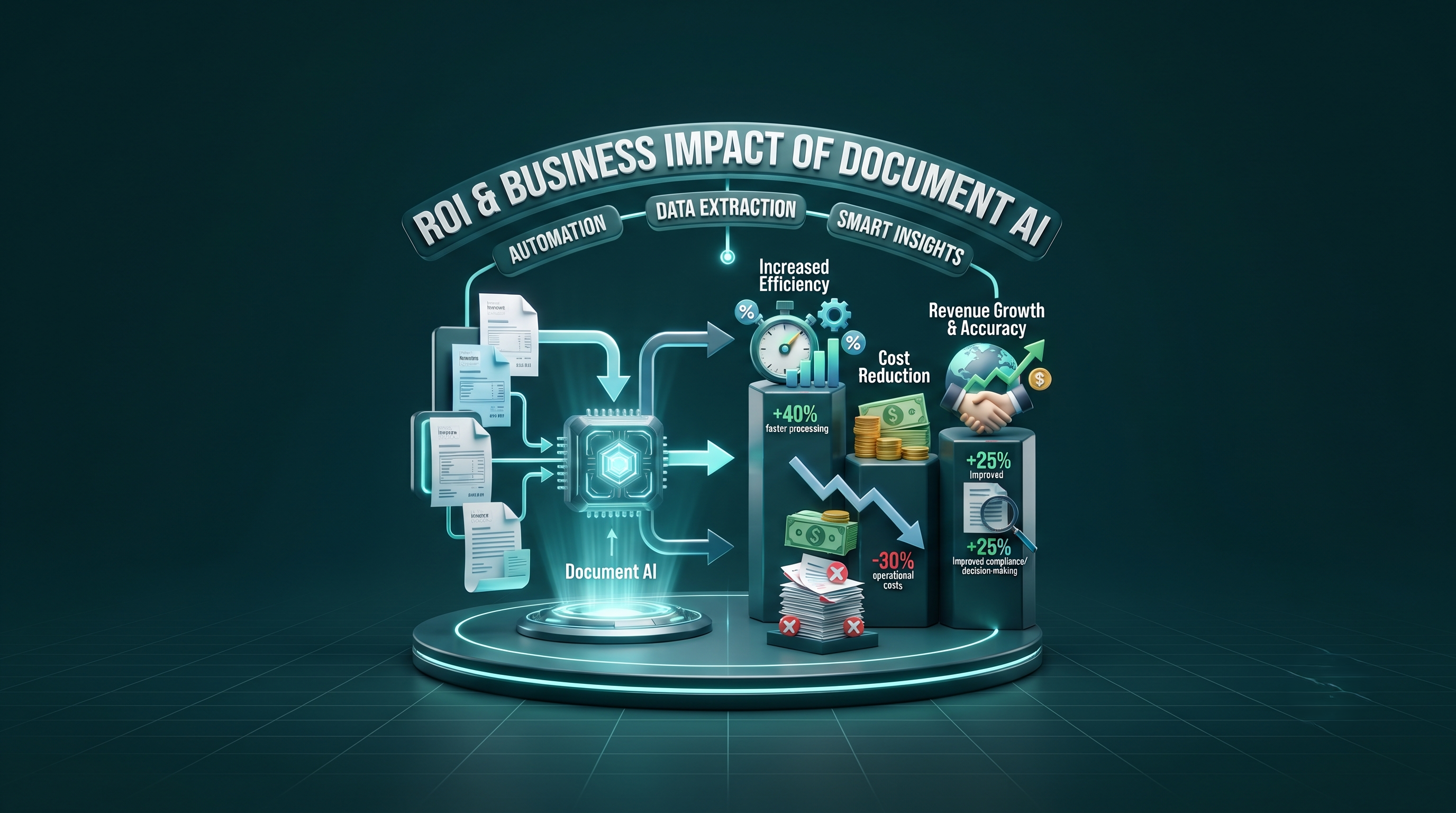
Benefits of Document AI for Your Business
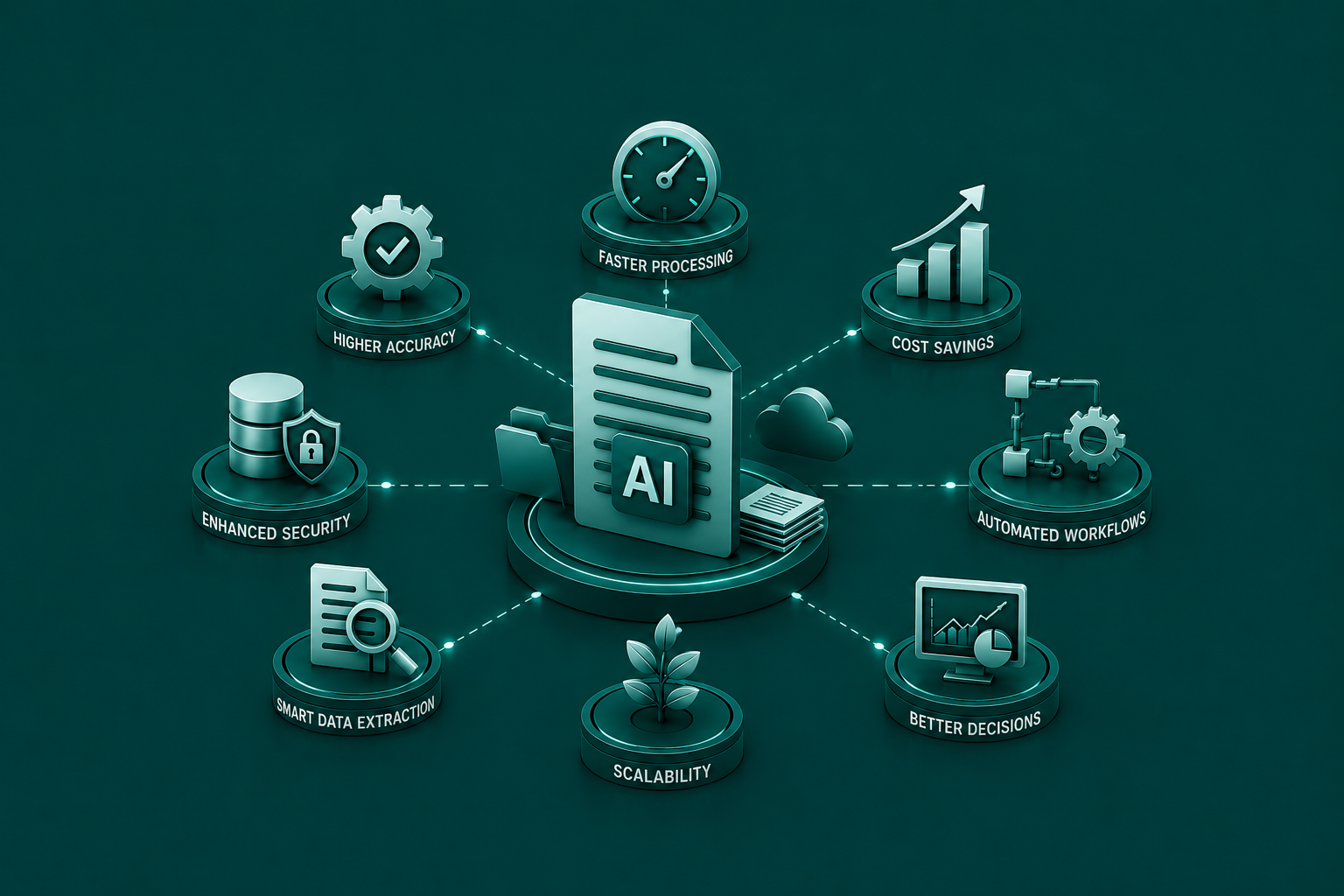
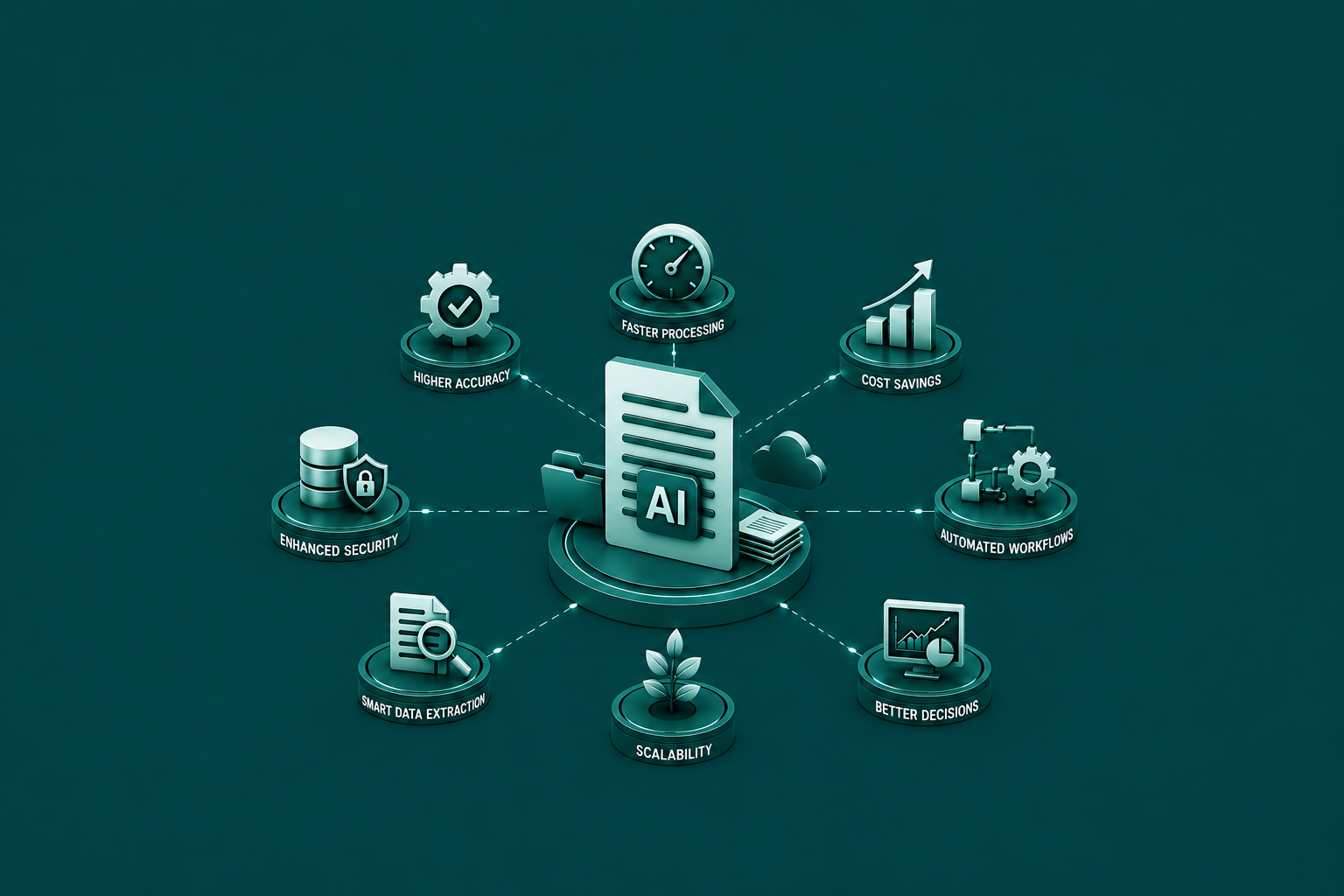
Dramatic Reduction in Processing Time
Manual invoice processing typically takes . Document AI processes the same invoice in - translating to 833-2,500 hours of labor saved every month for enterprises processing 10,000 invoices.
Significant Cost Reduction
According to Deloitte, organizations that implement intelligent document processing report on document-heavy processes.
Dramatically Improved Accuracy
Human data entry error rates typically range from . Document AI systems, once properly tuned, operate at - a 10x improvement in data quality.
Unlimited Scalability
Month-end invoice surges, peak enrollment seasons, post-merger document migrations - Document AI handles volume spikes without the operational cost of temporary staffing. The system scales horizontally on cloud infrastructure, processing thousands of documents simultaneously.
Faster Business Decisions
When data is extracted automatically and immediately available in your business systems, the downstream decisions happen faster. Payments clear sooner. Contracts are executed more quickly. Loan applications are approved in hours rather than days.
Enhanced Employee Experience
Eliminating repetitive, error-prone data entry from knowledge workers' days is not just good for the business - it's good for the people. Staff freed from document processing can focus on judgment-intensive work: exception resolution, relationship management, analysis, and strategy.
Why Every Enterprise Needs Document AI Now
The Document Volume Crisis
Enterprise document volumes are growing at an estimated 22.1% annually (Source: AIIM). Hiring more manual processors is increasingly expensive, increasingly difficult due to talent shortages, and ultimately unsustainable. You cannot hire your way out of a document processing backlog that grows 22% per year.
The Digital Transformation Imperative
Document AI is often the missing piece in digital transformation initiatives. Organizations invest millions in ERP modernization, cloud migration, and process reengineering - but their inputs to these systems are still manual data entry from paper documents. Document AI closes this gap, making digitized processes genuinely end-to-end.
Regulatory Pressure on Data Accuracy
India's GST compliance ecosystem demands accurate invoice data flowing into government portals. IRDAI data submissions require precisely structured claims data. Document AI systems are built to produce compliance-grade structured data as a natural output.
Competitive Dynamics
Early adopters of Document AI are establishing competitive advantages that will be very difficult to overcome. Banks that process loan applications in hours rather than weeks win customers. Insurers that settle claims in days rather than months retain policyholders. The competitive cost of not implementing Document AI compounds every year.
Industries Transforming Operations with Document AI
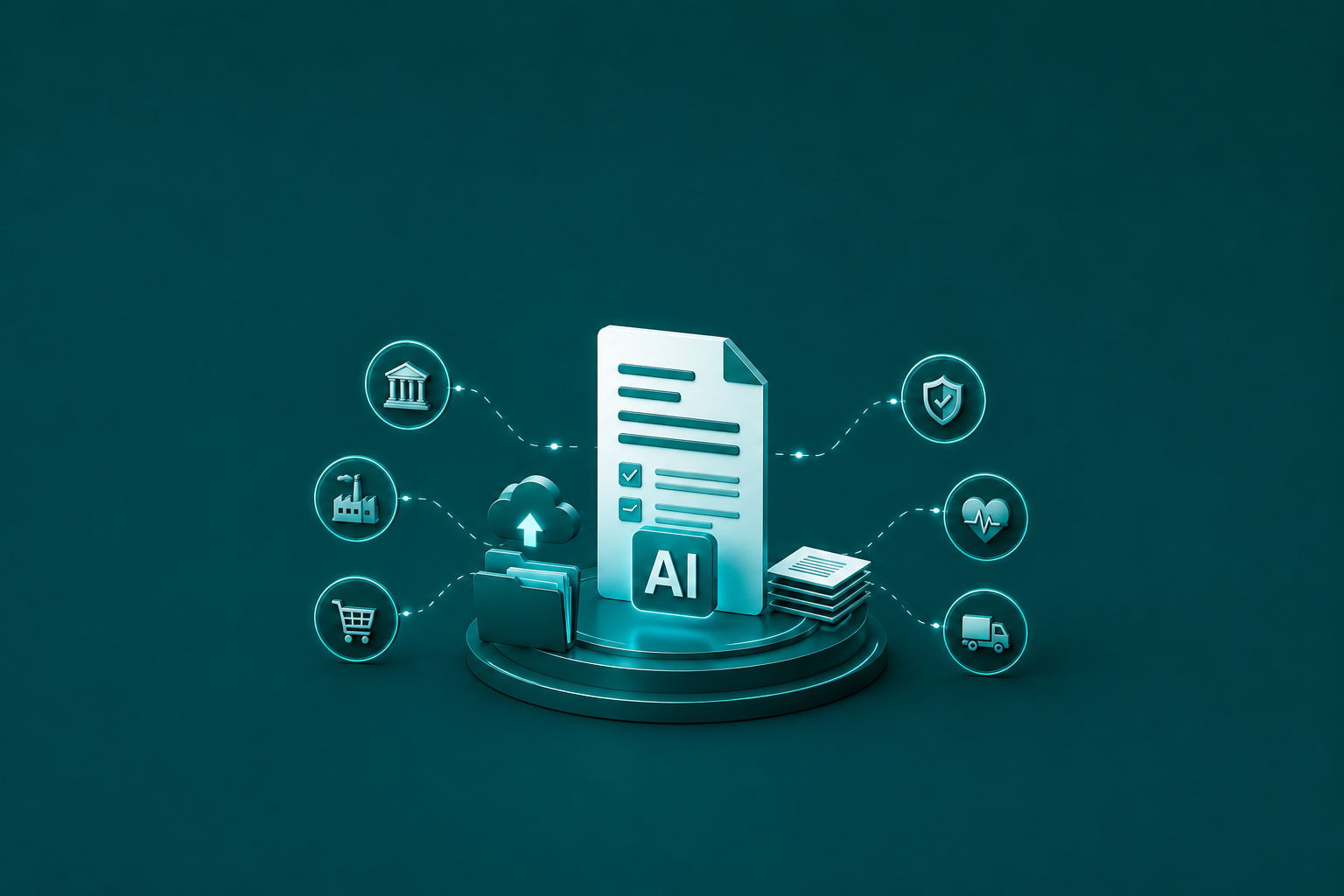
Banking, Financial Services & Insurance (BFSI)
Use cases: Loan origination document processing, KYC/AML document verification, trade finance documentation, insurance claims processing, account opening forms, regulatory reporting, mortgage underwriting, credit card applications.
Healthcare & Life Sciences
Use cases: Patient intake form digitization, medical record extraction, insurance pre-authorization processing, clinical trial documentation, lab report analysis, discharge summary processing, prescription digitization, NABH audit documentation.
Legal and Contract Management
Use cases: Contract review and extraction, due diligence document analysis, litigation document review, regulatory filing processing, IP documentation management, NDA clause extraction and tracking.
Logistics, Supply Chain & Trade
Use cases: Bill of lading processing, customs declaration automation, freight invoice reconciliation, purchase order matching, packing list extraction, export documentation compliance.
Government & Public Sector
Use cases: Citizen application processing, land record digitization, court filing management, compliance document processing, tax return processing, procurement documentation.
Manufacturing, Education & Real Estate
- Manufacturing: Technical drawing interpretation, quality inspection reports, BOM extraction, regulatory certifications
- Education: Admission form processing, transcript digitization, accreditation documentation, scholarship applications
- Real Estate: Property document verification, lease agreement extraction, sale deed processing, due diligence

Why Choose [Company Name] for Document AI
Frequently Asked Questions About Document AI
1. What types of documents can Document AI process?
Document AI can process virtually any document type - PDFs, scanned images, Word documents, Excel files, emails, handwritten forms, engineering drawings, medical records, financial statements, contracts, tax filings, government forms, invoices, receipts, and shipping documents. Modern Document AI systems handle both structured documents (with fixed layouts) and unstructured documents (where information appears in varying positions and formats).
2. How accurate is Document AI compared to manual processing?
Well-tuned Document AI systems achieve extraction accuracy of 95-99.5% on clean printed documents and 90-97% on handwritten content, compared to human data entry error rates of 1-5%. In production deployments, Document AI consistently outperforms manual processing on accuracy while operating at dramatically higher throughput.
3. How long does it take to implement a Document AI system?
For a mid-complexity implementation covering 3-5 document types and integration with 1-2 downstream systems, end-to-end implementation typically takes 12-20 weeks from project kick-off to production go-live. Simpler implementations can be deployed in 6-10 weeks. More complex multi-document-type, multi-system implementations typically run 20-36 weeks.
4. Is Document AI suitable for small businesses or only large enterprises?
Document AI is increasingly accessible to businesses of all sizes. Cloud-based Document AI platforms from Azure, Google Cloud, and AWS offer pay-per-use pricing that makes the technology accessible to SMBs. For small businesses, pre-built models and no-code configuration options significantly reduce implementation cost and complexity.
5. Can Document AI handle documents in Indian languages?
Yes. Our Document AI systems are specifically engineered to handle Indian language documents including Hindi, Tamil, Telugu, Kannada, Malayalam, Marathi, Gujarati, Bengali, Odia, and Punjabi, as well as mixed-language documents and Indian-specific formats including Aadhaar cards, PAN cards, GSTIN invoices, Form 16, property documents, and court filings.
6. How does Document AI handle documents it has never seen before?
Modern Document AI models based on transformer architectures generalize across document variations without requiring per-template configuration. Novel document types that differ significantly from the training distribution are flagged for human review and used to improve the model through active learning. Over time, the system handles an ever-wider range of document variants automatically.
7. What security certifications do Document AI systems support?
Enterprise Document AI systems can be deployed in environments certified to SOC 2 Type II, ISO 27001, HIPAA, GDPR, and India's DPDP Act requirements. Data-at-rest and data-in-transit encryption, role-based access control, audit logging, and configurable data retention policies are standard components of our deployments.
8. What is the difference between IDP and traditional OCR?
Traditional OCR converts document images to text but has no understanding of what that text means. Intelligent Document Processing (IDP) combines OCR with AI-driven classification, extraction, validation, and workflow integration. Where OCR gives you raw text, IDP gives you structured, validated, actionable data fields ready for downstream system consumption.
9. Can Document AI integrate with SAP, Oracle, or other ERP systems?
Yes. We have pre-built integration connectors for SAP S/4HANA and ECC, Oracle ERP Cloud and E-Business Suite, Microsoft Dynamics 365, Salesforce, ServiceNow, OpenText, and many other platforms. Custom integration with proprietary or legacy systems is supported through API development and, where necessary, robotic integration techniques.
10. How does Document AI handle confidential or PII-sensitive documents?
Document AI systems can be configured to automatically detect, mask, or redact personally identifiable information (PII) before documents are stored or shared. Role-based access controls limit who can view which document types and data fields. For the most sensitive use cases, we deploy on-premises or private cloud architectures that ensure document content never leaves your controlled infrastructure.
11. What ongoing support is needed after Document AI deployment?
Document AI systems require ongoing model monitoring for accuracy drift, periodic retraining as new document variants accumulate, new document type onboarding as business requirements evolve, and platform updates as underlying AI technologies advance. Our managed services offering includes all of these activities through a defined SLA framework.
12. What ROI should we expect from Document AI?
In accounts payable automation, typical ROI ranges from 300-500% over three years. In insurance claims processing, 200-400%. In loan origination document handling, 250-450%. The common factors driving high ROI are: high document volumes, complex multi-field extraction requirements, time-sensitive processing, and regulatory environments where accuracy errors carry penalty risk.