InfiniteTech AI - Navbar (navbar_html)
Intelligent Solutions for Enterprises | AI-Powered Business Transformation Company

Intelligent Solutions

Intelligent Solutions That Power the Future of Enterprise Decision-Making

What is an Intelligent Solution

An Intelligent Solution is a software system that uses artificial intelligence — including machine learning, deep learning, natural language processing, computer vision, and automation — to perform tasks that traditionally required human judgment, while continuously learning from new data to improve performance over time.

In simple terms: a traditional system tells you what happened. An intelligent system tells you what is happening, why it is happening, what will happen next, and what you should do about it — and in many cases, it does the "doing" for you through automated workflows.

Intelligent solutions typically combine several core capabilities:

  • Perception — ingesting and understanding structured and unstructured data (text, voice, images, sensor data, transactional records)
  • Reasoning — applying statistical models, machine learning algorithms, or large language models to derive insight
  • Prediction — forecasting outcomes, demand, risk, or behavior using historical and real-time data
  • Action — triggering workflows, alerts, recommendations, or fully automated processes
  • Learning — refining models continuously based on outcomes and feedback loops

This is fundamentally different from rule-based automation, which only executes fixed "if-this-then-that" logic and breaks the moment a scenario falls outside its rules. Intelligent solutions are designed to handle ambiguity, incomplete data, and changing conditions — the reality of how businesses actually operate.

Direct Answer: How is an Intelligent Solution different from regular software?

Regular software follows static, pre-programmed rules and cannot adapt without manual reprogramming. An intelligent solution uses machine learning and AI models that learn from data patterns, adapt to new scenarios, and improve their own accuracy over time — without requiring constant manual updates from developers.

Automation Technology

Why Businesses Need Intelligent Solutions

The shift toward intelligent solutions is not a trend driven by hype; it is a structural response to three converging pressures every modern enterprise faces.

Data Volume Has Outpaced Human Capacity

Enterprises now generate more data in a single day than entire organizations generated in a year just two decades ago. No human team, regardless of size, can manually review, correlate, and act on this volume of information. Intelligent solutions are the only practical way to convert this data surplus into usable business intelligence.

Customer Expectations Have Permanently Shifted

Customers benchmark every digital experience against the most sophisticated platforms they use — and they expect the same responsiveness and personalization from a regional logistics company that they get from a global tech platform. Intelligent solutions make that level of experience achievable for organizations of any size.

Margin Pressure Demands Automation

In nearly every industry, margins are under pressure from rising input costs, wage inflation, and intensifying competition. Intelligent automation is one of the few levers that simultaneously reduces cost and improves quality, rather than forcing a trade-off between the two.

Direct Answer: Why should a company invest in intelligent solutions now?

Companies that delay AI adoption risk falling permanently behind competitors who use intelligent systems to make faster, cheaper, and more accurate decisions at scale. Early movers compound their advantage because their AI models improve continuously with more data, creating a widening performance gap over time.

Why Businesses Need Intelligent Solutions Image

Key Features

Our AI powered solutions are engineered for the complexity, scale, and regulatory environment of enterprise workflows. Here are the core platform capabilities our clients rely on:


Adaptive Machine Learning Core

At the heart of every intelligent solution sits a machine learning engine capable of supervised, unsupervised, and reinforcement learning. This core continuously retrains on fresh production data, ensuring model accuracy does not decay over time — a problem known in the industry as model drift.

Natural Language Understanding

Modern intelligent solutions can read, interpret, and generate human language with remarkable fluency. This powers intelligent chatbots, document summarization engines, contract analysis tools, and conversational business intelligence dashboards that let non-technical staff simply "ask" their data a question.

Predictive and Prescriptive Analytics

Beyond forecasting what is likely to happen, our solutions are built to prescribe the optimal next action — whether that means flagging a high-risk transaction, recommending inventory replenishment quantities, or suggesting the next-best offer for a customer.

Real-Time Decisioning Engines

Latency kills opportunity. Our intelligent systems are engineered for real-time or near-real-time scoring and decisioning, critical for fraud detection, dynamic pricing, supply chain rerouting, and personalized customer experiences.

Composable, API-First Architecture

Every intelligent solution we build exposes clean, well-documented APIs so it can plug into your existing CRM, ERP, data warehouse, or customer engagement platform without forcing a costly rip-and-replace of your current tech stack.

Explainability and Governance Layer

Black-box AI is a liability in regulated industries. We embed explainability frameworks (such as SHAP and LIME-based interpretability) so business users and auditors can understand exactly why a model made a particular recommendation.

Human-in-the-Loop Controls

Full autonomy is not always desirable or compliant. Our architecture supports configurable approval gates, allowing humans to review, override, or approve AI-driven decisions before they take effect in high-stakes workflows.

Scalable Cloud-Native Deployment

Built on containerized, cloud-native infrastructure (Kubernetes, serverless functions, managed ML pipelines), our intelligent solutions scale elastically with demand, whether you are processing a thousand records a day or a billion.

Automation Technology

Benefits of Intelligent Solutions

Organizations that adopt intelligent solutions consistently report transformation across four dimensions: speed, accuracy, cost, and customer experience.

Benefit CategoryWhat ChangesTypical Business Impact
Operational EfficiencyManual, repetitive tasks are automated end-to-endSignificant reduction in process cycle time
Decision QualityDecisions backed by data patterns instead of intuition aloneFewer costly errors, more consistent outcomes
Customer ExperiencePersonalized, real-time, context-aware interactionsHigher engagement and retention rates
Risk ManagementContinuous anomaly and fraud detectionFaster detection, lower exposure
Cost StructureReduced dependency on manual labor for routine analysisLower operating cost per transaction
Innovation VelocityFaster experimentation through reusable AI componentsShorter time-to-market for new features

Beyond the table above, here are deeper, narrative benefits our enterprise clients consistently highlight:

  • Faster, more confident decision-making. Leaders no longer wait days for a report; intelligent dashboards surface insight the moment data changes, with natural language explanations attached.
  • Reduced operational drag. Tasks that once consumed hours of manual review — document processing, compliance checks, reconciliation — are compressed into seconds.
  • Proactive rather than reactive operations. Predictive maintenance, demand forecasting, and churn prediction shift teams from firefighting to prevention.
  • Scalable personalization. What used to require a large analyst team can now be delivered to every single customer, automatically, through recommendation engines and dynamic content systems.
  • Competitive differentiation. Intelligent solutions allow smaller, agile teams to compete with much larger incumbents by automating what used to require scale.

Industries Using Intelligent Solutions

Intelligent solutions are not confined to any single sector — but the implementation details, compliance constraints, and ROI levers differ meaningfully by industry.

Banking, Financial Services & Insurance (BFSI)

Fraud detection, credit risk scoring, anti-money-laundering monitoring, algorithmic trading support, intelligent claims processing, and conversational banking assistants.

Healthcare & Life Sciences

Clinical decision support, medical imaging analysis, patient risk stratification, intelligent appointment and resource scheduling, and drug discovery acceleration.

Retail & E-Commerce

Demand forecasting, dynamic pricing, personalized recommendation engines, intelligent inventory management, and AI-powered visual search.

Manufacturing & Industrial

Predictive maintenance, quality control through computer vision, intelligent supply chain orchestration, and energy consumption optimization.

Logistics & Supply Chain

Route optimization, intelligent demand-supply matching, warehouse automation, and real-time shipment risk monitoring.

Real Estate & Construction

Intelligent property valuation, lead scoring for sales teams, project risk forecasting, and smart facility management.

IT, SaaS & Technology

Intelligent customer support automation, churn prediction, usage-based product analytics, and AI-assisted software development tooling.

Education & EdTech

Adaptive learning systems, intelligent student performance analytics, and automated content personalization.

This breadth of applicability is precisely why intelligent solutions deliver such strong ROI — the underlying AI components (NLP engines, predictive models, recommendation systems, automation frameworks) can be recombined to solve industry-specific bottlenecks.

Industries Using Intelligent Solutions Image

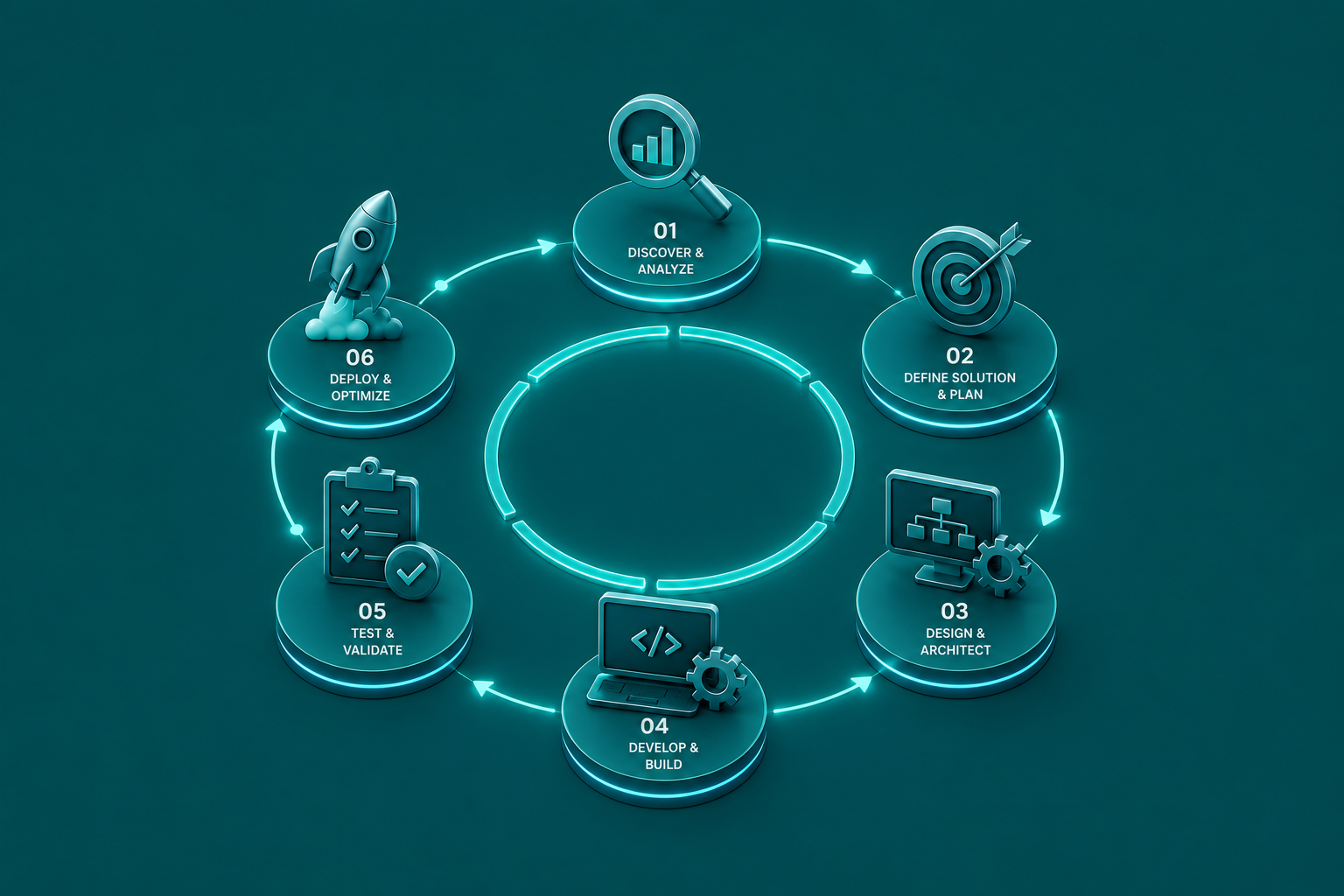
Our Development Process

We follow a structured, transparent lifecycle to take intelligent solutions from concept to production with minimal risk and maximum business alignment.

1

Discovery & Opportunity Mapping

We audit your existing workflows, data assets, and pain points to identify where AI delivers the highest, fastest ROI rather than chasing AI for its own sake.

2

Data Readiness Assessment

We evaluate data quality, completeness, and accessibility, since model performance is bounded by the quality of the underlying data.

3

Solution Architecture Design

We design the technical blueprint, selecting the right combination of ML models, LLMs, automation frameworks, and integration points.

4

Proof of Concept (POC) Development

A scoped, working prototype validates the approach against real data before full-scale investment.

5

Model Development & Training

Our data scientists build, train, and validate models using rigorous cross-validation and bias-testing methodologies.

6

System Integration

The intelligent solution is integrated into your existing CRM, ERP, data warehouse, or customer-facing applications via secure APIs.

7

Testing & Quality Assurance

Comprehensive testing covering functional accuracy, performance under load, security, and fairness/bias auditing.

8

Deployment & Change Management

We deploy to production using CI/CD pipelines and support your internal teams through training and adoption planning.

9

Continuous Monitoring & Optimization

Post-launch, we monitor model performance, retrain on new data, and iterate based on real-world outcomes.

Direct Answer: How long does it take to build an intelligent solution?

Most enterprise intelligent solutions move from discovery to a working proof of concept within four to eight weeks, with full production deployment typically completed within three to six months depending on data readiness, integration complexity, and regulatory requirements.

Our Development Process Image

Why Choose Our Company

Choosing the right AI development partner is one of the highest-leverage decisions a business leader will make this year. Here is what sets us apart:

Outcome-first engineering

We do not build AI for the sake of AI. Every engagement starts with a clear definition of the business metric the solution must move.

Cross-industry expertise

Our team has shipped intelligent solutions across BFSI, healthcare, retail, manufacturing, and SaaS, giving us pattern recognition that accelerates your timeline.

Full-stack AI capability

From data engineering and MLOps to generative AI and front-end experience design, we own the entire stack rather than handing off between vendors.

Transparent, governed AI

We build explainability and audit trails into every model, which matters enormously for regulated industries and enterprise risk teams.

Global delivery standards

Our teams in Chennai, Bangalore, and Hyderabad combine deep technical talent with cost-efficient delivery, serving clients globally.

Post-launch partnership

We do not disappear after go-live. Continuous model monitoring, retraining, and optimization are built into our engagement model.

Security and compliance

Our architecture aligns with data protection regulations including India's Digital Personal Data Protection Act, GDPR, HIPAA and PCI-DSS.

Case Study / Example Use Case

Industry: Mid-sized retail and e-commerce enterprise

Challenge:

A growing omnichannel retailer was relying on manual demand forecasting spreadsheets, leading to chronic overstocking in slow-moving categories and stockouts in high-demand SKUs during peak seasons. Customer support was also overwhelmed by repetitive order-status queries.

Intelligent Solution Deployed:

  • A demand forecasting engine combining historical sales data, seasonality patterns, promotional calendars, and external signals (weather, regional events) to generate SKU-level demand predictions.
  • An intelligent customer support assistant capable of handling order tracking, returns initiation, and product queries in natural language, escalating only complex cases to human agents.
  • A dynamic inventory rebalancing recommendation system that suggested optimal stock transfers between warehouses in near real time.

Outcome:

Within the first two quarters of deployment, the retailer reduced stockout incidents significantly during peak sales periods, cut excess inventory holding costs, and automated a large majority of routine customer support interactions — freeing the human support team to focus on high-value, complex resolution cases. Forecasting accuracy improved measurably compared to the previous spreadsheet-based approach, and the customer support team reported faster average resolution times.

This pattern — combining predictive analytics with conversational AI and automated decisioning — is one of the most common and highest-ROI intelligent solution deployments we build for retail, distribution, and logistics clients.

Retail Inventory Analytics Case Study

ROI & Business Impact

Quantifying ROI is central to how we scope every intelligent solution engagement. We typically evaluate impact across these dimensions:

  • Cost Reduction: Automation of manual, repetitive cognitive tasks (document review, data entry, first-line customer support, reconciliation) directly reduces labor cost per transaction.
  • Revenue Growth: Personalization engines, intelligent upsell/cross-sell recommendations, and dynamic pricing models directly increase average order value and conversion rates.
  • Risk Mitigation: Fraud detection, anomaly monitoring, and compliance automation reduce financial exposure and regulatory penalty risk, which can otherwise represent significant unbudgeted cost.
  • Speed-to-Market: Reusable AI components and modular architecture mean subsequent AI features can be shipped faster, compounding the ROI of the initial investment.

Industry research consistently shows that organizations with mature AI adoption report meaningfully higher revenue growth and operating margin improvement compared to organizations still in early-stage AI experimentation, reinforcing why a structured, expert-led implementation — rather than ad hoc internal pilots — produces stronger financial outcomes.

ROI DriverMechanismTypical Timeframe to Realize Value
Process AutomationReduced manual labor hours1-3 months post-deployment
Predictive ForecastingReduced inventory/resource waste1 sales/operations cycle
Personalization EnginesHigher conversion and retention2-4 months
Fraud/Anomaly DetectionReduced loss exposureImmediate upon deployment
Conversational AIReduced support cost per ticket1-2 months
ROI & Business Impact Image

Challenges & Solutions

Challenge: Poor or Fragmented Data Quality

Implementing intelligent solutions is not without obstacles.

OUR SOLUTION

We conduct a structured data readiness audit before any model development begins, and build data pipelines that clean, standardize, and unify data from disparate systems.

Challenge: Lack of Internal AI Expertise

Implementing intelligent solutions is not without obstacles.

OUR SOLUTION

We embed knowledge transfer and documentation into every engagement, and offer ongoing managed services so internal teams are never left maintaining a system they do not fully understand.

Challenge: Integration with Legacy Systems

Implementing intelligent solutions is not without obstacles.

OUR SOLUTION

Our API-first, composable architecture is specifically designed to wrap around legacy ERPs, CRMs, and on-premise systems without requiring a full replatform.

Challenge: Model Bias and Fairness Concerns

Implementing intelligent solutions is not without obstacles.

OUR SOLUTION

We run systematic bias audits across protected attributes during model validation and implement explainability tooling so stakeholders can scrutinize decision logic.

Challenge: Organizational Resistance to Change

Implementing intelligent solutions is not without obstacles.

OUR SOLUTION

We involve business stakeholders from the discovery phase onward and design human-in-the-loop controls so teams retain agency and trust in the system.

Challenge: Uncertain or Unclear ROI

Implementing intelligent solutions is not without obstacles.

OUR SOLUTION

Every engagement begins with explicit, measurable success metrics agreed upon before development starts, ensuring ROI can be tracked objectively rather than assumed.

Frequently Asked Questions

1. What exactly is an intelligent solution in business terms?

An intelligent solution is an AI-powered system that analyzes data, learns from patterns, and makes or recommends decisions automatically, reducing the need for manual analysis and intervention in business processes.

2. How is an intelligent solution different from traditional automation (RPA)?

Traditional robotic process automation (RPA) follows fixed, rule-based scripts and cannot handle exceptions outside its programming. Intelligent solutions use machine learning to adapt to new patterns, handle ambiguity, and improve accuracy over time without manual rule rewrites.

3. Do I need a large dataset to build an intelligent solution?

Not necessarily. While more data generally improves model accuracy, techniques like transfer learning, pre-trained large language models, and synthetic data generation make it possible to build effective intelligent solutions even with moderate data volumes.

4. How much does it cost to build an intelligent solution?

Cost depends on scope, data complexity, and integration requirements. A focused proof of concept can often be delivered cost-effectively within weeks, while a full enterprise-grade deployment is a larger investment scoped during the discovery phase based on your specific requirements.

5. Is my company’s data safe when using AI solutions?

Yes, when built correctly. We implement encryption at rest and in transit, role-based access controls, and compliance alignment with frameworks like India’s Digital Personal Data Protection Act and GDPR to ensure your data remains secure and your usage rights are respected.

6. Can intelligent solutions integrate with our existing software like SAP or Salesforce?

Yes. Our intelligent solutions are built with an API-first architecture specifically designed to integrate with existing ERP, CRM, and legacy systems without requiring a full system replacement.

7. What industries benefit most from intelligent solutions?

While nearly every industry benefits, banking and financial services, healthcare, retail, manufacturing, and logistics tend to see the fastest and most measurable ROI due to high data volumes and repetitive, data-intensive decision processes.

8. How do you ensure AI models are accurate and unbiased?

We use rigorous cross-validation, holdout testing, and systematic bias audits across model outputs, combined with explainability tooling so stakeholders can review and validate decision logic before and after deployment.

9. What happens after the intelligent solution is deployed?

We provide continuous monitoring, performance tracking, and periodic retraining to ensure the model’s accuracy does not degrade as real-world data patterns evolve, along with optional managed support plans.

10. Can intelligent solutions work for small and mid-sized businesses, not just large enterprises?

Yes. We design scoped, modular intelligent solutions that allow mid-sized businesses to start with a focused, high-ROI use case and expand incrementally as value is demonstrated.

11. How do generative AI and intelligent solutions relate to each other?

Generative AI, including large language models, is one of several technologies that power intelligent solutions — particularly for natural language understanding, content generation, and conversational interfaces — alongside predictive machine learning and automation frameworks.

12. How long does it take to see ROI from an intelligent solution?

Many of our clients begin seeing measurable operational impact within the first one to three months after deployment, particularly for automation-focused use cases, with compounding returns as models mature and additional use cases are added.

13. Do you provide AI solutions for companies based in Chennai, Bangalore, Hyderabad, and Mumbai?

Yes. We actively serve enterprise and mid-market clients across Chennai, Bangalore, Hyderabad, Mumbai, and pan-India, in addition to international clients, combining local market understanding with global engineering standards.

14. What is the difference between an AI consulting engagement and a full intelligent solution build?

AI consulting focuses on strategy, opportunity assessment, and roadmap development, while a full intelligent solution build includes end-to-end design, development, integration, deployment, and ongoing optimization of the actual production system.

15. How do you measure the success of an intelligent solution after launch?

Success is measured against the specific business metrics defined during the discovery phase — such as cost per transaction, forecast accuracy, conversion rate, or fraud detection rate — tracked through dashboards we build into the solution itself.

Ready to turn your data into your most valuable decision-making asset?

Stop experimenting with prototypes and start deploying production-ready AI software. Book a 60-minute strategy session with our senior AI architects. We will assess your data, identify high-ROI use cases, and map out a technical blueprint for your organization.

Schedule Your Free Session Now
InfiniteTech AI Footer
Scroll to Top