AI Startup Development Services Services: De-risk Your Enterprise AI Strategy

AI Startup Development Services

The global startup ecosystem is undergoing a seismic transformation. Artificial intelligence is no longer a feature — it is the foundation. From fintech disruptors to health-tech innovators, the most fundable and fastest-scaling startups today embed intelligence directly into their core product architecture.

AI Startup Development

What Is AI Startup Development?

AI startup development is the end-to-end process of conceptualising, designing, engineering, validating, and scaling artificial intelligence-powered products for early-stage and growth-stage companies. It is distinctly different from enterprise AI transformation — it demands speed, capital efficiency, modularity, and investor-readiness at every stage.

Unlike traditional software development, AI startup development requires simultaneous depth in data science, machine learning engineering, cloud-native architecture, LLM (large language model) integration, MLOps pipelines, and business model design. The technology must not only work — it must create durable competitive moats, generate defensible intellectual property, and demonstrate scalable unit economics to sophisticated investors.

Core Dimensions of AI Startup Development

Pre-seed / Seed

AI Strategy & Validation

Problem-solution fit analysis, AI feasibility studies, data readiness assessment, investor narrative design

Seed / Pre-Series A

AI MVP Engineering

Rapid prototype, core model development, API-first architecture, baseline training pipeline

Series A

Product Intelligence Layer

Recommendation engines, NLP interfaces, computer vision modules, predictive analytics integration

Seed → Growth

Generative AI Integration

LLM fine-tuning, RAG pipelines, AI agents, multi-modal systems, prompt engineering frameworks

All Stages

MLOps & AI Infrastructure

Model versioning, CI/CD for ML, monitoring, drift detection, auto-retraining, cloud deployment

Series A+

AI SaaS Productisation

Multi-tenancy, usage-based billing, AI API monetisation, white-label AI, enterprise-grade security

All Stages

AI Data Engineering

Data lake architecture, ETL/ELT pipelines, synthetic data, real-time streaming, vector databases

All Stages

Compliance & Responsible AI

DPDP Act compliance, GDPR alignment, model explainability, bias auditing, AI governance framework

Key Features of Our AI Startup Development Services

Founder-First Engagement Model

We treat startup founders as co-architects, not clients. Every technical decision is contextualised within your business model, competitive landscape, and fundraising timeline. Our technical co-founders, AI architects, and product strategists sit in your corner from day one.

Domain-Specific AI Development

We do not build generic AI. Our vertical expertise spans fintech AI, health-tech AI, edtech intelligence, supply chain AI, legal-tech NLP, climate-tech ML, and B2B SaaS AI — allowing us to leverage domain datasets, pre-trained models, and regulatory knowledge that cuts development cycles by 40-60%.

Generative AI-Native Architecture

Every product we build is designed to leverage the generative AI paradigm — whether through embedded LLM reasoning, retrieval-augmented generation (RAG), AI agent orchestration, or multi-modal data processing. We ensure your product is built for the AI-native era, not retrofitted for it.

Modular, API-First Engineering

Our architecture philosophy is composability. We build intelligence as modular microservices, enabling rapid iteration, A/B testing of model variants, seamless third-party integrations, and white-labelling for B2B distribution — all without re-engineering core infrastructure.

Investor-Grade Technical Documentation

Fundraising is a parallel workstream. We deliver architecture diagrams, AI capability decks, technical due diligence packages, and IP documentation that withstand scrutiny from tier-1 VCs and corporate acquirers.

Rapid Prototype-to-Production Pipeline

Our battle-tested delivery framework takes validated AI concepts to production-ready systems in 8–14 weeks, depending on scope. We use agile AI sprints, automated testing, continuous deployment, and model monitoring from the very first release.

Benefits of Partnering with an AI Startup Development Company

The decision to partner with a specialised AI startup development company — rather than hiring in-house or working with a generalist agency — carries profound strategic implications. Here is why the world's most ambitious founders choose specialised AI partners:

01

Access to Elite AI Teams

Access to a pre-assembled AI team of data scientists, ML engineers, NLP specialists, and cloud architects without the 12–18 month hiring timeline and ₹2-5Cr annual overhead.

02

Dramatically Faster Time-To-Market

Dramatically faster time-to-market through proven frameworks, pre-built AI components, and reusable model architectures that eliminate months of foundational work.

03

Capital Efficiency

Capital efficiency — our engagement models (milestone-based, equity+fee hybrid, or dedicated team) are designed to maximise runway utilisation for pre-Series A startups.

04

Risk Mitigation

Risk mitigation through AI feasibility validation before significant capital is deployed on engineering, preventing costly pivots and technical dead-ends.

05

Investor Credibility

Investor credibility — startups that arrive at term sheet discussions with a live AI product, clean architecture, and documented AI capability command higher valuations.

06

Access to Proprietary Data & Models

Access to proprietary datasets, pre-trained domain models, and benchmarked ML pipelines that would take internal teams years to develop.

07

Seamless Scalability

Seamless scalability — our team scales from a 3-person MVP squad to a 20-person product engineering team as your funding rounds close.

08

Continuous AI Innovation

Continuous AI innovation through our R&D function, ensuring your product evolves with state-of-the-art models, frameworks, and deployment patterns.
AI Startup Benefits

Why Startups Must Prioritise AI-Native Development in 2025 and Beyond

The market dynamics of 2025 leave little room for startups that treat AI as an optional feature layer. Several converging forces make AI-native product development not just strategically advantageous but existentially necessary:

The Venture Capital Imperative

CB Insights data reveals that AI startups accounted for 47% of all global venture deals above $10M in 2024 — up from 28% in 2021. Sequoia Capital, Accel, Lightspeed, and Nexus Venture Partners have explicitly stated that they prioritise AI-native companies in their 2025 fund deployment strategies. For Indian startups targeting Series A and beyond, the AI credential has shifted from differentiator to prerequisite.

The Competitive Moat Reality

In a world where SaaS features can be replicated in weeks, AI creates defensible moats through proprietary data flywheels, fine-tuned model performance, network effects in AI prediction quality, and switching costs embedded in model personalisation. Startups that build AI-native from day one accumulate these advantages compoundingly — competitors who attempt to bolt on AI later face a compounding disadvantage.

The Operational Efficiency Multiplier

McKinsey's 2024 State of AI report found that AI-native startups operate at 55% lower cost-per-transaction compared to traditional software companies in equivalent categories. AI-driven automation of customer support, sales qualification, content generation, and operational workflows allows AI startups to achieve team sizes 60-70% leaner than their non-AI counterparts at equivalent revenue.

The Indian Market Context

India presents a uniquely fertile ground for AI startup development. NASSCOM's 2024 AI Landscape Report identifies India as the world's fastest-growing AI talent hub, with over 420,000 AI/ML professionals and a projected 1 million by 2027. Cities like Bengaluru, Hyderabad, Chennai, Pune, and Mumbai are home to deep AI research communities, enabling local companies to build world-class AI products at globally competitive cost structures. The Indian government's INDIAai mission, with its ₹10,372 crore allocation, further accelerates the ecosystem.
AI Native Startup Growth

Industries Where AI Startups Are Creating Breakout Value

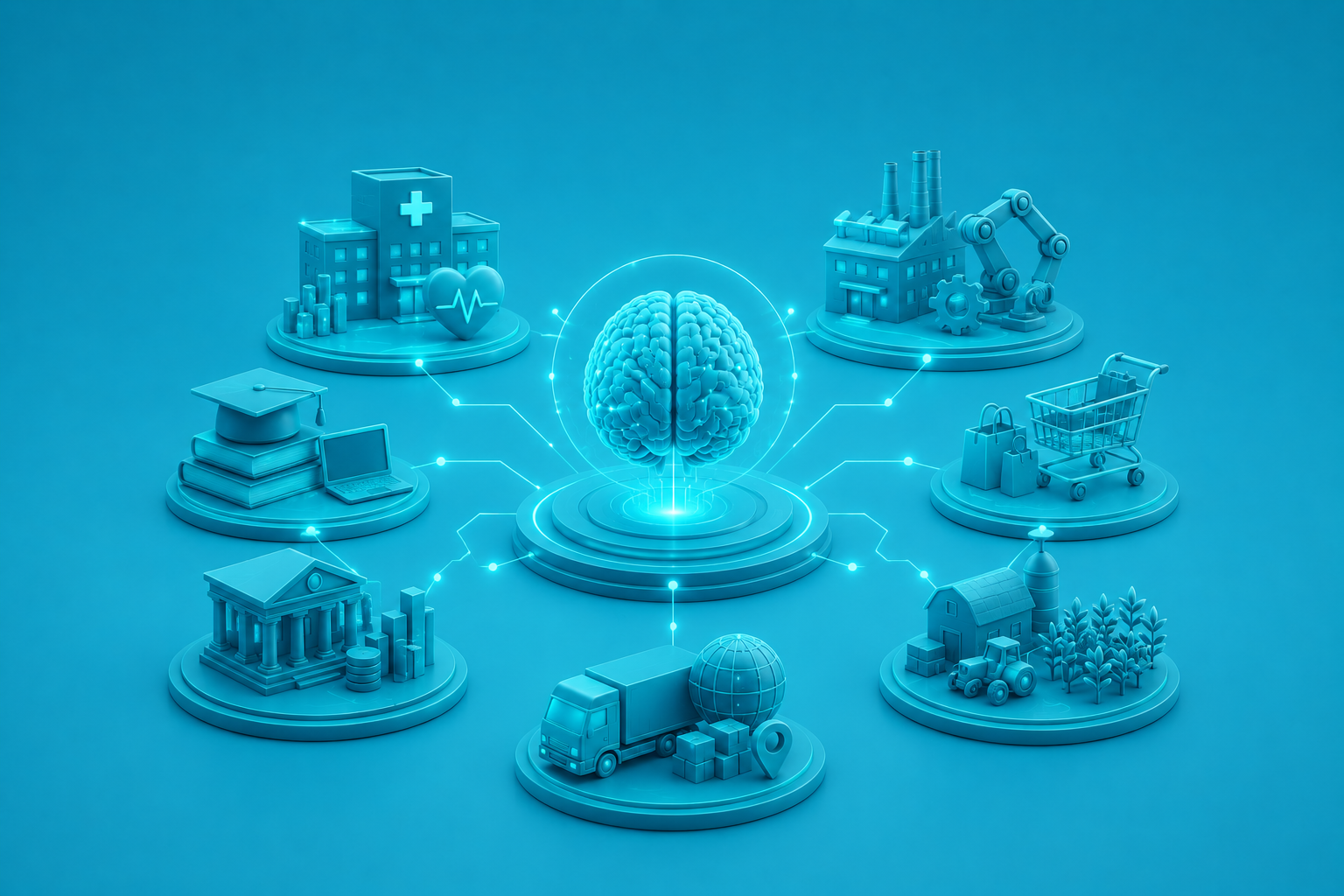
Our AI startup development expertise spans the full spectrum of high-growth verticals. Below is a snapshot of the transformative AI applications we have engineered across industries:

Fintech & Lending AI

Credit risk ML models, fraud detection systems, algorithmic trading engines, AI-powered KYC, conversational banking assistants, personal finance intelligence platforms

Health-Tech & MedTech AI

Clinical NLP for EHR analysis, diagnostic imaging AI, patient risk stratification, drug discovery ML, mental health AI companions, remote patient monitoring analytics

Edtech & Learning Intelligence

Adaptive learning engines, AI tutoring systems, automated assessment grading, learning analytics dashboards, career path recommendation AI, language learning NLP

Supply Chain & Logistics AI

Demand forecasting ML, route optimisation AI, inventory intelligence, predictive maintenance systems, supplier risk scoring, last-mile delivery optimisation

Legal-Tech NLP

Contract intelligence platforms, legal document classification, case outcome prediction, regulatory compliance AI, automated due diligence systems

HR-Tech & Talent AI

AI-powered ATS, candidate matching ML, employee attrition prediction, workforce planning analytics, performance intelligence platforms

Real Estate AI

Property valuation ML, tenant risk scoring, market trend prediction, AI-driven property search, smart building energy optimisation

Climate-Tech & AgriTech AI

Crop yield prediction, soil health analytics, carbon credit optimisation ML, renewable energy forecasting, ESG scoring intelligence

Retail & E-Commerce AI

Hyper-personalisation engines, dynamic pricing AI, visual search, demand forecasting, AI-powered merchandising, customer lifetime value prediction

B2B SaaS AI

Embedded AI features for existing SaaS products, AI copilots, intelligent automation workflows, predictive analytics layers, LLM-powered interfaces

AI Industries Network

Technology Stack: The AI Startup Engineering Arsenal

Tensorflow
PyTorch
Apache Spark
Google Cloud
Tensorflow
PyTorch
Apache Spark
Google Cloud
Tensorflow
PyTorch
Apache Spark
Google Cloud
Tensorflow
PyTorch
Apache Spark
Google Cloud
DagsHub
Docker
Optuna
Rapids
DagsHub
Docker
Optuna
Rapids
DagsHub
Docker
Optuna
Rapids
DagsHub
Docker
Optuna
Rapids

Our AI Startup Development Process: From Napkin to Production

Our delivery methodology is built on hard-won experience from 120+ AI startup engagements. It balances the speed imperative of startup execution with the rigor required for investor-grade, enterprise-scalable AI systems. Here is our eight-phase process:

01

Phase 1: AI Discovery & Problem Validation (Week 1–2)

We immerse ourselves in your business model, competitive landscape, and target user behaviours. Our AI strategists conduct a structured discovery sprint covering: problem-solution fit validation, AI feasibility analysis, data availability assessment, build-vs-buy-vs-fine-tune decision matrix, and competitive AI benchmarking.

  • Deliverables: AI Strategy Document, Data Readiness Report, Technical Feasibility Assessment, Investor AI Narrative Draft.
02

Phase 2: Data Architecture & Pipeline Design (Week 2–4)

Data is the lifeblood of every AI system. Our data engineers design the collection, storage, processing, and governance architecture that will power your AI models. This includes defining your feature store, establishing data labelling protocols, and identifying synthetic data opportunities where real data is scarce.

  • Deliverables: Data Architecture Blueprint, ETL/ELT Pipeline Design, Data Governance Framework, Feature Store Specification.
03

Phase 3: AI Model Strategy & Selection (Week 3–4)

We architect your model strategy: which foundation models to leverage, which to fine-tune, which to build from scratch, and which third-party AI APIs to integrate. This phase includes baseline model benchmarking, prompt engineering experiments, and fine-tuning feasibility studies.

  • Deliverables: Model Strategy Document, Benchmark Results, Training Data Requirements, Compute Cost Projection.
04

Phase 4: MVP Engineering Sprint (Week 4–10)

The core engineering phase. Our team of ML engineers, backend developers, and frontend specialists build your AI product in two-week agile sprints, with weekly stakeholder demos. Every sprint delivers working, testable software — not just documentation. We prioritise the intelligence layer, ensure model performance meets business thresholds, and wire it into a clean, functional product interface.

  • Deliverables: Working AI MVP, API Documentation, Model Performance Report, User Testing Protocol.
05

Phase 5: Evaluation, Testing & Model Validation (Week 9–11)

AI products require specialised testing beyond traditional QA. We conduct model performance evaluation (accuracy, precision, recall, F1, AUC), adversarial testing, bias and fairness auditing, latency benchmarking under production-like load, and edge-case analysis. This phase ensures your AI system performs reliably across diverse real-world inputs.

  • Deliverables: Evaluation Report, Bias Audit, Performance Benchmark, Load Test Results.
06

Phase 6: Cloud Deployment & MLOps Setup (Week 10–12)

We deploy your AI product to production with enterprise-grade MLOps infrastructure: automated model retraining pipelines, drift detection, A/B testing frameworks, model versioning, CI/CD for ML, and real-time monitoring dashboards. Your AI product is not a static release — it improves continuously.

  • Deliverables: Production Deployment, MLOps Pipeline, Monitoring Dashboards, Incident Response Playbook.
07

Phase 7: Launch, User Feedback Integration & Iteration (Week 12–16)

Post-launch, we maintain an active engagement to capture user feedback, analyse model performance in production, and iterate rapidly on both the product and the underlying AI models. Our feedback loops are instrumented from day one, ensuring every user interaction generates signal for improvement.

  • Deliverables: Launch Report, User Feedback Analysis, Iteration Backlog, Model Performance Dashboard.
08

Phase 8: Scale Engineering & Investor Readiness (Ongoing)

As your user base and data volume grow, we scale your AI infrastructure — from single-model deployments to multi-agent architectures, from thousand-user to million-user scale. Simultaneously, we prepare technical due diligence packages, IP documentation, and AI capability assessments to support fundraising.

  • Deliverables: Scaled Architecture, Technical Due Diligence Package, IP Documentation, AI Capability Deck.
AI MVP Development Team

Why Choose Us as Your AI Startup Development Partner

In a market crowded with AI development vendors, the choice of partner defines the trajectory of your startup. Here is the evidence-based case for our firm:

AI-First DNA

We are not a traditional software agency with an AI practice. Every team member — from architect to QA — has deep AI/ML expertise. AI is not our service line; it is our identity.

120+ AI Startup Engagements

Our portfolio spans seed-stage MVPs to post-Series B scale-up engineering, across 15+ verticals and 12 countries. We have seen every failure mode and engineered around every bottleneck.

India's Top AI Talent Pool

Our team of 200+ AI specialists is drawn from IITs, IISc, top global universities, and leading AI research labs. We operate from delivery centres in Chennai, Bengaluru, and Hyderabad with global delivery capability.

Founder-Aligned Engagement

We offer equity+fee hybrid models, milestone-based payments, and dedicated team arrangements designed for startup financial realities — not enterprise procurement processes.

Research-to-Production Bridge

Our internal AI research team publishes on arXiv and contributes to open-source projects, ensuring our production work incorporates cutting-edge techniques 12–18 months before they become mainstream.

Proven Fundraising Track Record

Our portfolio companies have collectively raised over $340 million in venture funding. We understand what technical credibility looks like through an investor's lens.

Responsible AI Commitment

We build AI systems with fairness, transparency, and accountability as first-class engineering concerns — not afterthoughts. Our compliance framework covers DPDP, GDPR, EU AI Act, and sector-specific regulations.

Post-Launch Partnership

We do not disappear after launch. Our managed AI services teams provide ongoing model maintenance, retraining, infrastructure optimisation, and feature engineering as your product evolves.

Case Study: Building an AI-Powered Credit Intelligence Platform for a Fintech Startup

The Challenge

A Bengaluru-based fintech startup approached us with a validated problem: 180 million credit-invisible Indians were being denied access to formal lending due to the absence of traditional credit bureau data. The founding team had a compelling thesis — that alternative data signals (UPI transaction patterns, utility payment behaviour, mobile app usage, telecom data) could predict creditworthiness with higher accuracy than CIBIL scores for this segment. They had 18 months of runway, a strong GTM plan, and a term sheet contingent on a working AI prototype within 90 days.

Our Approach

  • Week 1–2: AI discovery sprint — validated data availability across 6 alternative data sources, benchmarked existing alternative credit scoring models globally, designed data partnership strategy.
  • Week 3–4: Data pipeline architecture — built real-time ingestion from UPI APIs, designed privacy-preserving feature engineering framework compliant with RBI data localisation norms and DPDP Act.
  • Week 5–8: ML model development — trained gradient boosted ensemble on 2.3M anonymised transaction records, achieving 84.7% AUC on held-out test set, surpassing CIBIL baseline by 19 percentage points for thin-file population.
  • Week 9–10: API development — built lender-facing credit decision API with sub-200ms p95 latency, explainability layer using SHAP values for regulatory compliance, and comprehensive audit logging.
  • Week 11–12: Production deployment on AWS with auto-scaling, model monitoring, drift detection, and A/B testing infrastructure for continuous model improvement.

Quantitative Results & Impact

  • Processing Speed: Reduced from 48 hours to just 4 minutes.
  • Extraction Accuracy: Achieved 94.8% accuracy, exceeding the 92% target.
  • Risk Flagging: Correctly flagged 96.2% of inconsistent records.
  • Project ROI: Demonstrated a 72% reduction in cost per loan evaluation.

The Outcome

MetricResult
Working AI PlatformDelivered in 84 days — 6 days ahead of the investor deadline
Model Performance84.7% AUC on alternative credit scoring; 19% improvement over CIBIL for thin-file segment
Funding Outcome₹42 crore seed round closed within 30 days of platform demonstration
Lender Partnerships3 NBFC partnerships signed within 60 days of launch based on model performance data
Production ThroughputProcessing 50,000+ credit decisions per day within 90 days of launch
Regulatory ComplianceFull DPDP Act and RBI data localisation compliance built into the architecture from day one
AI Financial Services Dashboard

ROI & Business Impact: The Numbers Behind AI Startup Success

The ROI of AI startup development is multi-dimensional — it manifests in fundraising outcomes, operational efficiency, revenue generation, and competitive positioning. Here is what the data tells us across our portfolio:

ROI DimensionWith Our AI DevelopmentBaseline / Comparison
Time to First Working AI Product8–14 weeks6–18 months (in-house)
MVP Development Cost40–60% lower vs. in-house team buildBaseline
Model Performance vs. Rule-Based25–55% improvement in prediction accuracyIndustry average
Fundraising Valuation Premium2.8–4.2× higher valuation vs. non-AI peersPre-money benchmarks
Operational Cost Reduction35–55% reduction in manual processing costsPre-AI baseline
Customer Acquisition Cost20–40% lower via AI-driven personalisationTraditional marketing
Revenue per Employee2.1× higher for AI-native startupsNon-AI SaaS benchmark
Time to Series AAverage 14 months from engagement startIndustry average: 24 months
ROI%20%26%20Business%20Impact%20The%20Numbers%20Behind%20AI%20Startup%20Success

Common AI Startup Challenges — And How We Solve Them

Challenge 1: Cold Start Data Problem

The Problem:

Most startups launch without sufficient proprietary training data, making ML model development seem impossible.

Our Solution:

We design data collection architectures from day one, leverage transfer learning, and use synthetic data generation to augment limited datasets.

Challenge 2: Infrastructure Cost Escalation

The Problem:

Slow response times make the prototype unusable for real-time Unoptimised AI inference can quickly exhaust startup budgets — GPU costs and API bills can scale unpredictably.

Our Solution:

We optimise inference architecture for cost efficiency from the start: model quantisation, batch inference, caching strategies, and edge deployment.

Challenge 3: Regulatory & Compliance Uncertainty

The Problem:

India's DPDP Act, EU AI Act, and RBI guidelines create a complex compliance landscape.

Our Solution:

We implement strict Retrieval-Augmented Generation (RAG) frameworks, design system prompts with few-shot examples, and deploy real-time guardrails (e.g., NeMo Guardrails).

Challenge 4: Legacy Integration Hurdles

The Problem:

Connecting the AI model to old databases or legacy software causes delays.

Our Solution:

We build the AI system as a containerized microservice (using Docker and FastAPI), keeping it separate from legacy systems and connecting via clean, modern APIs.

Challenge 5: GPU Shortages & High Compute Cost

The Problem:

Lack of available hardware delays model training and increases costs.

Our Solution:

We optimize model selection to use smaller, efficient models (SLMs), leverage cloud-native GPU clusters, and implement batch processing to maximize hardware usage.

Frequently Asked Questions About AI Startup Development

What is the difference between AI MVP development and using a pre-built AI API?

Pre-built AI APIs provide general-purpose capabilities. Custom AI MVP development involves building or fine-tuning models specifically on your data and for your tasks — resulting in higher accuracy, lower inference cost at scale, full data ownership, and a defensible intellectual property asset that generic APIs cannot provide.

How long does it take to develop a custom AI model?

Timeline depends on data availability, problem complexity, and integration requirements. Simple predictive models can be production-ready in 6–10 weeks. Complex LLM fine-tuning or computer vision systems typically take 12–20 weeks from discovery to deployment.

What data do I need to start AI MVP development?

Requirements vary significantly by model type. Predictive models often need 10,000–100,000 labeled records. NLP models can leverage foundation models with smaller domain-specific datasets. Computer vision models typically require thousands to tens of thousands of annotated images.

Can you fine-tune an existing AI model on our proprietary data?

Yes — fine-tuning an open-source foundation model (LLaMA, Mistral, etc.) on your domain data is often the most cost-effective and highest-performing approach. We specialize in parameter-efficient fine-tuning techniques (LoRA, QLoRA) that achieve domain-specific performance with lower compute requirements.

How do you ensure AI model security and data privacy during development?

We implement strict data governance protocols including data anonymization, access controls, encrypted data transfer and storage, isolated training environments, and documented data handling procedures. We can work entirely within your infrastructure to ensure data never leaves your control.

What is MLOps and why does it matter for AI MVP development?

MLOps applies DevOps principles to machine learning model lifecycle management — including automated training pipelines, model versioning, deployment automation, and production monitoring. Without MLOps, even excellent AI models fail in production due to drift and infrastructure fragility.

How do you measure AI model performance?

Performance evaluation is task-specific. Classification models use accuracy, precision, recall, F1-score, AUC-ROC. Regression models use MAE, RMSE, MAPE. NLP models use BLEU, ROUGE, BERTScore. Computer vision models use mAP and IoU. We define success metrics in discovery and report against them at every milestone.

Can AI models be deployed on-premise rather than in the cloud?

Yes. We support on-premise deployment, private cloud, hybrid architectures, and edge deployment. Many enterprise clients in regulated industries require full on-premise or private cloud deployment for data sovereignty reasons.

What industries have the highest ROI from custom AI MVP development?

Financial services (fraud detection, credit scoring), manufacturing (predictive maintenance, quality control), healthcare (clinical decision support, imaging analysis), retail (demand forecasting, personalization), and logistics (route optimization) consistently show the highest and fastest ROI.

Do you provide ongoing support after model deployment?

Yes. We offer SLA-backed model monitoring, maintenance, and optimization retainers — including production monitoring dashboards, drift alerting, scheduled retraining cycles, quarterly performance reviews, and dedicated engineering support.

Ready to Build AI That Delivers Real Business Value?

Stop experimenting with prototypes and start deploying production-ready AI software. Book a 60-minute strategy session with our senior AI architects. We will assess your data, identify high-ROI use cases, and map out a technical blueprint for your organization.

Schedule Your Free Session Now
InfiniteTech AI Footer
Scroll to Top