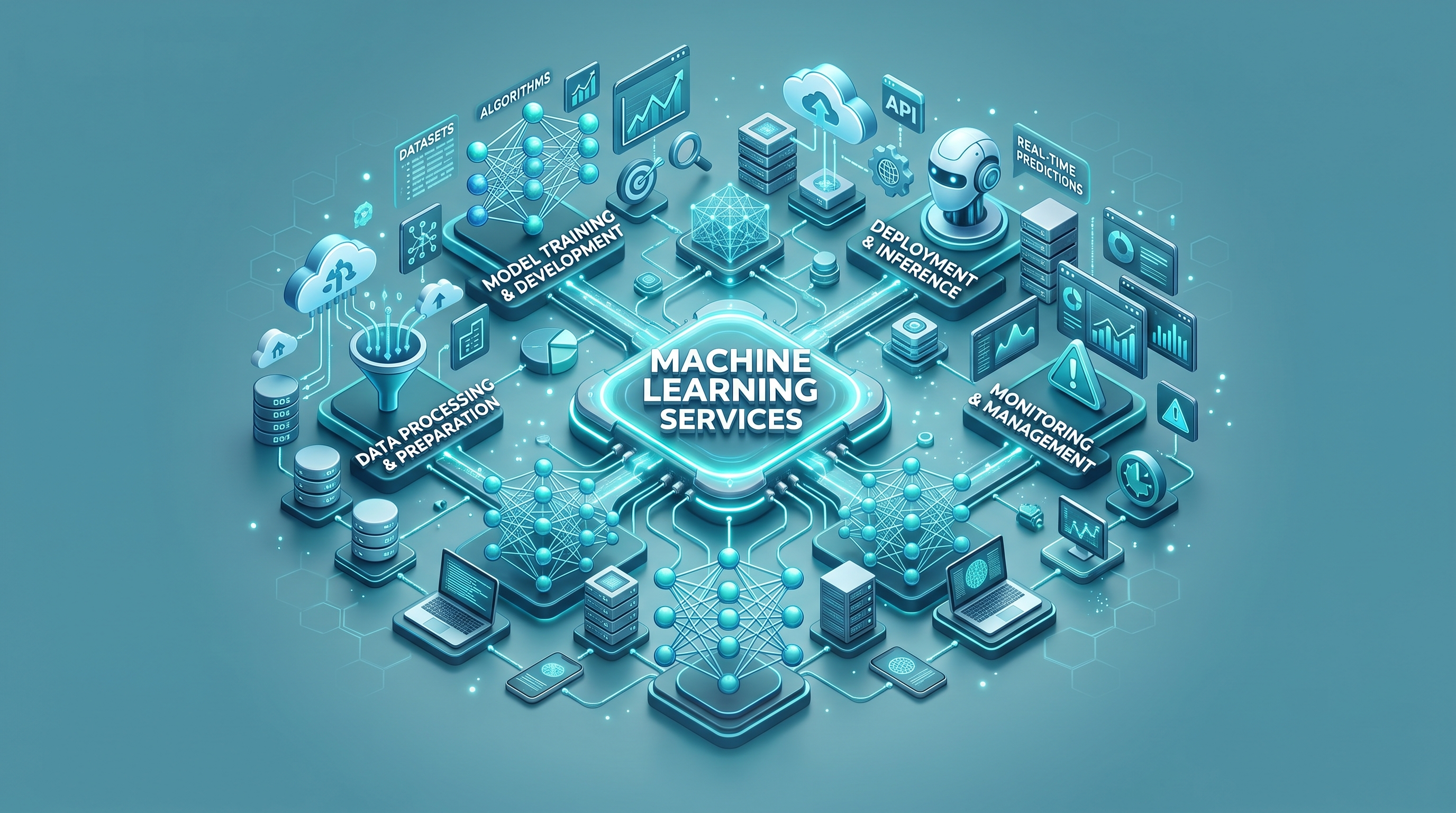
What Are Machine Learning Services?
Machine Learning Services refer to the full spectrum of professional services involved in designing, building, training, deploying, and maintaining machine learning systems for enterprise and commercial use. These are not off-the-shelf software products. They are custom-engineered AI systems built specifically around your data, your business context, and your performance objectives.
At their core, ML services encompass several interconnected disciplines:data engineering, feature engineering, algorithm selection,model training and validation,MLOpsinfrastructure, and production deployment. A mature machine learning service provider handles all of these layers cohesively — not just the glamorous 'model training' part, but the entire pipeline that gets intelligence from raw data to decision-making systems.
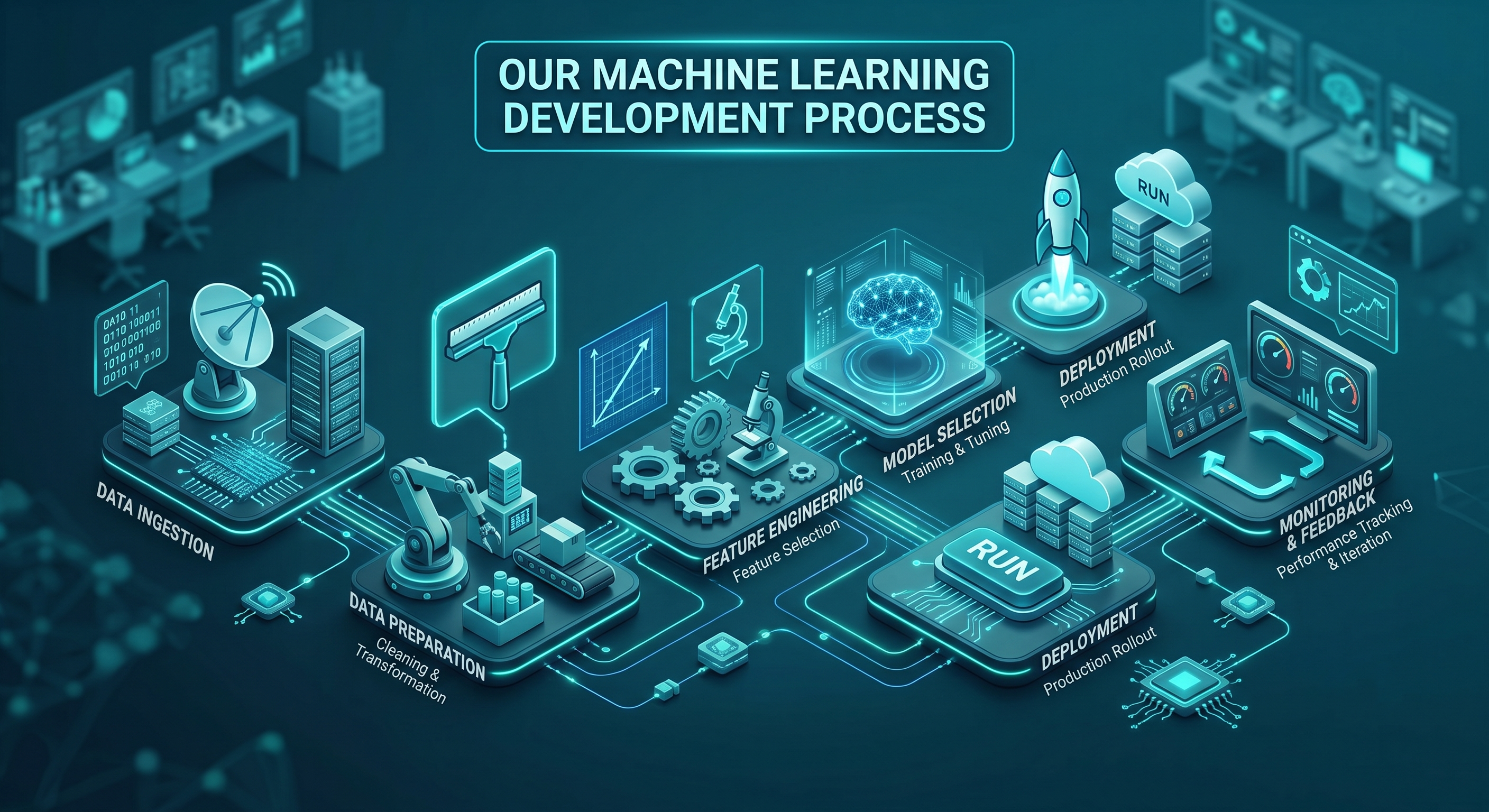
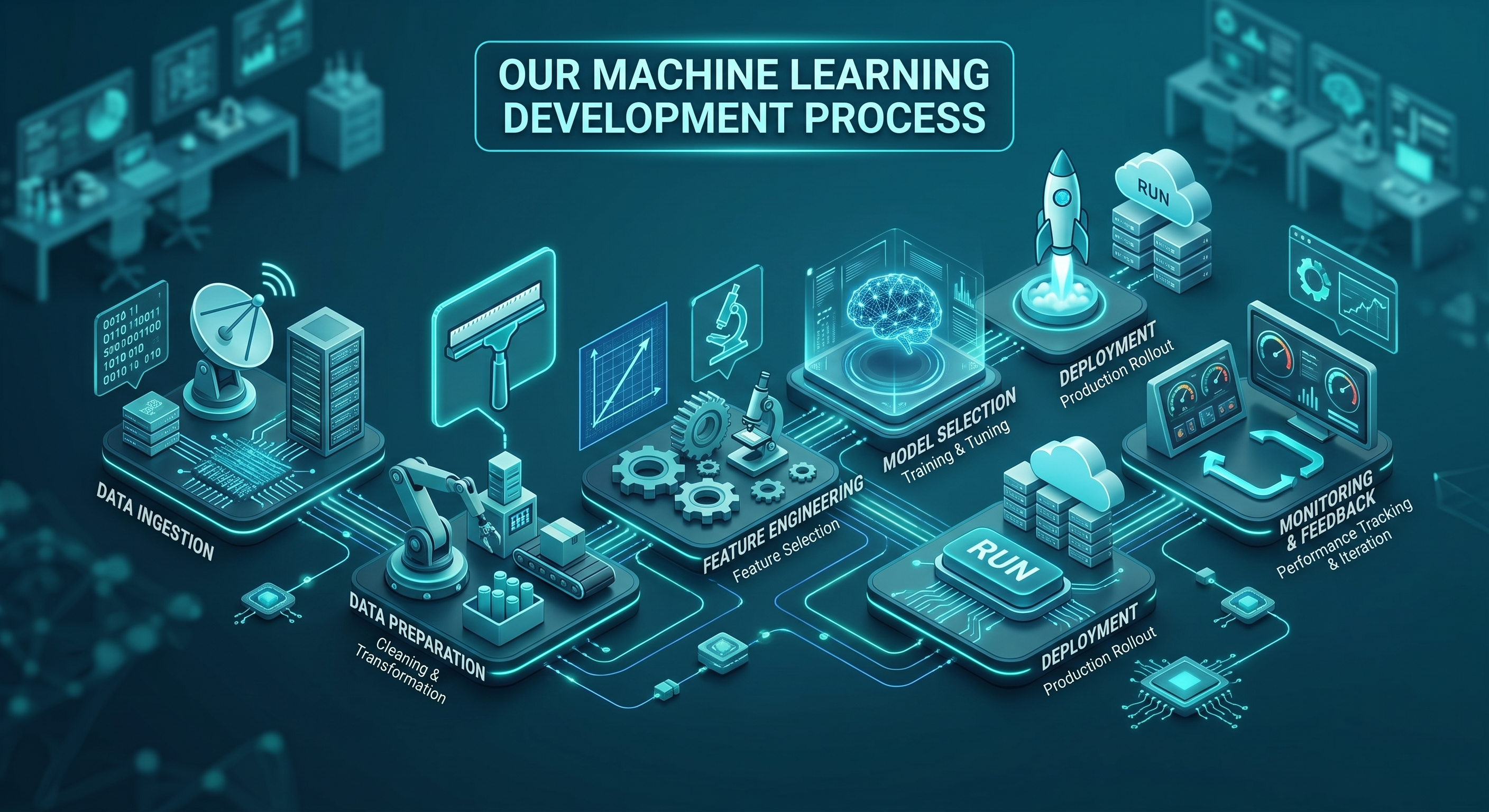
Understanding the machine learning value chain helps you evaluate what you are actually buying when you engage an ML services firm. Here is how value flows:
Raw Data Ingestion
structured, unstructured, streaming, and batch data is collected from source systems
Data Engineering
pipelines are built to clean, transform, enrich, and store data in ML-ready formats
Feature Engineering
meaningful signals are extracted from raw data that help models learn patterns
Model Development
algorithms are selected, trained, and evaluated against business-relevant metrics
Model Validation
rigorous testing ensures models generalize well to unseen data without overfitting
Deployment & Integration
models are packaged as APIs or microservices and integrated into production systems
Monitoring & Retraining
deployed models are monitored for drift and retrained as data distributions evolve
Key Features of Our Machine Learning Services
Not all ML service providers are created equal. Here is what distinguishes our machine learning services from generic data science consulting or basic ML project shops:
End-to-End Ownership
We take full ownership of the ML pipeline from data assessment to production deployment and beyond. You get a single accountable partner for the entire lifecycle — not a fragmented relationship between a data vendor, an ML consultant, and a DevOps team.
Business-First Model Design
Every model we build is optimized for a business metric, not just a technical benchmark. We align model objectives with revenue impact, cost reduction, or operational efficiency from day one. This discipline prevents the common problem of 'technically accurate but commercially useless' models.
Explainable AI (XAI) by Default
Enterprise stakeholders — regulators, executives, and end users — need to understand why an AI system made a particular decision. We implement SHAP values, LIME explanations, attention visualizations, and counterfactual analysis in every model we build, ensuring transparency and auditability that meet regulatory requirements in banking, insurance, healthcare, and other regulated industries.
Production-Ready Architecture
Our ML engineers do not hand you a Jupyter notebook and call it done. Every model is packaged as a production-grade microservice with REST or gRPC APIs, containerized with Docker, deployed on Kubernetes, and integrated with your existing data infrastructure. We build for reliability, scalability, and low-latency inference from the ground up.
Continuous Learning Pipelines
Models deployed in production degrade over time as the world changes. We implement automated drift detection, data quality monitoring, and retraining triggers that ensure your ML systems remain accurate and relevant — not just on day one, but months and years into deployment.
Multi-Cloud Flexibility
We are cloud-agnostic and platform-agnostic. We build ML solutions on AWS SageMaker, Google Cloud Vertex AI, Azure Machine Learning, and private cloud or on-premise infrastructure. You are never locked into a single vendor's ecosystem through our ML engagements.
Business Benefits of Machine Learning Services
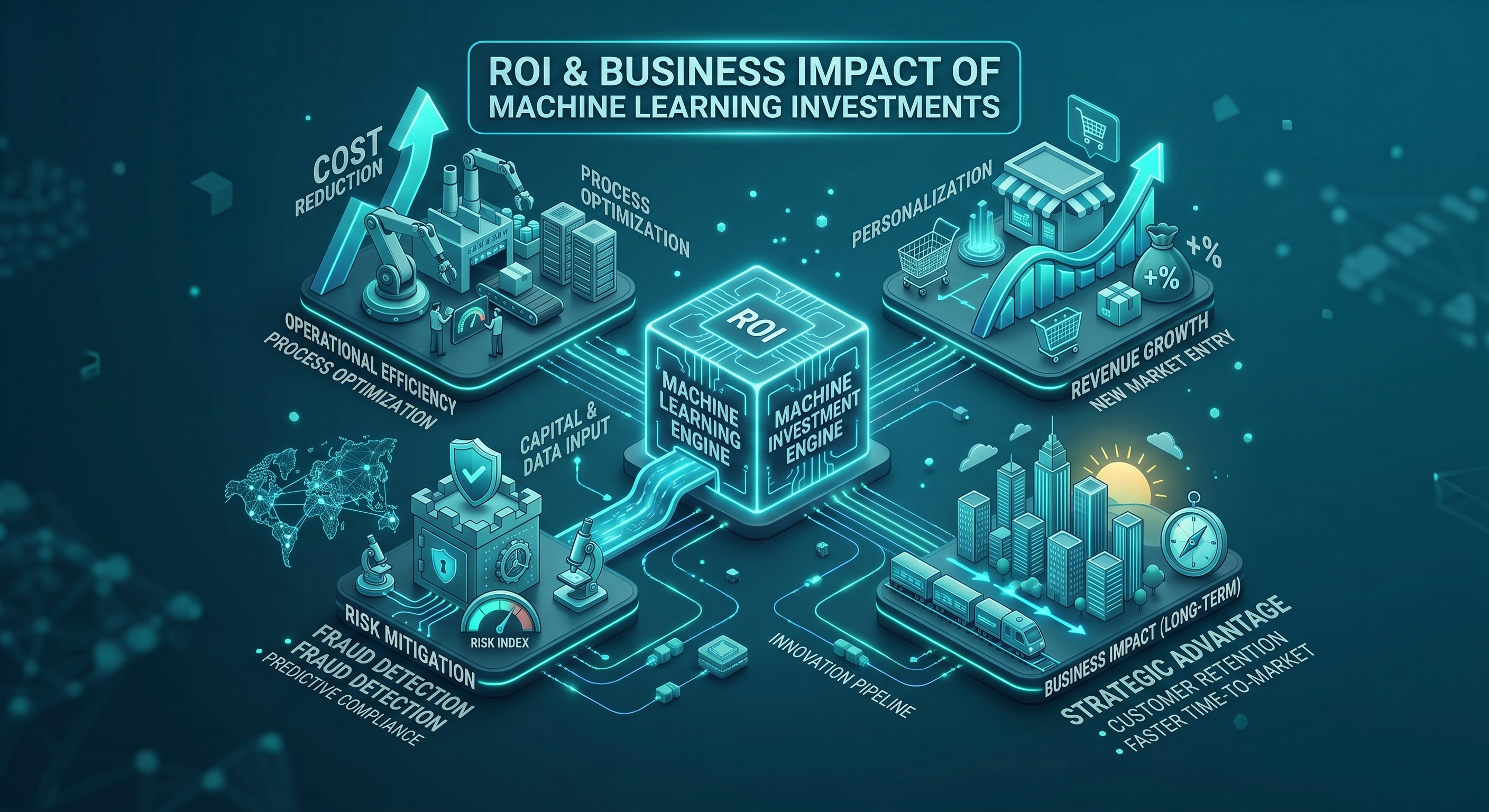
The return on investment from professionally implemented machine learning services is well-documented across industries. Here are the concrete benefits organizations realize:
Dramatic Cost Reduction Through Automation
Machine learning automates the cognitive labor that currently requires armies of analysts, reviewers, and decision-makers. A well-designed ML system can process thousands of insurance claims, loan applications, or support tickets per minute — at a fraction of the cost of human processing. Organizations implementing intelligent automation through ML report operational cost reductions of 30-60% in targeted workflows.
Superior Prediction Accuracy
Human judgment, while valuable, is subject to cognitive biases, fatigue, and information limitations. Machine learning models that are properly trained on comprehensive historical data consistently outperform human expert judgment on structured prediction tasks — whether forecasting sales, identifying at-risk patients, or predicting equipment failures.
Real-Time Decision Intelligence
In domains like fraud detection, dynamic pricing, or real-time personalization, decisions need to be made in milliseconds. Machine learning inference systems can evaluate thousands of features and return a prediction in under 50 milliseconds, enabling decision intelligence at speeds and scales that are humanly impossible.
Personalization at Scale
Machine learning enables every customer interaction to be personalized based on individual behavior, preferences, and context — across millions of customers simultaneously. This level of personalization, previously achievable only for VIP segments, drives measurable improvements in engagement, satisfaction, and lifetime value.
Proactive Risk Management
Predictive ML models identify risks before they materialize — whether that is a customer about to churn, a machine about to fail, a fraudulent transaction about to execute, or a safety incident about to occur. This shift from reactive to proactive management fundamentally changes business outcomes.
Competitive Differentiation
Organizations that successfully operationalize machine learning create structural competitive advantages that are difficult for competitors to replicate — because those advantages are embedded in proprietary data assets and learned models that become more accurate over time.
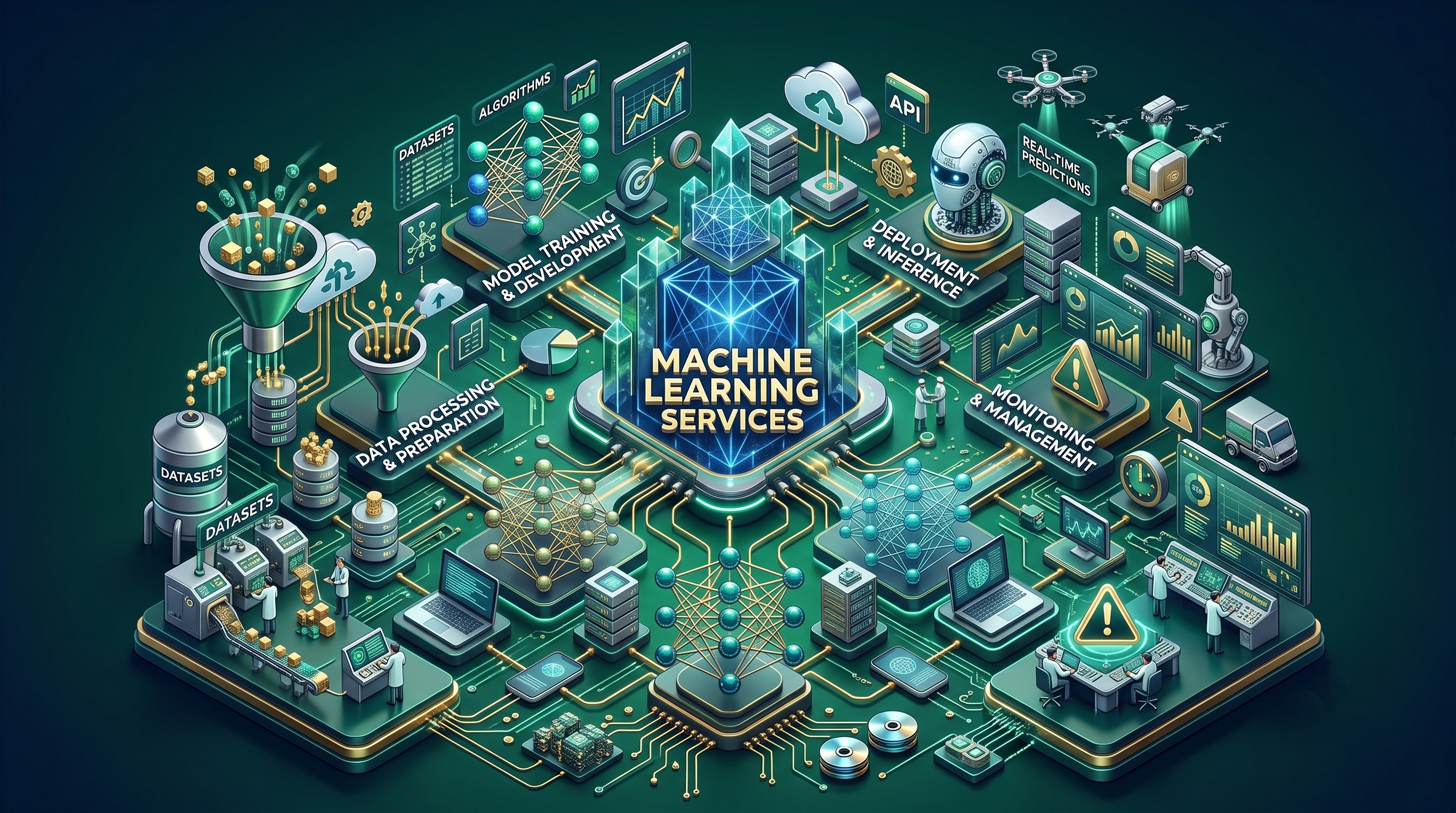
Why Businesses Need Machine Learning Services in 2025 and Beyond
The case for machine learning adoption has never been stronger — or more urgent. Consider these market signals: The global machine learning market was valued at $21.17 billion in 2022 and is projected to reach $209.91 billion by 2029, growing at a CAGR of 38.8% (Fortune Business Insights, 2023) According to McKinsey's State of AI report, organizations that have fully scaled AI adoption report 20% or higher EBIT improvements attributable to AI initiatives Gartner predicts that by 2026, more than 80% of enterprises will have used generative AI APIs and models in production environments — up from less than 5% in 2023 In India specifically, the AI market is projected to add $967 billion to the economy by 2035, with ML-enabled automation playing a central role (Accenture and NASSCOM data) Companies in the top quartile of AI adoption outperform their peers by 3.5x in revenue growth according to BCG's AI adoption benchmarking study The window for competitive differentiation through ML adoption is still open — but it is closing. Organizations that build ML capabilities now establish compounding advantages through proprietary data assets, organizational learning, and technical infrastructure that become increasingly difficult for latecomers to replicate.
The global machine learning market was valued at $21.17 billion in 2022 and is projected to reach $209.91 billion by 2029, growing at a CAGR of 38.8% (Fortune Business Insights, 2023)
According to McKinsey's State of AI report, organizations that have fully scaled AI adoption report 20% or higher EBIT improvements attributable to AI initiatives
Gartner predicts that by 2026, more than 80% of enterprises will have used generative AI APIs and models in production environments — up from less than 5% in 2023
In India specifically, the AI market is projected to add $967 billion to the economy by 2035, with ML-enabled automation playing a central role (Accenture and NASSCOM data)
Companies in the top quartile of AI adoption outperform their peers by 3.5x in revenue growth according to BCG's AI adoption benchmarking study
The window for competitive differentiation through ML adoption is still open — but it is closing. Organizations that build ML capabilities now establish compounding advantages through proprietary data assets, organizational learning, and technical infrastructure that become increasingly difficult for latecomers to replicate.

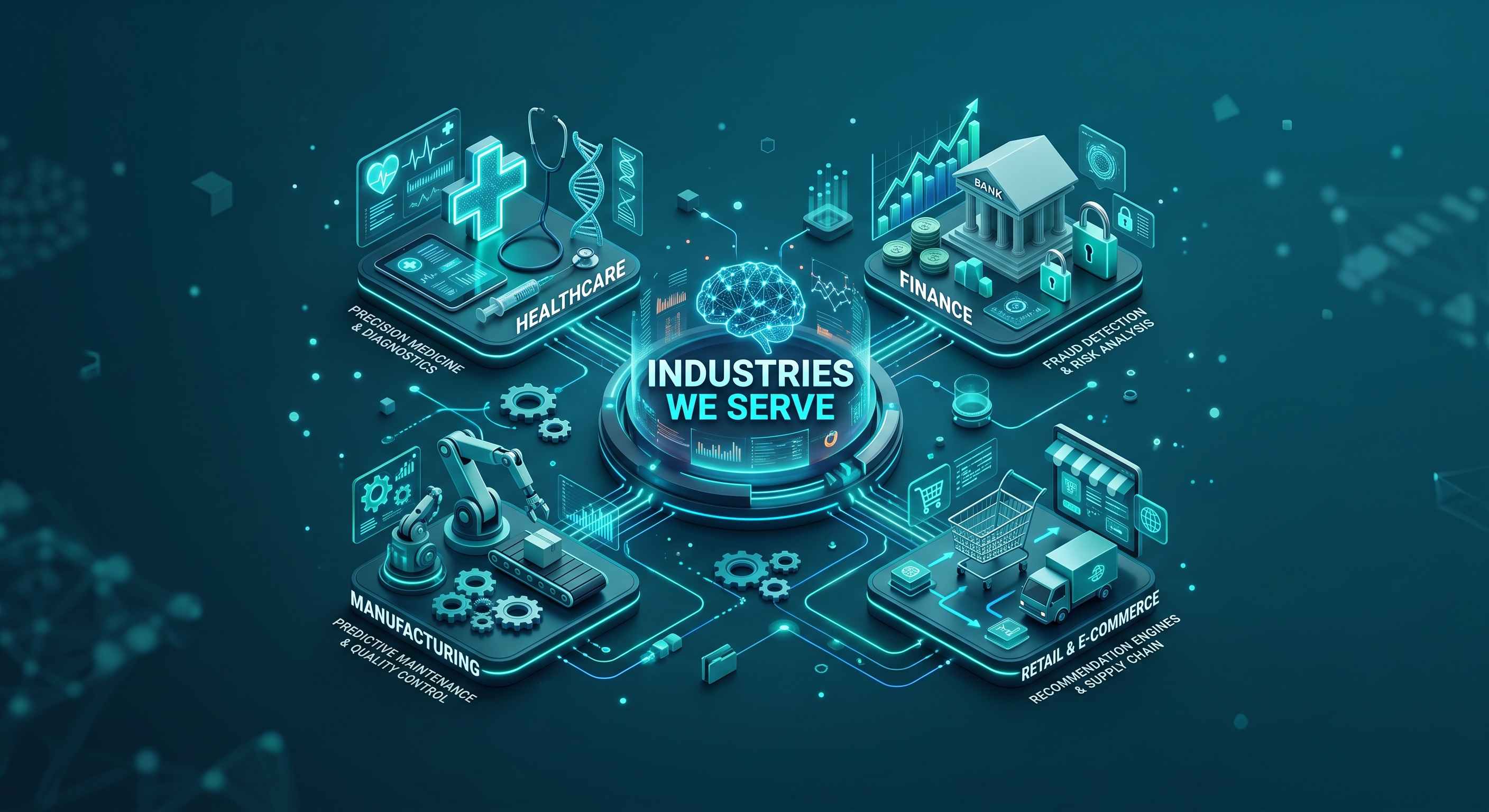
Industries We Serve with Machine Learning Solutions
Machine Learning models have moved well beyond chatbots. Across the industries we serve, here is where Machine Learning is delivering measurable value today:
Banking, Financial Services & Insurance (BFSI)
Financial services is arguably the most data-rich and ML-mature industry vertical. We build credit scoring models that improve loan approval accuracy while reducing default rates, fraud detection systems that identify anomalous transactions in real time with sub-100ms latency, anti-money laundering pattern recognition, algorithmic trading signal generation, insurance underwriting automation, and claims fraud detection systems. Our BFSI ML solutions are built with full compliance with RBI guidelines, SEBI regulations, and global standards like GDPR and Basel III model risk management requirements. We implement model explainability frameworks that satisfy both business stakeholders and regulatory examiners.
Healthcare & Life Sciences
Healthcare ML applications carry life-or-death consequences — which is why clinical rigor, explainability, and validation matter more in this vertical than perhaps any other. We develop clinical decision support systems, medical image analysis (radiology, pathology, ophthalmology), patient readmission prediction, drug discovery acceleration using molecular property prediction, clinical trial optimization, and hospital resource forecasting. All our healthcare ML systems are developed in compliance with applicable regulations including HIPAA data handling requirements and adhere to the FDA's framework for AI-based Software as a Medical Device (SaMD) where applicable.
Manufacturing & Industrial
Predictive maintenance is the most compelling ML application in manufacturing — reducing unplanned downtime by 30-50% and extending equipment life. We also build quality control vision systems that detect defects at line speed, demand forecasting systems that optimize raw material procurement, and supply chain ML that improves logistics efficiency and reduces carrying costs.
Retail & E-Commerce
Retail ML applications directly drive top-line revenue. We build product recommendation engines that increase average order value, dynamic pricing systems that optimize margins, inventory forecasting that reduces stockouts and overstock, customer lifetime value prediction, and visual search capabilities that improve product discovery. Retail clients typically see 15-35% revenue uplift on ML-instrumented product pages.
Telecommunications
Telcos sit on vast behavioral data assets that, when properly modeled, enable powerful customer intelligence capabilities. We build churn prediction systems that enable proactive retention interventions, network anomaly detection for quality management, customer lifetime value segmentation for marketing optimization, and predictive capacity planning for network infrastructure.
Logistics & Supply Chain
Logistics optimization is a natural fit for ML — the combination of high-dimensional variables, dynamic real-world constraints, and massive cost implications makes it an ideal domain for learned optimization approaches. We build route optimization ML systems, demand forecasting for logistics planning, last-mile delivery prediction, and freight pricing models.
Real Estate & PropTech
Automated valuation models (AVMs), rental price prediction, demand forecasting for property markets, tenant screening, and investment risk assessment are transforming how real estate businesses operate. Our ML solutions have been deployed by property platforms across India and Southeast Asia.
Why Choose Us as Your Machine Learning Services Partner
There is no shortage of companies claiming machine learning capabilities. Here is what genuinely differentiates our ML services:
Frequently Asked Questions About Machine Learning Services
Q1. What industries do you serve with machine learning solutions?
We serve a broad range of industries including BFSI (banking, financial services, and insurance), healthcare and life sciences, manufacturing and industrial, retail and e-commerce, telecommunications, logistics and supply chain, real estate, media, and SaaS technology companies. We have deep vertical expertise in BFSI and healthcare in particular, with domain specialists who understand the regulatory and operational contexts specific to these industries.
Q2. Do you work with companies that have limited data science teams internally?
Absolutely. Many of our clients are organizations where business leaders have recognized the opportunity for ML but have not yet built internal data science capabilities. We operate as an embedded ML team, handling the end-to-end delivery while actively building your team's understanding of the systems we build. For clients looking to build internal capabilities, we offer capability-building programs alongside project delivery.
Q3. How do you handle sensitive or confidential data during ML development?
Data security is a top priority in every engagement. We operate under strict NDAs, use data minimization principles (working with the minimum data necessary), implement encryption at rest and in transit, and can work within your existing security perimeter for highly sensitive projects. For regulated industries, we are familiar with and compliant with HIPAA, GDPR, and RBI data localization requirements.
Q4. What is the difference between ML development and MLOps?
ML development refers to the process of building, training, and validating machine learning models. MLOps (Machine Learning Operations) refers to the practices, tools, and infrastructure required to deploy, monitor, and maintain those models in production reliably and efficiently. Both are essential — a great model that cannot be reliably deployed and maintained creates no business value.
Q5. Can you integrate ML models with our existing systems like Salesforce, SAP, or Oracle?
Yes. We have extensive experience integrating ML systems with major enterprise platforms including Salesforce, SAP, Oracle, Microsoft Dynamics, and custom ERP systems. Our ML APIs are designed for easy integration and we provide detailed technical documentation, client SDKs where needed, and dedicated integration support.
Q6. How do you ensure ML models are fair and unbiased?
Fairness in ML is a first-class concern in every project we deliver. We conduct subgroup performance analysis to identify disparate impact across demographic groups, apply bias mitigation techniques at the data, algorithm, and post-processing levels as appropriate, implement ongoing fairness monitoring in production, and document fairness assessments as part of our standard model cards. In regulated industries, our fairness methodology meets or exceeds regulatory guidance from bodies like RBI, SEBI, and the EU AI Act requirements.
Q7. What ongoing support do you provide after model deployment?
Post-deployment support options range from automated monitoring-only engagements (where we set up monitoring infrastructure and alert systems) to full managed ML operations where our team handles ongoing model monitoring, drift detection, retraining, and performance optimization. We offer flexible support models including retainer-based and outcome-based pricing structures.
Q8. How do you price machine learning development projects?
Pricing depends on the scope and complexity of the ML system being built. We offer fixed-price engagements for well-defined, bounded projects and time-and-materials arrangements for exploratory or evolving scope engagements. We also offer value-based pricing for certain high-ROI applications where we can tie our compensation to demonstrated business outcomes. Contact us for a detailed proposal and cost estimate.
Q9. Do you develop ML solutions in Indian languages?
Yes. We have dedicated NLP capabilities for Indian languages including Hindi, Tamil, Telugu, Kannada, Malayalam, Bengali, Marathi, and Gujarati. Our language capabilities include text classification, sentiment analysis, named entity recognition, machine translation, and conversational AI in these languages. This is particularly relevant for customer-facing applications in the Indian market where regional language support is a competitive differentiator.
Q10. What is your approach to model explainability for regulated industries?
For regulated industries — BFSI and healthcare primarily — we implement explainability by design. This means every model is built with an interpretability plan from the outset, not bolted on after the fact. We use SHAP values for feature attribution, LIME for local explanations, counterfactual generation for rejection explanations (as required for credit decisions), and decision audit logging for all high-stakes predictions. Our explainability approach satisfies the requirements of RBI's model risk management guidelines, IRDAI frameworks, and SEBI's algorithmic trading regulations.
Q11. Can you help us build an internal data science capability alongside the project?
Yes. We offer structured knowledge transfer programs as part of every engagement — from technical documentation and code reviews to hands-on training workshops and co-development sprints where your team works alongside ours. For clients making a strategic investment in internal ML capabilities, we offer dedicated data science capability-building programs that combine advisory, training, and embedded mentorship.
Q12. How do you handle model performance degradation over time?
Model performance degradation — caused by data drift, concept drift, or distribution shift — is a known and manageable challenge in production ML. We implement three-layer monitoring covering input data distributions, model predictions distributions, and downstream business metrics. Automated drift thresholds trigger retraining pipelines without requiring manual intervention. For most production systems we build, models are retrained automatically when drift exceeds defined thresholds, with human review only for significant architecture changes.