InfiniteTech AI - Navbar (navbar_html)
AI Automation Services Services & Consulting Company

Document AI

Transform unstructured documents into structured business intelligence with our enterprise Document AI solutions. OCR, IDP, NLP, and intelligent automation — built for scale.

What Is Document AI?

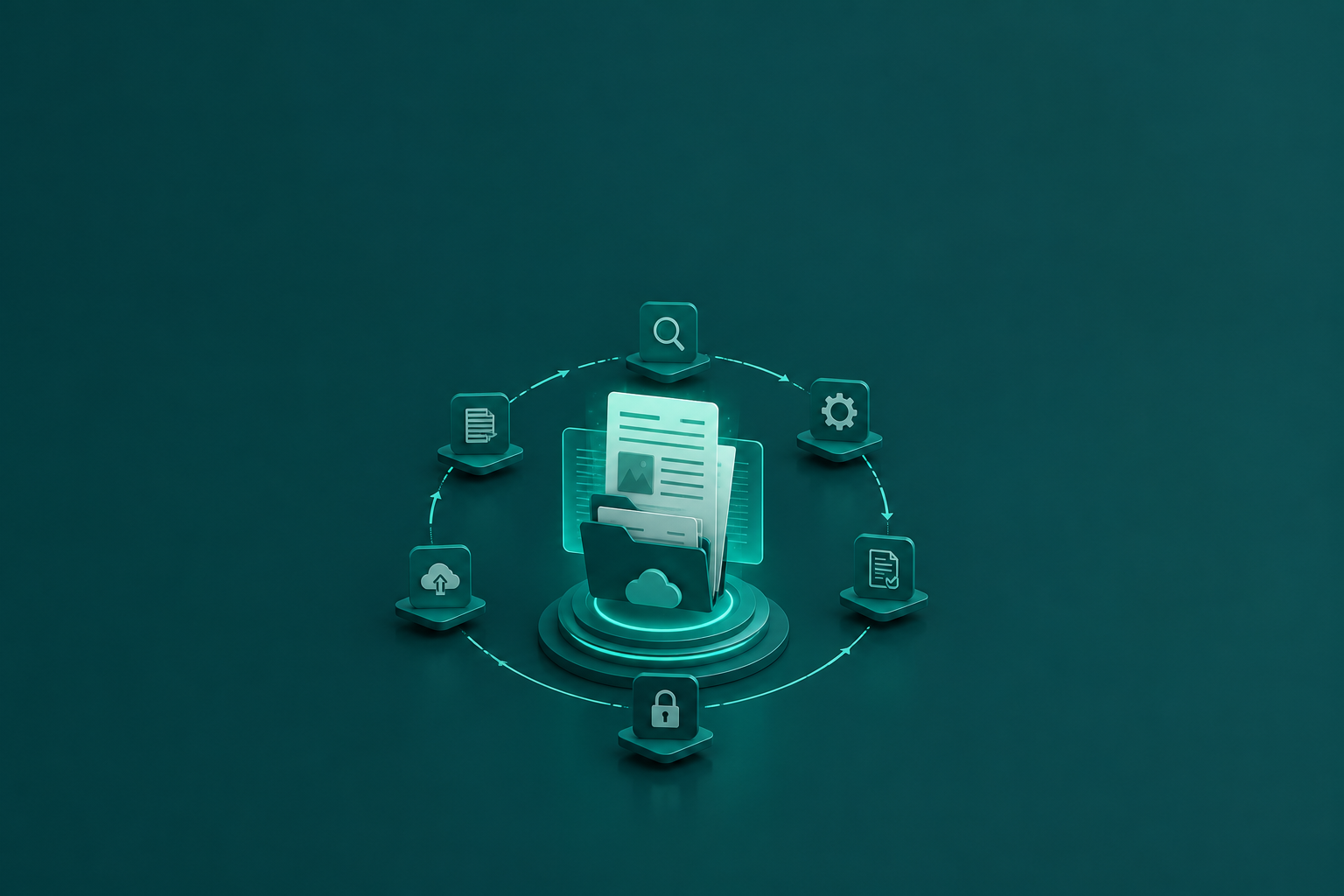
Document AI is a category of artificial intelligence technology that enables computers to automatically read, interpret, extract, classify, and process information from structured, semi-structured, and unstructured documents — without requiring manual human intervention at each step.

Traditional document processing relied on rules-based OCR (Optical Character Recognition) that could only work with fixed templates. If a vendor sent an invoice in a slightly different format, the system would fail. Document AI replaces brittle rules with adaptive intelligence using a combination of:

  • Computer Vision — to interpret images of documents
  • Natural Language Processing (NLP) — to understand the meaning and context of text
  • Named Entity Recognition (NER) — to identify key data points like names, dates, amounts, addresses, and codes
  • Machine Learning classification models — to categorize document types automatically
  • Large Language Models (LLMs) — to reason about complex, multi-page, context-rich documents
  • Knowledge graphs — to connect extracted entities to enterprise data structures

Document AI vs. Traditional OCR

Feature Traditional OCR Document AI
Handles fixed templates only Yes Yes
Works with new/unseen document formats No Yes
Understands document context and meaning No Yes
Classifies document types automatically No Yes
Extracts relationships between data fields No Yes
Validates extracted data against business rules No Yes
Handles handwriting Limited Yes
Processes multi-language documents Limited Yes
Self-improves with feedback No Yes
Integrates with downstream workflows Manual Automated
Processes tables and complex layouts Limited Yes

The Anatomy of a Document AI System

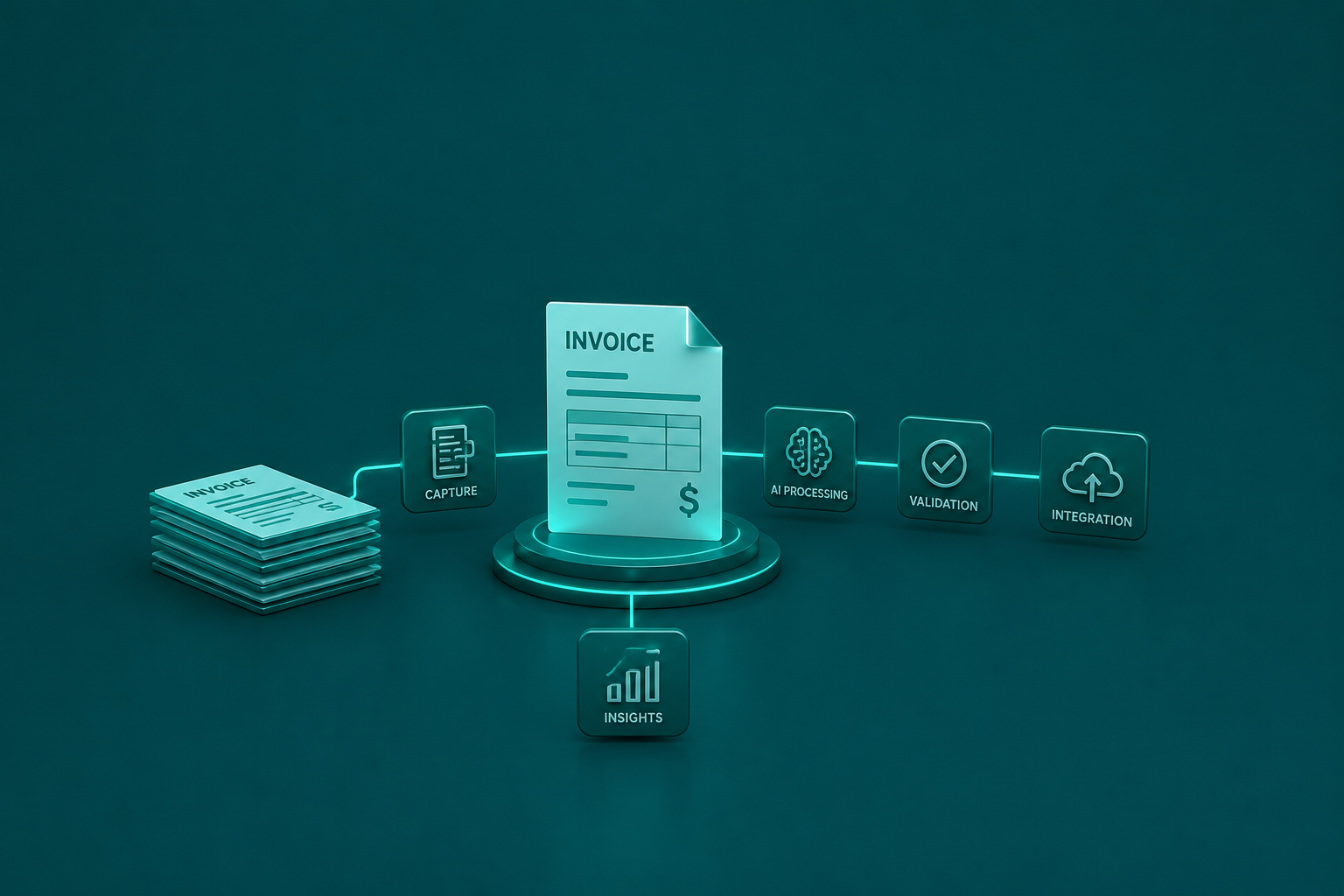
Stage 1: Document Ingestion

Documents arrive through multiple channels - email attachments, web uploads, scanner feeds, API submissions, FTP transfers, and cloud storage buckets. A production-grade Document AI system connects to all of these ingestion points through pre-built connectors and APIs.

Stage 2: Pre-Processing and Image Enhancement

For scanned documents and photographs, pre-processing is critical to accuracy. The system applies:

These steps can increase OCR and extraction accuracy by 20-40% on challenging document inputs.

Stage 3: Text Recognition (OCR + HTR)

For printed text, advanced neural-network-based OCR converts image pixels to characters and words with far greater accuracy than rule-based OCR engines. For handwritten content, Handwritten Text Recognition (HTR) - a specialized AI discipline - handles cursive, print, mixed styles, and degraded handwriting.

Stage 4: Document Understanding and Layout Analysis

Beyond recognizing characters, Document AI must understand the structure and layout of a document:

Layout analysis models - often based on LayoutLM, Donut, or similar transformer architectures - parse the spatial relationships between text elements and understand document structure the way a human reader would.

Stage 5: Intelligent Data Extraction

This is where the AI identifies and extracts the specific data fields your business needs:

Extraction is powered by a combination of NER models, transformer-based language models, and custom fine-tuned classifiers trained on your document types.

Stage 6: Validation and Business Rule Application

Raw extracted data is validated against:

Documents that pass validation are routed directly to downstream systems. Exceptions are flagged for human review with highlighted discrepancies - significantly reducing the time reviewers spend on each document.

Stage 7: Workflow Routing and System Integration

Validated data is pushed into your business systems - SAP, Oracle, Salesforce, ServiceNow, Microsoft Dynamics, custom ERP, or any API-enabled application. Documents are filed into your ECM or DMS system. Notifications and approval workflows are triggered. Audit logs are created for compliance.

Key Features of Enterprise Document AI

Omni-Format Document Support

  • PDFs (native and scanned)
  • Microsoft Word, Excel, PowerPoint files
  • TIFF, PNG, JPEG, WebP image formats
  • Email messages and attachments (.msg, .eml)
  • XML and HTML documents
  • Multi-page documents with hundreds of pages
  • Low-resolution and degraded scans
  • Multi-language documents across 100+ languages including Hindi, Tamil, Telugu, Kannada, Marathi, Bengali, and all major Indian scripts

Intelligent Document Classification

Our classification engine recognizes hundreds of document types - invoices, purchase orders, delivery notes, bank statements, passports, driving licenses, PAN cards, Aadhaar cards, GSTIN filings, customs declarations, loan applications, insurance claims, and more. New document types can be added with minimal training samples using few-shot learning techniques.

Multi-Entity Extraction with Relationship Mapping

The system doesn't just extract individual data points - it understands relationships between them. On a contract, it connects each obligation to the responsible party and the applicable deadline. On a medical record, it links each medication to the prescribing physician and the diagnosis it treats. This relational intelligence is what separates true Document AI from data scraping.

Confidence Scoring and Exception Handling

Every extracted data point receives a confidence score. Your business rules determine which confidence thresholds trigger automatic processing and which trigger human review. This human-in-the-loop design ensures quality while minimizing unnecessary manual effort.

Continuous Learning and Model Improvement

When human reviewers correct an extraction, that correction feeds back into the model. Over time, the system learns from your specific document variations, vendor formats, and edge cases - continuously improving accuracy without requiring manual retraining cycles.

Audit Trail and Compliance Logging

Every document, every extraction, every validation outcome, and every human intervention is logged with timestamps, user IDs, and data lineage tracking - satisfying GDPR, HIPAA, SOC 2, RBI guidelines, SEBI regulations, and industry-specific compliance frameworks.

Benefits of Document AI for Your Business

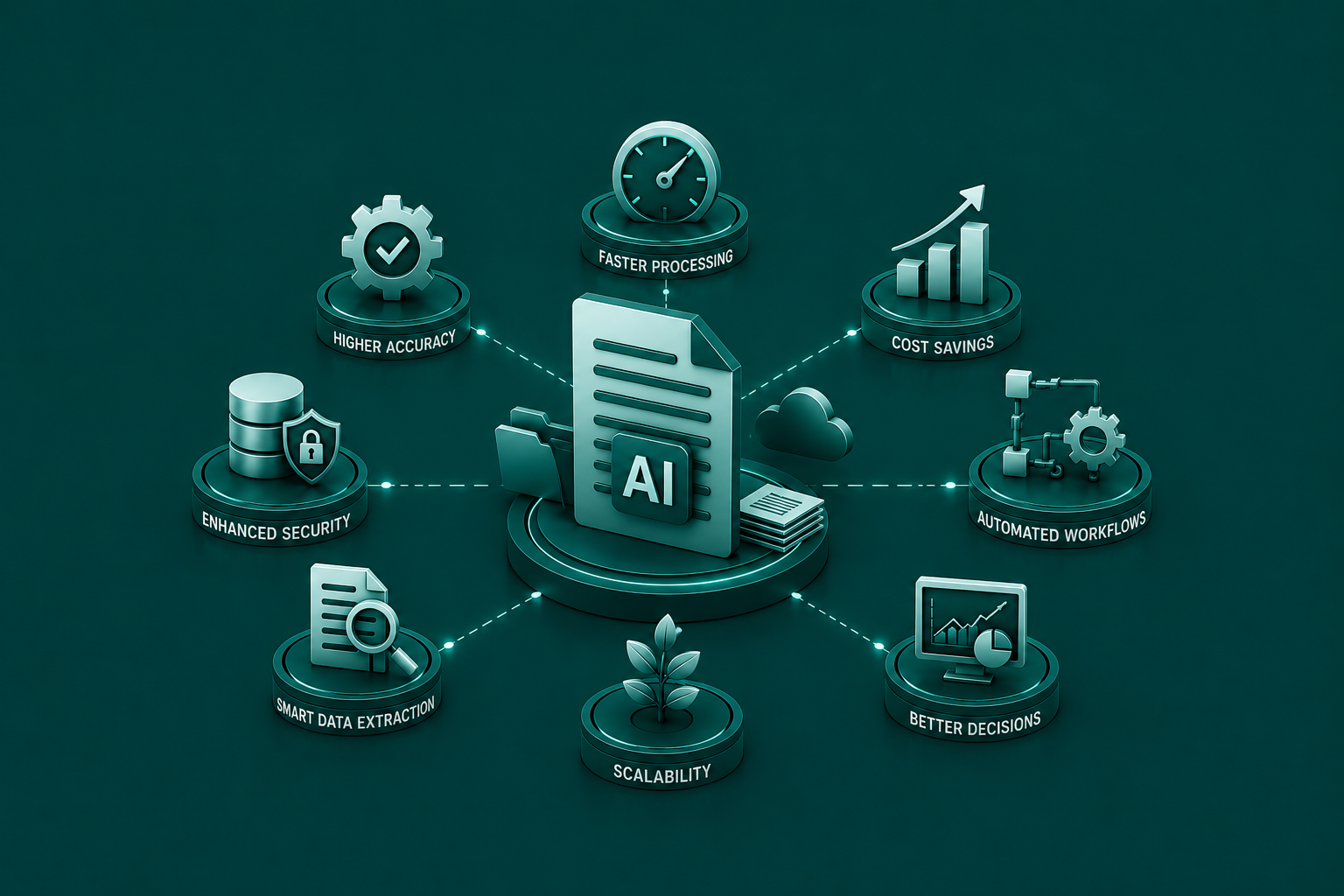
Dramatic Reduction in Processing Time

Manual invoice processing typically takes . Document AI processes the same invoice in - translating to 833-2,500 hours of labor saved every month for enterprises processing 10,000 invoices.

Significant Cost Reduction

According to Deloitte, organizations that implement intelligent document processing report on document-heavy processes.

Dramatically Improved Accuracy

Human data entry error rates typically range from . Document AI systems, once properly tuned, operate at - a 10x improvement in data quality.

Unlimited Scalability

Month-end invoice surges, peak enrollment seasons, post-merger document migrations - Document AI handles volume spikes without the operational cost of temporary staffing. The system scales horizontally on cloud infrastructure, processing thousands of documents simultaneously.

Faster Business Decisions

When data is extracted automatically and immediately available in your business systems, the downstream decisions happen faster. Payments clear sooner. Contracts are executed more quickly. Loan applications are approved in hours rather than days.

Enhanced Employee Experience

Eliminating repetitive, error-prone data entry from knowledge workers' days is not just good for the business - it's good for the people. Staff freed from document processing can focus on judgment-intensive work: exception resolution, relationship management, analysis, and strategy.
AI Startup Benefits
Why%20Every%20Enterprise%20Needs%20Document%20AI%20Now

Why Every Enterprise Needs Document AI Now

The Document Volume Crisis

Enterprise document volumes are growing at an estimated 22.1% annually (Source: AIIM). Hiring more manual processors is increasingly expensive, increasingly difficult due to talent shortages, and ultimately unsustainable. You cannot hire your way out of a document processing backlog that grows 22% per year.

The Digital Transformation Imperative

Document AI is often the missing piece in digital transformation initiatives. Organizations invest millions in ERP modernization, cloud migration, and process reengineering - but their inputs to these systems are still manual data entry from paper documents. Document AI closes this gap, making digitized processes genuinely end-to-end.

Regulatory Pressure on Data Accuracy

India's GST compliance ecosystem demands accurate invoice data flowing into government portals. IRDAI data submissions require precisely structured claims data. Document AI systems are built to produce compliance-grade structured data as a natural output.

Competitive Dynamics

Early adopters of Document AI are establishing competitive advantages that will be very difficult to overcome. Banks that process loan applications in hours rather than weeks win customers. Insurers that settle claims in days rather than months retain policyholders. The competitive cost of not implementing Document AI compounds every year.

Industries Transforming Operations with Document AI

Banking, Financial Services & Insurance (BFSI)

Use cases: Loan origination document processing, KYC/AML document verification, trade finance documentation, insurance claims processing, account opening forms, regulatory reporting, mortgage underwriting, credit card applications.

Healthcare & Life Sciences

Use cases: Patient intake form digitization, medical record extraction, insurance pre-authorization processing, clinical trial documentation, lab report analysis, discharge summary processing, prescription digitization, NABH audit documentation.

Legal and Contract Management

Use cases: Contract review and extraction, due diligence document analysis, litigation document review, regulatory filing processing, IP documentation management, NDA clause extraction and tracking.

Logistics, Supply Chain & Trade

Use cases: Bill of lading processing, customs declaration automation, freight invoice reconciliation, purchase order matching, packing list extraction, export documentation compliance.

Government & Public Sector

Use cases: Citizen application processing, land record digitization, court filing management, compliance document processing, tax return processing, procurement documentation.

Manufacturing, Education & Real Estate

  • Manufacturing: Technical drawing interpretation, quality inspection reports, BOM extraction, regulatory certifications
  • Education: Admission form processing, transcript digitization, accreditation documentation, scholarship applications
  • Real Estate: Property document verification, lease agreement extraction, sale deed processing, due diligence
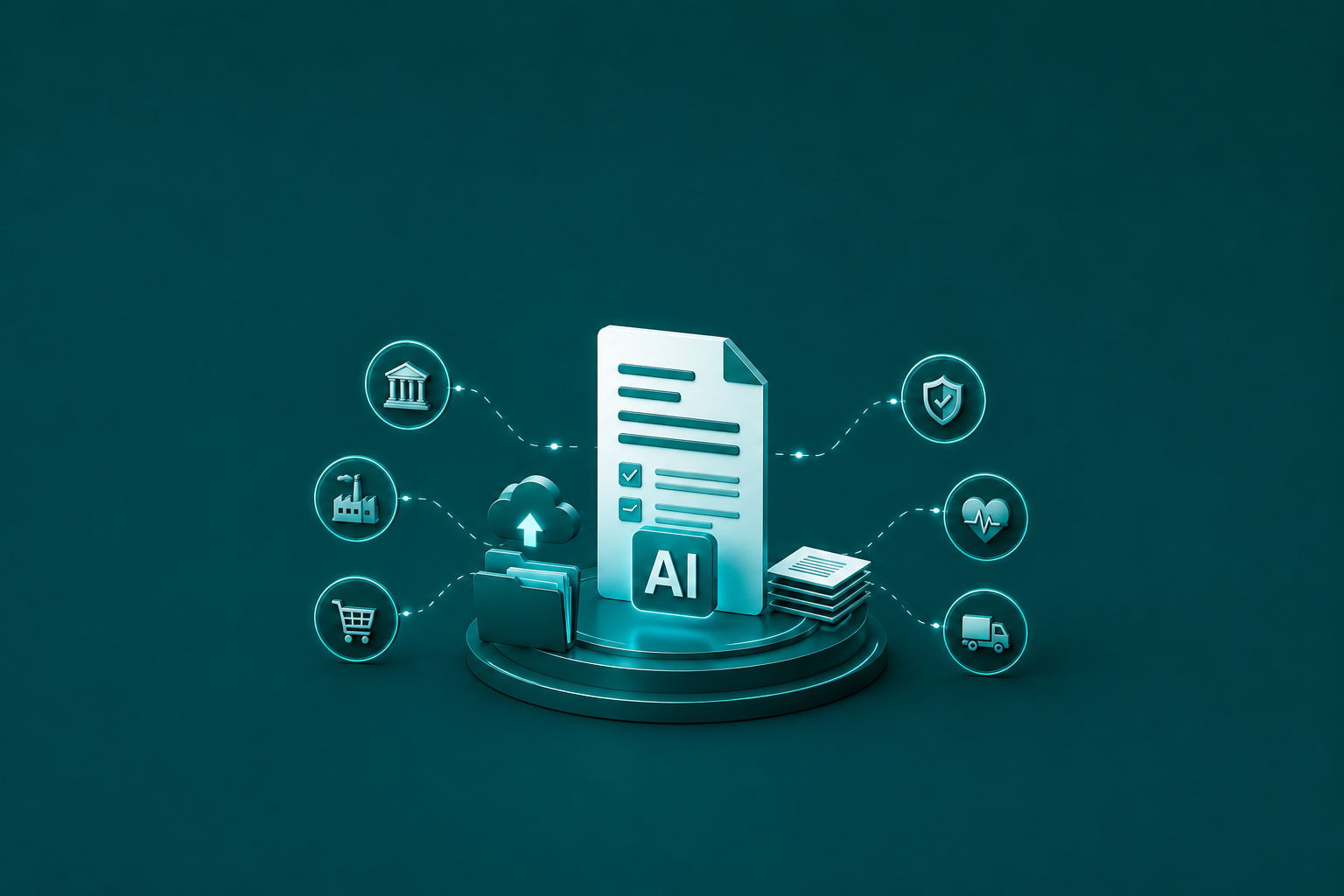
AI Industries Network

Technologies and Tools Powering Our Solutions

Tensorflow
PyTorch
Apache Spark
Google Cloud
Tensorflow
PyTorch
Apache Spark
Google Cloud
Tensorflow
PyTorch
Apache Spark
Google Cloud
Tensorflow
PyTorch
Apache Spark
Google Cloud
DagsHub
Docker
Optuna
Rapids
DagsHub
Docker
Optuna
Rapids
DagsHub
Docker
Optuna
Rapids
DagsHub
Docker
Optuna
Rapids

Our Document AI Development and Implementation Process

We follow a structured, proven implementation methodology that minimizes risk, accelerates time-to-value, and ensures long-term system performance.

1

Phase 1: Discovery and Document Assessment (Weeks 1-2)

  • Catalog all document types in scope - formats, sources, volumes, and variations
  • Identify the data extraction requirements for each document type
  • Map the downstream workflows that will receive extracted data
  • Assess document quality - scanning quality, handwriting prevalence, language diversity
  • Identify regulatory and compliance requirements governing data handling
  • Baseline current process metrics - cycle time, error rates, labor cost, exception volumes
2

Phase 2: Data Collection and Annotation (Weeks 2-5)

AI models are only as good as the training data they learn from. We collect representative document samples, define annotation guidelines, manage professional annotation workflows, and build training/validation/test datasets. For enterprises with privacy constraints, we support annotation in your secure environment.

3

Phase 3: Model Development and Training (Weeks 4-10)

  • Classification models to identify document types
  • Extraction models fine-tuned on your specific document formats and data fields
  • Validation rule engines encoding your business logic
  • Post-processing pipelines to normalize, format, and enrich extracted data
  • Confidence calibration to tune precision-recall tradeoffs
4

Phase 4: System Integration Development (Weeks 6-12)

  • Ingestion connectors for your document sources (email, scanner, cloud storage, ERP)
  • API interfaces for downstream system integration
  • Exception management workflows with human review queues
  • Audit logging and compliance reporting infrastructure
  • User interface for human review - built for speed, clarity, and minimal cognitive load
  • Performance monitoring and alerting dashboards
5

Phase 5: Testing, Validation, and UAT (Weeks 10-14)

  • Accuracy testing across representative document samples from each type
  • Performance testing to validate throughput and latency at peak volumes
  • Integration testing across all connected systems
  • Security penetration testing and data handling validation
  • User Acceptance Testing (UAT) with your operations team
6

Phase 6: Pilot Deployment and Tuning (Weeks 12-16)

We deploy to production in a controlled pilot - typically 20-30% of document volume running through the AI system in parallel with existing manual processing. This phase validates real-world accuracy, identifies edge cases, tunes confidence thresholds, and gathers feedback from human reviewers.

7

Phase 7: Full Production Rollout and Optimization (Weeks 14-20)

  • Continuous learning pipelines to incorporate review corrections into model improvement
  • Performance monitoring dashboards showing accuracy, throughput, exception rates, and system health
  • Model drift detection to identify when document format changes require retraining
  • SLA-aligned support and maintenance from our AI operations team
8

Phase 8: Ongoing Support, Enhancement, and Expansion

  • Quarterly model performance reviews and retraining cycles
  • New document type onboarding as your business evolves
  • Platform upgrades as underlying AI technologies improve
  • Expansion consulting as you identify new automation opportunities

This process is typically delivered over 6-14 weeks for an initial model or model family, with subsequent models onboarded onto the established platform far faster once the foundational pipeline exists.

AI MVP Development Team

Why Choose [Company Name] for Document AI
Deep Specialization, Not Generalism

Document AI sits at the intersection of computer vision, NLP, knowledge engineering, business process analysis, and systems integration. Our dedicated Document AI practice combines AI scientists, NLP engineers, computer vision specialists, integration architects, and domain experts across BFSI, healthcare, logistics, government, and manufacturing - in India and internationally.

Proven at Enterprise Scale

We have designed and deployed Document AI systems processing more than 2 million documents per month in production environments. Our architecture patterns, integration templates, and accuracy benchmarks are battle-tested across diverse enterprise contexts.

Indian Language and Document Expertise

Processing documents in Hindi, Tamil, Telugu, Kannada, Marathi, Bengali, Gujarati, Malayalam, Odia, and Punjabi - as well as Indian-specific document formats including Aadhaar cards, PAN cards, GSTIN invoices, RTO documents, and court filings - requires specialized expertise that few vendors possess.

Regulatory Compliance by Design

Our Document AI systems are designed with compliance embedded, not bolted on. We understand RBI data localization requirements, DPDP Act obligations, SEBI reporting standards, IRDAI data requirements, and MeitY AI governance guidelines.

Transparent Accuracy Benchmarking

Before you commit to a production deployment, we provide benchmark results on your own document samples. You see the accuracy, the exception rate, and the performance before you sign a production contract. We do not hide behind aggregated statistics.

Flexible Deployment Models

We support cloud deployment on Azure, AWS, or GCP; on-premises deployment for data sovereignty requirements; hybrid architectures; and private cloud environments. We do not lock you into a single cloud platform or infrastructure model.

Long-Term Partnership, Not Project Delivery

Our client retention rate exceeds 94% because we measure our success by your ROI, not our project closure rate. We stay engaged through production operations, continuous model improvement, and expansion into adjacent automation opportunities.

Case Study: Automating Invoice Processing

Client Overview

A diversified manufacturing and retail conglomerate headquartered in Mumbai, operating across 14 business units with over 8,000 vendors, processing approximately 180,000 invoices per month through a central shared services center.

The Challenge

The accounts payable team of 140 people was spending 85% of their working hours on manual invoice data entry, three-way matching, and exception resolution. Payment cycle time averaged 34 days. Duplicate payment losses exceeded ₹1.8 crores annually. Audit preparation consumed three full-time employees working for two weeks ahead of every quarterly review.

The invoice formats across 8,000 vendors were highly heterogeneous — no two vendors formatted their invoices identically, and the organization received invoices in English, Hindi, Marathi, and Gujarati.

Our Document AI Solution

We implemented a comprehensive Document AI system including:

  • Multi-format invoice ingestion from email, vendor portals, and scanned document feeds
  • Vendor-agnostic extraction engine trained on 45,000 annotated invoice samples covering all vendor formats in their supplier base
  • Multi-language processing for English, Hindi, Marathi, and Gujarati invoices
  • Three-way matching automation connecting invoice data to purchase orders and goods receipt notes in their SAP S/4HANA system
  • Duplicate detection engine using entity matching and amount comparison
  • Exception management workflow with a purpose-built reviewer interface prioritizing exceptions by value and age
  • SAP integration pushing validated invoice data directly to accounts payable workflows

Results (12 Months Post-Deployment)

Metric Before After Improvement
Invoices processed per month 180,000 180,000 Same volume
Manual processing rate 100% 22% 78% straight-through
Payment cycle time 34 days 8 days 76% reduction
AP team headcount on data entry 140 38 102 redeployed
Duplicate payment losses ₹1.8 Cr/year ₹0.04 Cr/year 98% reduction
Invoice processing cost per document ₹187 ₹41 78% cost reduction
Audit preparation time 2 weeks (3 FTE) 4 hours (automated) 95% time reduction

The annual financial impact of the Document AI implementation exceeded ₹22 crores in combined labor savings, duplicate payment prevention, and early payment discount capture — against a total implementation investment of ₹4.2 crores, representing an ROI exceeding 420% in the first year.

Online Retailer E-commerce Platform

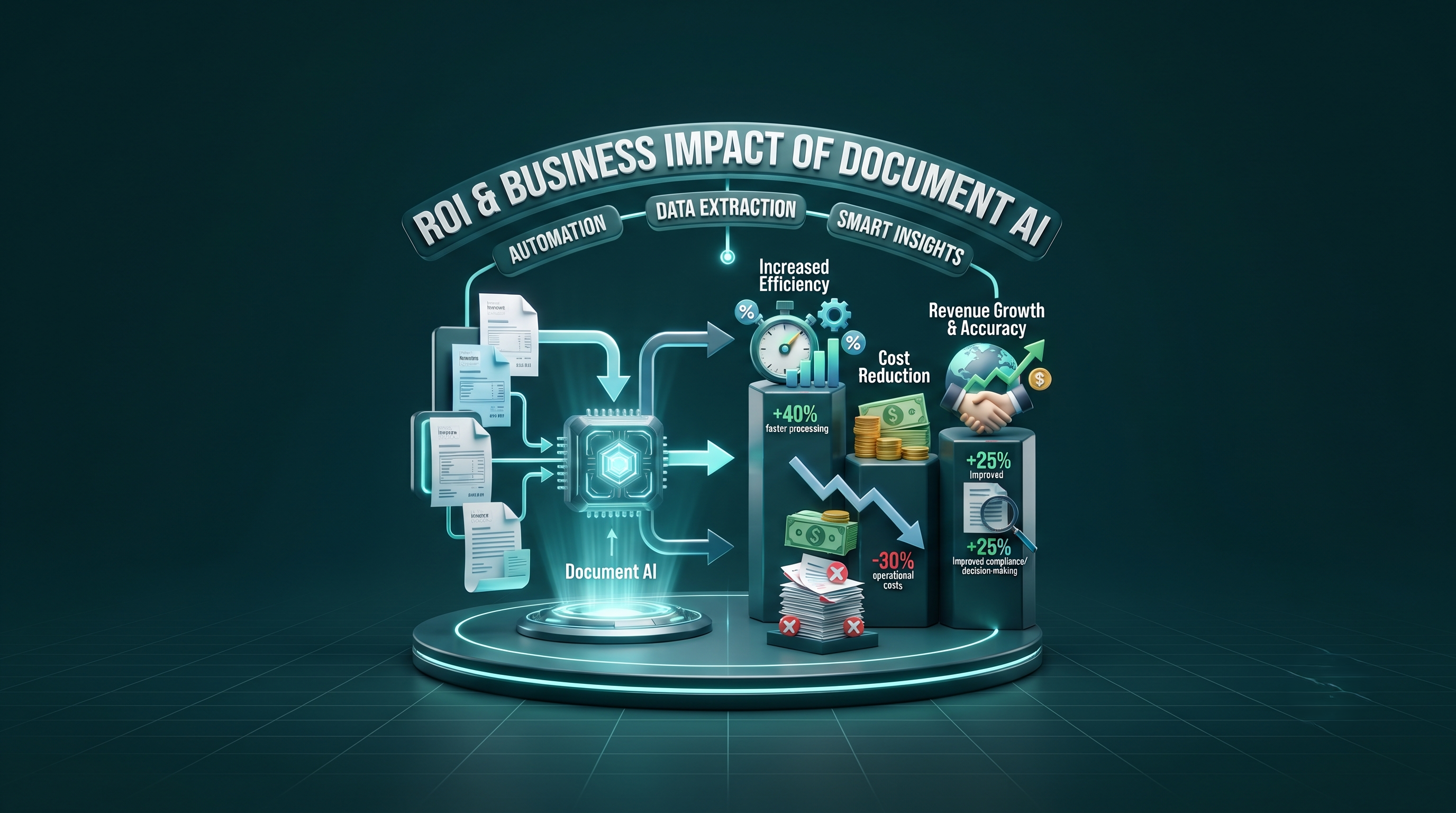
ROI and Business Impact of Document AI

How to Calculate Document AI ROI

The business case for Document AI is typically straightforward to quantify:

Direct Cost Savings: - (Annual labor cost on document processing) × (Reduction in manual processing rate) - Reduction in error correction and rework costs - Reduction in duplicate payment and compliance penalty losses

Indirect Value Creation: - Faster cash flow from accelerated invoice processing and earlier payment capture - Improved vendor relationships from faster payment cycles - Reduced audit preparation costs - Freed employee capacity redirected to higher-value work

Revenue Impact: - Faster loan approvals translating to more loans processed - Faster insurance claims settlement improving customer retention - Faster customs clearance improving supply chain velocity

Typical ROI Timeline

Milestone Timeline
Initial deployment and pilot Months 1–4
Break-even on implementation investment Month 6–8
Full ROI realization Month 10–14
Compounding benefits from continuous improvement Months 12+

Most enterprise Document AI implementations reach positive ROI within 8–12 months of go-live and deliver 200–500% ROI over a 3-year horizon, according to industry benchmarks from Gartner and Forrester Research.

ROI%20and%20Business%20Impact%20of%20Document%20AI

Common Challenges in Document AI and How We Solve Them

Low-Quality Document Inputs

Reality: Many organizations' incoming document quality is poor - low-resolution scans, handwritten notes on printed forms, crumpled or damaged paper.

SOLUTION

We invest heavily in pre-processing pipeline engineering - deskewing, denoising, resolution enhancement, and contrast normalization - before documents reach the AI extraction layer.

High Document Format Variability

Reality: Even within a single document category, format variability can be enormous - 8,000 vendors means potentially 8,000 invoice formats.

SOLUTION

We use transformer-based extraction models trained on large, diverse document collections that generalize across format variations without requiring per-vendor template configuration.

Complex Multi-Page Documents

Reality: Many high-value documents - contracts, loan applications, regulatory filings - span dozens or hundreds of pages with complex cross-referential content.

SOLUTION

We apply long-context LLM techniques, hierarchical document parsing, and semantic chunking strategies. Our contract analysis models can extract clause-level information from 200-page agreements.

System Integration Complexity

Reality: Enterprise system landscapes are complex - multiple ERPs, ECMs, business units with different systems, legacy applications with limited API support.

SOLUTION

Our integration engineering team has built connectors for SAP, Oracle ERP, Microsoft Dynamics, Salesforce, ServiceNow, OpenText, SharePoint, and dozens of industry-specific platforms.

Change Management and User Adoption

Reality: Document processing teams may resist AI-driven automation if they perceive it as threatening rather than augmenting their roles.

SOLUTION

We involve end users from the earliest stages of requirements definition, design exception management workflows that make human reviewers more effective, and implement change management programs in partnership with your HR and operations leadership.

Frequently Asked Questions About Document AI

1. What types of documents can Document AI process?

Document AI can process virtually any document type - PDFs, scanned images, Word documents, Excel files, emails, handwritten forms, engineering drawings, medical records, financial statements, contracts, tax filings, government forms, invoices, receipts, and shipping documents. Modern Document AI systems handle both structured documents (with fixed layouts) and unstructured documents (where information appears in varying positions and formats).

2. How accurate is Document AI compared to manual processing?

Well-tuned Document AI systems achieve extraction accuracy of 95-99.5% on clean printed documents and 90-97% on handwritten content, compared to human data entry error rates of 1-5%. In production deployments, Document AI consistently outperforms manual processing on accuracy while operating at dramatically higher throughput.

3. How long does it take to implement a Document AI system?

For a mid-complexity implementation covering 3-5 document types and integration with 1-2 downstream systems, end-to-end implementation typically takes 12-20 weeks from project kick-off to production go-live. Simpler implementations can be deployed in 6-10 weeks. More complex multi-document-type, multi-system implementations typically run 20-36 weeks.

4. Is Document AI suitable for small businesses or only large enterprises?

Document AI is increasingly accessible to businesses of all sizes. Cloud-based Document AI platforms from Azure, Google Cloud, and AWS offer pay-per-use pricing that makes the technology accessible to SMBs. For small businesses, pre-built models and no-code configuration options significantly reduce implementation cost and complexity.

5. Can Document AI handle documents in Indian languages?

Yes. Our Document AI systems are specifically engineered to handle Indian language documents including Hindi, Tamil, Telugu, Kannada, Malayalam, Marathi, Gujarati, Bengali, Odia, and Punjabi, as well as mixed-language documents and Indian-specific formats including Aadhaar cards, PAN cards, GSTIN invoices, Form 16, property documents, and court filings.

6. How does Document AI handle documents it has never seen before?

Modern Document AI models based on transformer architectures generalize across document variations without requiring per-template configuration. Novel document types that differ significantly from the training distribution are flagged for human review and used to improve the model through active learning. Over time, the system handles an ever-wider range of document variants automatically.

7. What security certifications do Document AI systems support?

Enterprise Document AI systems can be deployed in environments certified to SOC 2 Type II, ISO 27001, HIPAA, GDPR, and India's DPDP Act requirements. Data-at-rest and data-in-transit encryption, role-based access control, audit logging, and configurable data retention policies are standard components of our deployments.

8. What is the difference between IDP and traditional OCR?

Traditional OCR converts document images to text but has no understanding of what that text means. Intelligent Document Processing (IDP) combines OCR with AI-driven classification, extraction, validation, and workflow integration. Where OCR gives you raw text, IDP gives you structured, validated, actionable data fields ready for downstream system consumption.

9. Can Document AI integrate with SAP, Oracle, or other ERP systems?

Yes. We have pre-built integration connectors for SAP S/4HANA and ECC, Oracle ERP Cloud and E-Business Suite, Microsoft Dynamics 365, Salesforce, ServiceNow, OpenText, and many other platforms. Custom integration with proprietary or legacy systems is supported through API development and, where necessary, robotic integration techniques.

10. How does Document AI handle confidential or PII-sensitive documents?

Document AI systems can be configured to automatically detect, mask, or redact personally identifiable information (PII) before documents are stored or shared. Role-based access controls limit who can view which document types and data fields. For the most sensitive use cases, we deploy on-premises or private cloud architectures that ensure document content never leaves your controlled infrastructure.

11. What ongoing support is needed after Document AI deployment?

Document AI systems require ongoing model monitoring for accuracy drift, periodic retraining as new document variants accumulate, new document type onboarding as business requirements evolve, and platform updates as underlying AI technologies advance. Our managed services offering includes all of these activities through a defined SLA framework.

12. What ROI should we expect from Document AI?

In accounts payable automation, typical ROI ranges from 300-500% over three years. In insurance claims processing, 200-400%. In loan origination document handling, 250-450%. The common factors driving high ROI are: high document volumes, complex multi-field extraction requirements, time-sensitive processing, and regulatory environments where accuracy errors carry penalty risk.

Ready to Build AI That Delivers Real Business Value?

Stop experimenting with prototypes and start deploying production-ready AI software. Book a 60-minute strategy session with our senior AI architects. We will assess your data, identify high-ROI use cases, and map out a technical blueprint for your organization.

Schedule Your Free Session Now
InfiniteTech AI Footer
Scroll to Top