InfiniteTech AI - Navbar (navbar_html)
Recommendation Engine Development Services

MLOps Services

Harness the power of collaborative filtering and personalization algorithms to drive engagement, conversions, and enterprise growth.

AI Startup Development

MLOps is not simply "DevOps for machine learning," even though that is the common shorthand. It carries additional complexity that traditional software operations was never designed to handle - models depend on data that changes over time, performance is probabilistic rather than binary pass/fail, and a model can be technically "running" while being functionally wrong. A serious MLOps practice is built around that distinction from day one.

What is MLOps

MLOps, short for Machine Learning Operations, is the set of practices, automation, and infrastructure that takes a trained machine learning model and makes it reliably deployable, monitorable, reproducible, and continuously improvable in a production environment. It borrows heavily from DevOps principles - version control, continuous integration, automated testing, infrastructure as code - but extends them to handle the unique lifecycle of a machine learning model, including data versioning, experiment tracking, model registries, and drift monitoring.

In direct terms: if a data scientist hands over a trained model file and a notebook, and your engineering team has no repeatable, automated way to package it, test it against held-out data, deploy it behind an API, track its live performance, and retrain it when accuracy slips - you do not yet have MLOps, regardless of how sophisticated the underlying model is.

The Core Pillars of MLOps

Version Control

Code, data, and model versioning together, not just code

BENEFIT

Reproducibility - knowing exactly what produced a given prediction

CI/CD for ML

Automated testing, packaging, and deployment of models

BENEFIT

Faster, safer releases without manual deployment risk

Model Registry

Centralised tracking of model versions, lineage, and approval status

BENEFIT

Governance, rollback capability, audit trails

Monitoring & Observability

Live tracking of prediction accuracy, latency, and input data drift

BENEFIT

Catching silent model failure before it damages the business

Automated Retraining

Triggered retraining pipelines based on drift or schedule

BENEFIT

Keeping models accurate as real-world data evolves

Infrastructure as Code

Reproducible, scalable compute environments for training and serving

BENEFIT

Consistency across dev, staging, and production environments

Feature Stores

Centralised, reusable, consistent feature computation

BENEFIT

Eliminating training-serving skew between offline and online features

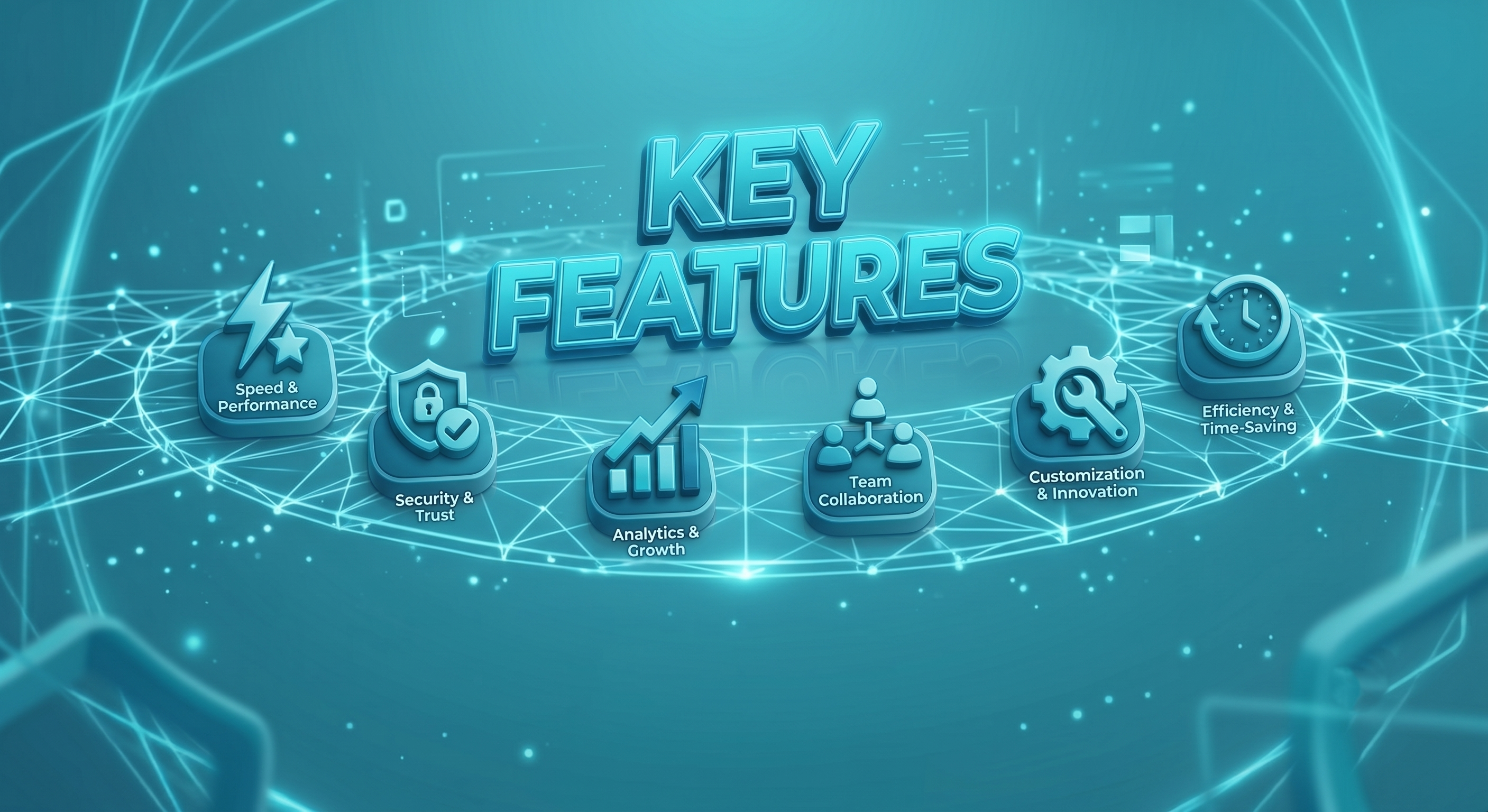
Key Features

End-to-end CI/CD pipelines for models

Automated testing, validation, and deployment triggered by code or data changes, removing manual deployment steps that introduce risk and delay.

Model registries with full lineage tracking

Every deployed model is traceable back to the exact code version, training data snapshot, and hyperparameters that produced it.

Real-time and batch monitoring dashboards

Live visibility into prediction latency, throughput, input data drift, and accuracy decay, surfaced to both engineering and business stakeholders.

Automated rollback and canary deployment

New model versions are rolled out gradually and automatically reverted if live performance dips below defined thresholds.

Feature store implementation

A single source of truth for features used across training and serving, eliminating the common and costly bug of training-serving skew.

Multi-environment infrastructure as code

Reproducible dev, staging, and production environments defined declaratively, removing "it worked on my machine" failures.

Governance and approval workflows

Configurable human-in-the-loop checkpoints for regulated industries where a model cannot go live without sign-off.
AI Startup Benefits

Benefits of MLOps Services

A properly built MLOps practice changes what machine learning means inside an organisation - from a series of one-off data science projects into a dependable, scalable operational capability.

Dramatically faster time-to-production

Where a model deployment used to take weeks of manual handoff between data science and engineering, automated CI/CD pipelines typically compress that to days or hours, letting the business capture value from a model far sooner after it is validated.

Fewer silent failures

The single most damaging failure mode in machine learning is a model that keeps running and keeps returning predictions while being quietly wrong. Continuous monitoring and drift detection turn that invisible risk into a visible, actionable alert.

Reproducibility and auditability

When every model version is tied to a specific data snapshot and code commit, "why did the model make this decision in March" becomes an answerable question rather than a guess - critical for regulated industries and for basic engineering sanity.

Lower total cost of ownership

Manual deployment and firefighting around broken pipelines consume disproportionate engineering time. Automating the repetitive operational work frees data science and engineering talent to focus on improving models rather than babysitting infrastructure.

Safer experimentation

Canary releases and automated rollback mean teams can ship model updates more frequently and with more confidence, because a bad deployment is caught and reversed automatically rather than discovered by an angry stakeholder days later.

Cross-team alignment

A shared model registry and monitoring dashboard gives data science, engineering, and business stakeholders a common, real-time view of what is deployed and how it is performing, closing the communication gap that often exists between teams that built a model and teams that depend on it.

Why%20Businesses%20Need%20MLOps%20Services

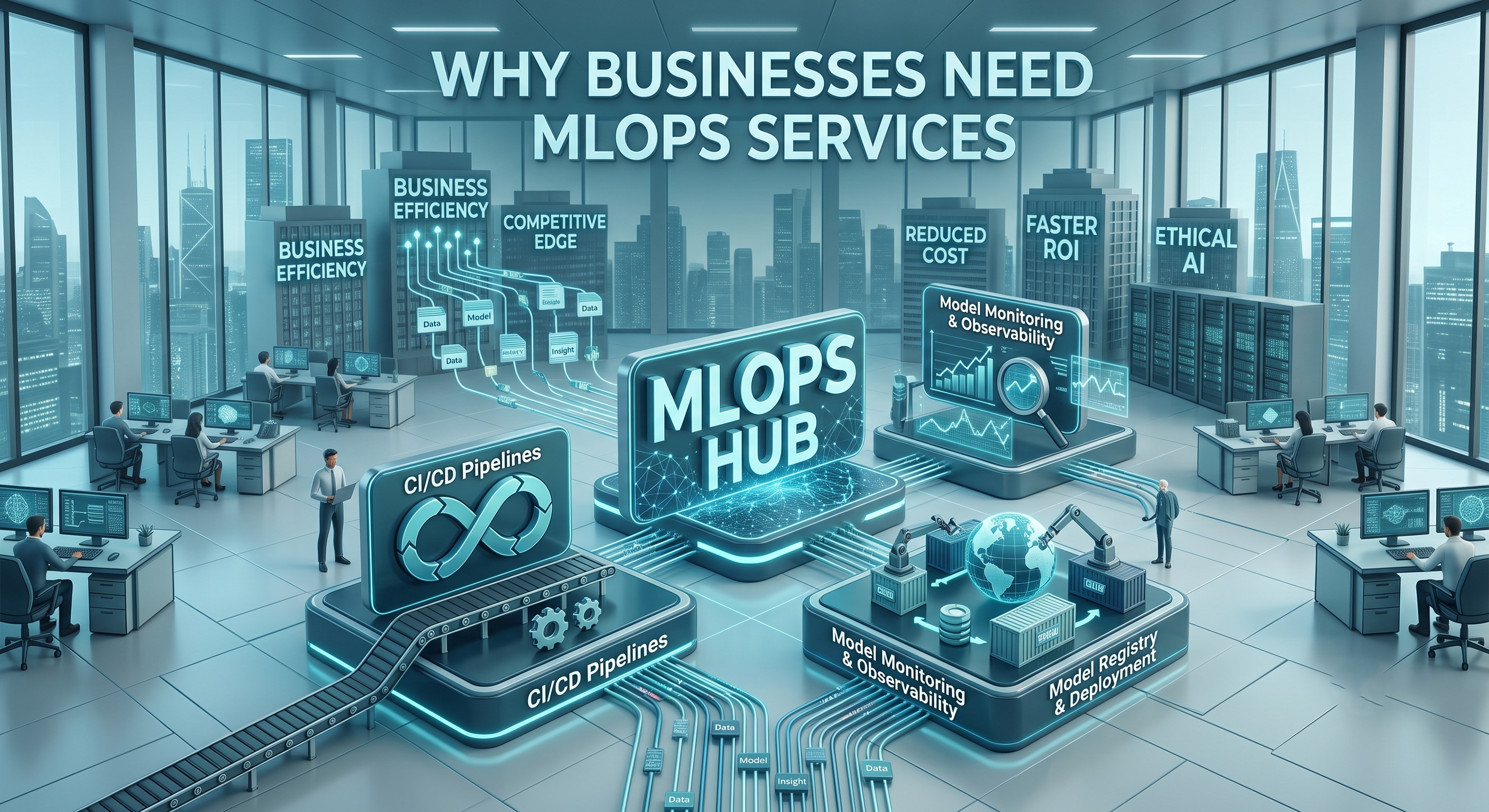
Why Businesses Need MLOps Services

The uncomfortable pattern across enterprise AI adoption is well documented: organisations invest heavily in data science hiring and model development, then significantly under-invest in the operational layer required to run those models reliably. The result is a portfolio of impressive proof-of-concept models that never become dependable production systems, or worse, production systems that silently degrade because nobody owns ongoing monitoring.

This gap exists for a structural reason - building a model and operating a model require genuinely different skill sets. A data scientist optimising for predictive accuracy on a held-out test set is not the same discipline as a platform engineer designing for uptime, rollback safety, and cost efficiency under live production load. Few organisations naturally have both skill sets embedded in the same team from day one, which is exactly why a dedicated MLOps capability - whether built in-house or brought in through a specialist partner - becomes necessary the moment a business has more than one or two models genuinely depended on for daily decisions.

There is also a compounding cost argument. Every month a model runs without proper monitoring is a month of accumulating risk - the longer drift goes undetected, the more decisions get made on a degraded model, and the more expensive the eventual correction becomes, both financially and reputationally. Conversely, organisations that have matured their MLOps practice consistently report being able to deploy new models and model updates several times faster than peers still relying on manual processes, turning operational reliability into a genuine competitive speed advantage rather than just a risk-reduction exercise.

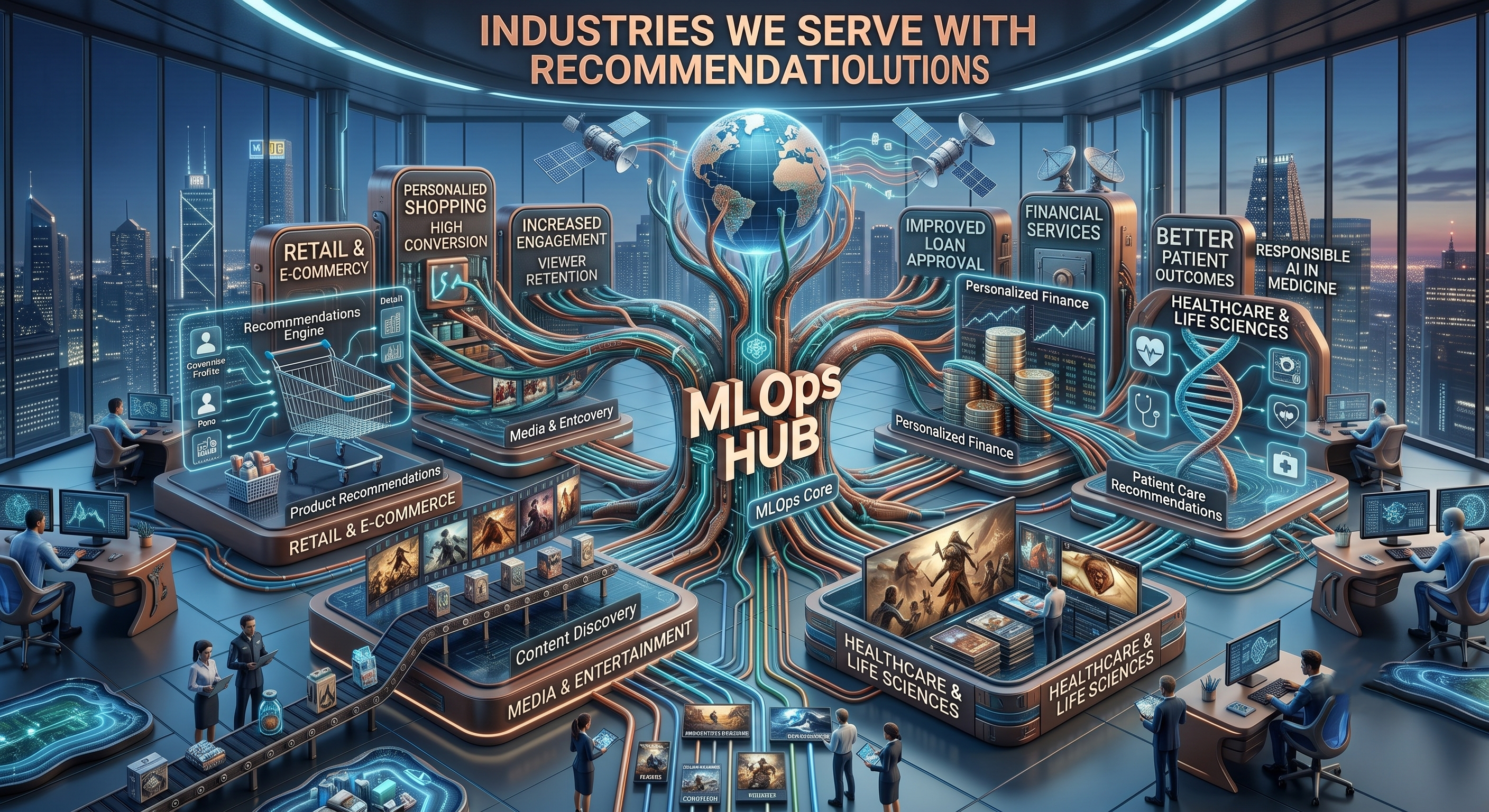
Industries We Serve with Recommendation Engine Solutions

Recommendation engines are most valuable wherever a platform has both a meaningful catalogue of items and a meaningful volume of user interaction data to learn from.

E-commerce & Retail

Product recommendations, cross-sell/upsell, personalised homepage merchandising

Media & Streaming

Content recommendations, next-episode suggestions, personalised content discovery

SaaS & Technology Platforms

Feature and module recommendations, in-app content surfacing, onboarding personalisation

Travel & Hospitality

Destination, accommodation, and activity recommendations based on traveller profile

EdTech & Online Learning

Course and content recommendations based on learning history and goals

Marketplaces

Listing recommendations for buyers, personalised search ranking

Food Delivery & Quick Commerce

Restaurant and item recommendations based on order history and time of day
AI Industries Network

Technologies & Tools Used

Tensorflow
PyTorch
Apache Spark
Google Cloud
Tensorflow
PyTorch
Apache Spark
Google Cloud
Tensorflow
PyTorch
Apache Spark
Google Cloud
Tensorflow
PyTorch
Apache Spark
Google Cloud
DagsHub
Docker
Optuna
Rapids
DagsHub
Docker
Optuna
Rapids
DagsHub
Docker
Optuna
Rapids
DagsHub
Docker
Optuna
Rapids

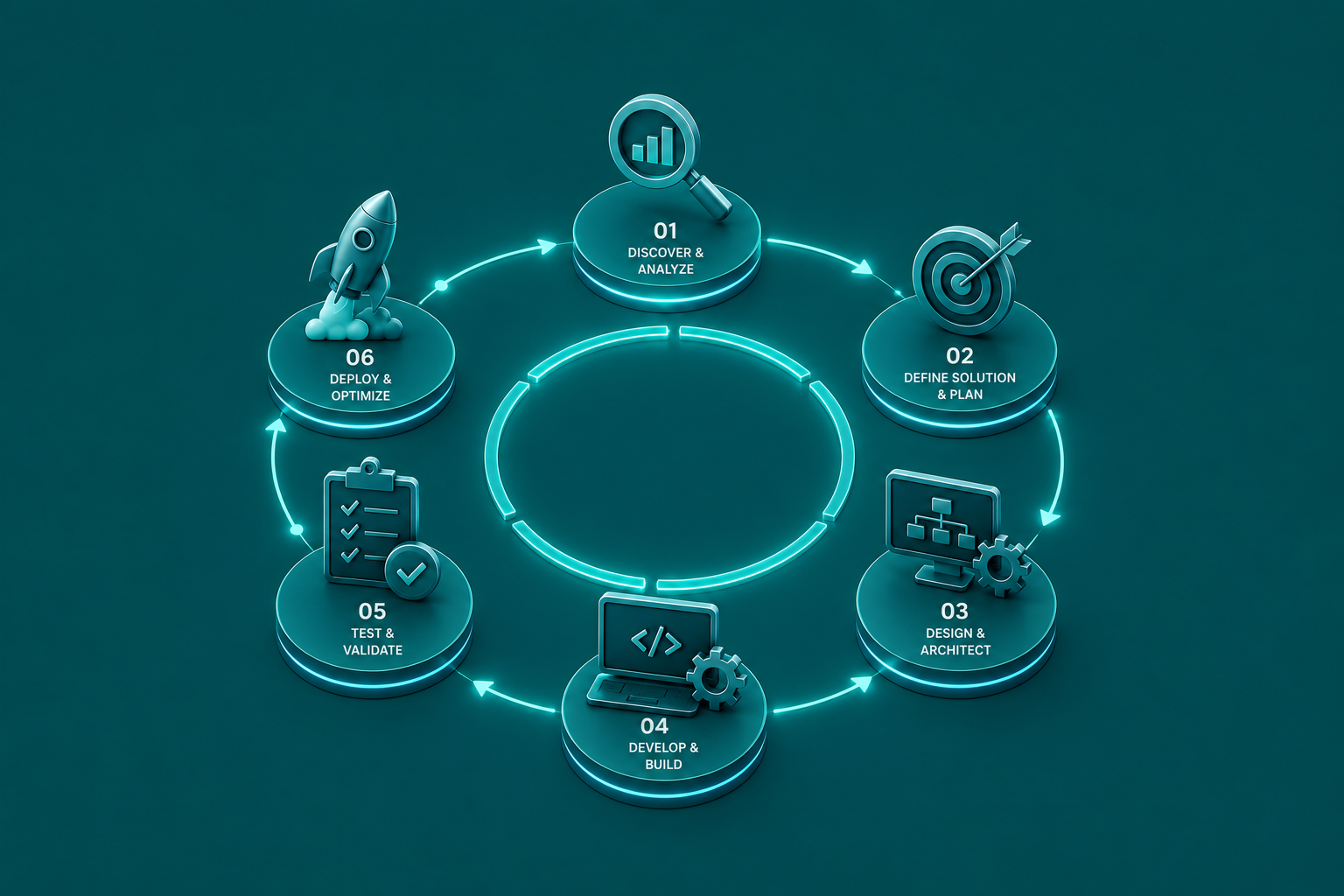
Our Development Process

We approach MLOps implementation as an incremental maturity uplift rather than a single, risky platform migration.

1

MLOps Maturity Assessment

We audit existing model deployment practices, infrastructure, and pain points, and benchmark current maturity against a defined MLOps maturity model to identify the highest-leverage starting point.

2

Pipeline Design & Tooling Selection

Based on existing infrastructure, team skillset, and compliance requirements, we select and design the CI/CD, registry, and monitoring stack appropriate to the client - not a generic template.

3

Version Control Foundation

We establish unified versioning across code, data, and models, typically the single highest-impact early intervention for reproducibility.

4

CI/CD Pipeline Build

We implement automated testing, validation, and deployment pipelines, starting with the highest-value or highest-risk model in production.

5

Monitoring & Alerting Implementation

We deploy drift detection, performance dashboards, and alerting thresholds tuned to the specific model and business context, not generic defaults.

6

Automated Retraining Pipeline

We build retraining triggers - scheduled, drift-based, or both - with validation gates to ensure a retrained model cannot auto-promote to production without passing defined accuracy thresholds.

7

Governance & Access Controls

For regulated clients, we implement approval workflows, audit logging, and role-based access aligned to the relevant compliance framework.

8

Knowledge Transfer & Handover

We document the full pipeline architecture and run structured training sessions so the client's internal team can operate and extend the system independently, rather than remaining dependent on us indefinitely.

This process is typically delivered over 6-14 weeks for an initial model or model family, with subsequent models onboarded onto the established platform far faster once the foundational pipeline exists.

AI MVP Development Team

Why Choose Our Company

We build platforms, not one-off scripts

Our MLOps engagements are designed so the pipeline infrastructure built for your first model scales cleanly to your fifth and fiftieth, rather than requiring a rebuild every time a new use case is added.

Deep familiarity with both data science and platform engineering

Because InfiniteTech AI builds models as well as the infrastructure to run them, our MLOps team understands the actual failure modes data scientists encounter, rather than approaching MLOps purely as a generic DevOps exercise bolted onto someone else's models.

India-based delivery with enterprise-grade engineering discipline

Operating from Chennai with delivery teams active across Bangalore, Hyderabad, and Mumbai gives international clients a meaningfully more efficient cost structure without compromising on production reliability standards expected in regulated Western and Middle Eastern markets.

Vendor-neutral tooling decisions

We are not tied to reselling a single cloud platform's MLOps suite, which means our toolchain recommendations are driven by what is right for your infrastructure and compliance needs, not by a partnership commission.

Built for handover, not lock-in

Every engagement includes structured documentation and team training so your internal engineers can operate and extend the platform independently - we measure success partly by how quickly we can make ourselves optional.

Case Study / Example Use Case

Rebuilding a Fragile Model Deployment Pipeline for a Retail Demand Forecasting Team

A retail client with operations spanning Bangalore and Mumbai had a data science team producing accurate demand forecasting models, but every new model version required a data scientist to manually export files, hand them to an engineer, and coordinate a deployment that regularly took over a week and occasionally broke downstream inventory systems with no warning. Forecast accuracy had quietly degraded for several months before anyone noticed, because there was no monitoring layer tracking live prediction error against actual sales.

InfiniteTech AI's MLOps team began with a two-week maturity assessment, which revealed the core issue was not model quality but the complete absence of automated testing, versioning, and monitoring around an otherwise solid forecasting approach. We implemented a CI/CD pipeline that automatically validated new model versions against a held-out historical period before allowing promotion, paired with a feature store to eliminate inconsistencies between the features used in training versus live serving - a discrepancy that had been silently hurting accuracy without anyone realising it.

A monitoring dashboard tracking forecast error against actual sales by region and product category was deployed alongside automated alerts triggered when error exceeded defined thresholds, replacing the previous situation where degraded accuracy was only discovered when a regional manager complained about stockouts.

Within the first two months of the new pipeline being live, deployment time for a new model version dropped from over a week to under a day, the previously undetected feature inconsistency was identified and corrected within the first deployment cycle, and the client's data science team reported being able to ship model improvements on a weekly cadence for the first time, rather than the roughly quarterly cadence the old manual process had effectively forced on them.

(Client name withheld per confidentiality agreement; reference details available on request for qualified enterprise buyers.)

Online Retailer E-commerce Platform

ROI & Business Impact

The return on an MLOps investment shows up less in any single model's accuracy and more in the speed, reliability, and cost-efficiency of running an entire portfolio of models over time.

Infrastructure costRight-sized, auto-scaled compute reducing wasted training and inference spend
Compliance readinessFaster, lower-risk audits through built-in lineage and governance trails
Cross-model scalabilityEach additional model onboarded onto existing pipelines at a fraction of the original setup cost

Industry research on machine learning adoption consistently surfaces the same pattern we see directly in client engagements: a significant share of trained models never reach production, and operational immaturity - not model quality - is cited as a leading cause. Organisations that close that operational gap do not just deploy more models; they deploy them faster, retire underperforming ones sooner, and avoid the slow, invisible cost of decisions being made on silently degraded predictions.

We work with clients to define concrete before-and-after operational metrics - average deployment lead time, mean time to detect model degradation, number of production incidents per quarter - so the value of an MLOps investment is demonstrable in operational terms a CFO can evaluate, not just a data science vanity metric.

Enterprise surveys consistently report that organisations deploying AI in core operations see higher revenue growth. We work with clients up front to define specific business metrics—cost per unit inspected, fraud loss rate, claims processing time—so that ROI is measurable from day one.

ROI%20%26%20Business%20Impact

Challenges & Solutions

No existing versioning across code, data, and models

SOLUTION

Establish unified version control as the foundational first step before any automation is layered on top

Training-serving skew between offline and online features

SOLUTION

Implement a centralised feature store as a single source of truth for both training and inference

Lack of visibility into live model performance

SOLUTION

Deploy monitoring dashboards with drift detection and threshold-based alerting from the outset

Manual, error-prone deployment processes

SOLUTION

Build automated CI/CD pipelines with validation gates and canary rollout

Spiralling cloud compute costs as model count grows

SOLUTION

Infrastructure-as-code with auto-scaling, spot-instance strategies, and right-sizing reviews

Frequently Asked Questions About MLOps Services

1. What is the difference between MLOps and DevOps?

DevOps focuses on automating and monitoring software code delivery, while MLOps extends those same principles to also handle data versioning, model versioning, experiment tracking, and the unique problem of models that can silently degrade in accuracy even while technically running correctly.

2. How do we know if our organisation needs dedicated MLOps services?

If deploying a new model version takes more than a few days of manual coordination, if nobody is actively monitoring live model accuracy, or if you cannot easily answer "exactly what data and code produced this model," your organisation would benefit materially from a dedicated MLOps practice.

3. How long does it take to set up a basic MLOps pipeline?

An initial CI/CD and monitoring pipeline for a single model family is typically delivered within 6-14 weeks, depending on existing infrastructure maturity and compliance requirements, with each subsequent model onboarded considerably faster.

4. Can MLOps be implemented without migrating to a new cloud platform?

Yes. Most MLOps tooling, including open-source options like MLflow, Airflow, and Feast, can be implemented on top of existing cloud or on-premise infrastructure without requiring a full platform migration.

5. What is model drift and why does it matter?

Model drift occurs when the statistical properties of live input data or the relationship between inputs and outcomes change over time, causing a model's real-world accuracy to degrade even though the model itself has not changed - making drift detection one of the most important MLOps capabilities.

6. Do we need a feature store if we only have a handful of models?

Not necessarily at first, but a feature store becomes increasingly valuable as the number of models grows or as the same features are reused across multiple models, since it eliminates the common and costly inconsistency between training and live serving calculations.

7. How does MLOps help with regulatory compliance?

A properly implemented model registry provides full lineage tracking - exactly which data, code, and approval steps produced a given production model - which directly supports audit requirements in regulated industries like banking, insurance, and healthcare.

8. What happens if a newly deployed model performs worse than the previous version?

With canary deployment and automated rollback in place, a small percentage of live traffic is routed to the new model first, performance is compared against defined thresholds, and the system automatically reverts to the previous version if the new model underperforms.

9. Is MLOps only relevant for large enterprises with many models?

No. Even organisations running a single business-critical model benefit significantly from basic MLOps practices like versioning and monitoring, since the cost of an undetected model failure can be high regardless of how many other models exist.

10. How does MLOps reduce cloud infrastructure costs?

Through infrastructure as code, auto-scaling, and right-sizing reviews, MLOps practices typically eliminate the over-provisioned, manually managed compute resources that accumulate when models are deployed and scaled ad hoc without a systematic operational layer.

11. Can existing data science teams be trained to manage an MLOps platform themselves?

Yes, and we structure every engagement to include documentation and hands-on training specifically so the client's internal team can operate, extend, and troubleshoot the platform independently after handover.

12. What is a model registry and do we really need one?

A model registry is a centralised system tracking every trained model version, its lineage, approval status, and deployment history. It becomes necessary the moment more than one person is involved in deploying models, since it removes ambiguity about which model version is actually live in production.

13. How does MLOps differ for generative AI and large language models compared to traditional ML?

Generative AI introduces additional operational concerns - prompt versioning, output quality evaluation, and per-token cost monitoring - that traditional MLOps tooling was not originally built for, leading to the emerging discipline often called LLMOps, which we treat as an extension of the same underlying MLOps principles.

14. Do you offer MLOps services to clients outside India?

Yes. While headquartered in Chennai with active delivery across Bangalore, Hyderabad, and Mumbai, we serve enterprise clients internationally across North America, the UK, and the Middle East, with engagement processes designed for distributed, asynchronous collaboration.

15. What is the first step to starting an MLOps engagement with InfiniteTech AI?

The first step is an MLOps maturity assessment, typically completed within one to two weeks, where we review your current deployment practices and infrastructure and identify the highest-leverage starting point before any commercial commitment to a full build.

Ready to Build AI That Delivers Real Business Value?

Stop experimenting with prototypes and start deploying production-ready AI software. Book a 60-minute strategy session with our senior AI architects. We will assess your data, identify high-ROI use cases, and map out a technical blueprint for your organization.

Schedule Your Free Session Now
InfiniteTech AI Footer
Scroll to Top