What Is AI Software Development?
AI software development is the engineering discipline of designing, building, training, deploying, and maintaining software systems that can perceive their environment, learn from data, reason about complex inputs, and take actions — with or without constant human intervention.
This is fundamentally different from conventional software development. Traditional software follows deterministic rules: given input A, it always produces output B. AI software, by contrast, is probabilistic and adaptive. It improves with exposure to data, surfaces patterns invisible to human analysts, and generates outputs — predictions, recommendations, classifications, content, decisions — that evolve as conditions change.
AI software development encompasses several distinct but interrelated disciplines:
- Machine Learning (ML) Engineering — building predictive models trained on structured and unstructured data
- Deep Learning Development — designing and training neural networks for complex recognition and generation tasks
- Natural Language Processing (NLP) — enabling machines to understand, interpret, and generate human language
- Computer Vision Engineering — building systems that extract meaning from images, video, and visual data streams
- Generative AI Development — integrating or fine-tuning large language models (LLMs) like GPT-4, Claude, and Gemini for enterprise applications
- MLOps & AI Infrastructure — designing the data pipelines, model registries, monitoring frameworks, and CI/CD systems that keep AI in production
- Autonomous Agents & AI Orchestration — building multi-step AI systems that can plan, use tools, and complete complex tasks independently
When done well, AI software development produces systems that do not just automate existing processes — they fundamentally expand what is possible.
Industries We Serve with AI Software Development
Our AI development capabilities span industries. Here is how we apply AI software development across specific verticals:
Financial Services & FinTech
Credit risk scoring models, fraud detection systems, algorithmic trading signal generation, regulatory compliance automation, intelligent document processing for KYC/AML, AI-powered wealth management advisors, real-time transaction anomaly detection.
Healthcare & Life Sciences
Clinical decision support systems, medical imaging analysis, patient risk stratification models, drug discovery acceleration tools, EHR data extraction and structuring, AI-assisted diagnostics, health outcomes prediction, and hospital operations optimization.
Manufacturing & Industrial
Predictive maintenance systems trained on sensor time-series data, computer vision-based quality inspection, supply chain demand forecasting, production scheduling optimization, energy consumption prediction, and defect classification models.
E-Commerce & Retail
Personalized recommendation engines, dynamic pricing systems, inventory optimization models, visual search, customer churn prediction, sentiment analysis pipelines, and AI-powered merchandising intelligence.
Legal Technology
Contract analysis and clause extraction, case outcome prediction, legal research automation, regulatory change monitoring, due diligence acceleration, and intelligent contract drafting assistants.
Logistics & Supply Chain
Route optimization engines, demand forecasting models, warehouse automation AI, carrier selection intelligence, real-time supply chain risk monitoring, and last-mile delivery optimization.
SaaS & Technology Companies
AI-native product features, embedded ML capabilities, intelligent search and discovery, content generation pipelines, usage pattern analysis, and churn prediction models integrated into SaaS platforms.
Education Technology
Adaptive learning systems, student performance prediction, content personalization engines, automated grading and feedback tools, and intelligent tutoring systems.

Our AI Software Development Process
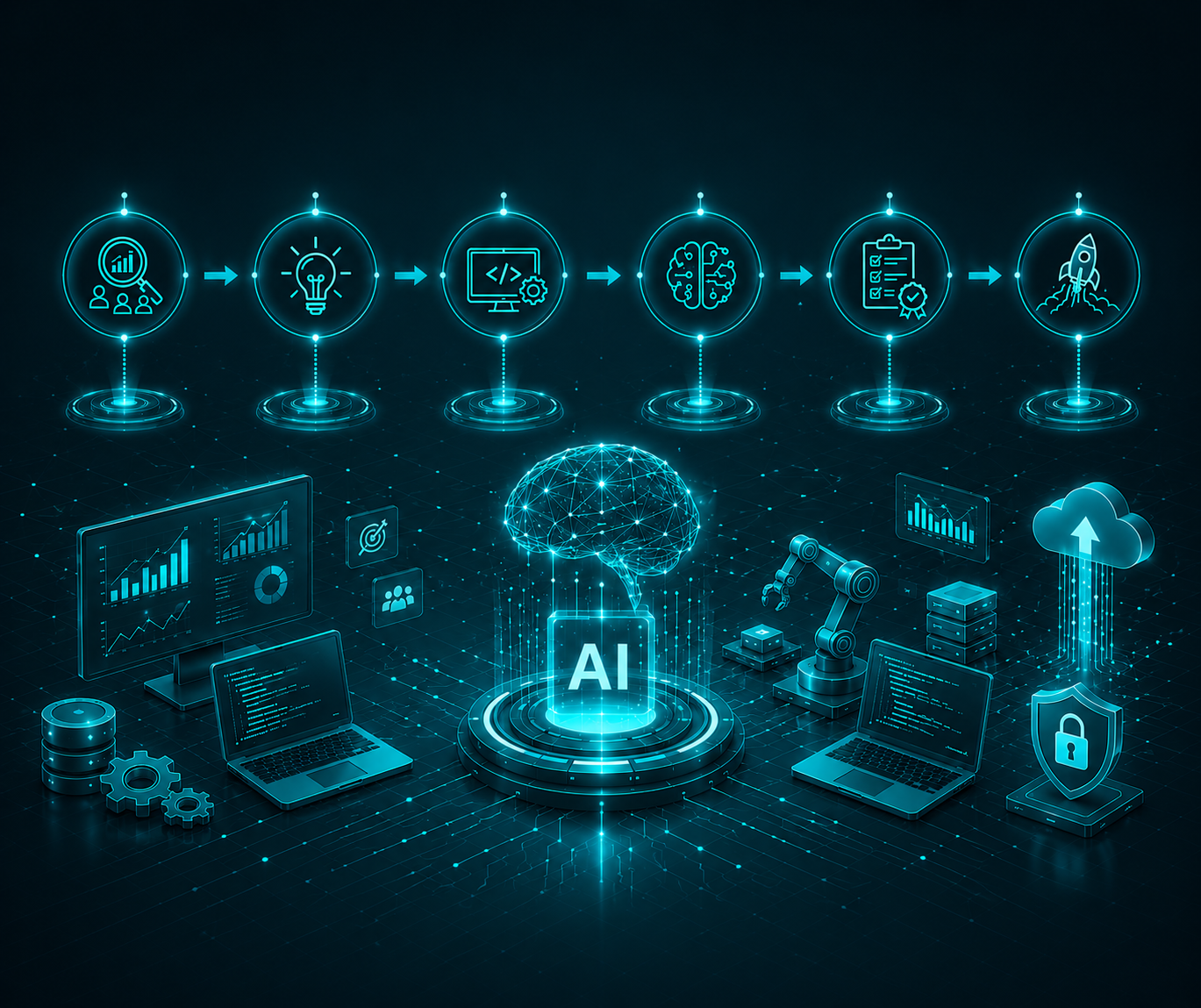
We follow a structured, milestone-driven development process that balances speed with rigor. Every engagement moves through the following phases:
Phase 1: Discovery & AI Feasibility Assessment (Weeks 1–2)
We begin with a structured discovery process — not a sales conversation. Our team works with your domain experts, data engineers, and business stakeholders to understand your problem space, evaluate your data assets, identify the highest-value AI opportunities, and assess technical feasibility.
Deliverables: Problem statement document, data readiness assessment, AI feasibility report, recommended solution architecture, and a milestone-based project plan.
Phase 2: Data Strategy & Engineering (Weeks 2–6)
Data is the foundation of every AI system. We audit your existing data sources, design data collection strategies where gaps exist, build ingestion and transformation pipelines, establish data quality monitoring, and create the clean, structured datasets that model training requires.
Deliverables: Data architecture diagram, ETL/ELT pipelines, feature engineering specifications, data quality report, and a curated training dataset.
Phase 3: Model Research & Prototype Development (Weeks 4–10)
This is where the AI work begins in earnest. Our ML engineers conduct systematic experiments — testing multiple model architectures, training strategies, and evaluation frameworks — to identify the approach that best fits your problem. For generative AI projects, this phase includes LLM selection, RAG system design, and prompt architecture.
Deliverables: Experiment tracking dashboard, model comparison report, prototype model with evaluation benchmarks, and a recommended production architecture.
Phase 4: Production Model Development (Weeks 8–16)
With the optimal approach validated, we build the production-grade model. This includes hyperparameter optimization, training on the full dataset, rigorous evaluation across multiple metrics, bias auditing, and explainability implementation.
Deliverables: Production-ready model artifacts, evaluation report, explainability analysis, and model documentation.
Phase 5: Application Engineering & Integration (Weeks 12–20)
The model is only one component. We engineer the full application layer: APIs, data connectors, user interfaces, workflow integrations, authentication systems, and operational tooling. Every integration is built to your enterprise security and compliance requirements.
Deliverables: Deployed AI application, API documentation, integration test suite, and security audit report.
Phase 6: MLOps & Monitoring Setup (Weeks 18–22)
Production AI requires ongoing operational infrastructure. We build and configure model monitoring dashboards, drift detection alerts, automated retraining pipelines, A/B testing frameworks, and performance reporting — so your AI system continues to perform and improve after launch.
Deliverables: MLOps infrastructure, monitoring dashboards, retraining documentation, and operations runbook.
Phase 7: Launch, Training & Ongoing Support
We manage the production launch, provide comprehensive training for your team, conduct post-launch performance reviews, and offer ongoing support packages ranging from advisory retainers to full managed AI operations.
Benefits of AI Software Development for Your Business
Organizations that invest in serious AI software development — not experimentation, but production-grade deployment — report outcomes that compound over time. Based on our client engagements and corroborated by industry research, the most consistent benefits include:
These are not theoretical outcomes. They represent documented results across industries including manufacturing, financial services, healthcare technology, e-commerce, and logistics — industries where the margin between good and great decisions is measured in millions of dollars.
Beyond the numbers, AI software development creates a structural competitive advantage that is difficult to replicate. A custom AI system trained on your proprietary data, integrated with your unique workflows, and refined through months of production feedback becomes a moat — one that competitors cannot simply purchase off a shelf.
Case Study: AI-Powered Claims Processing for a Leading Insurance Provider
Background: A mid-sized insurance company was processing approximately 12,000 claims per month using a team of 45 claims adjusters. Average processing time was 8.3 days per claim, with a manual error rate of approximately 6% requiring costly rework. The organization had attempted to implement a rule-based automation system two years earlier that failed to handle the variability of real-world claims documents.
Our Approach: We conducted a four-week discovery engagement to assess data availability, document the claims workflow end-to-end, and identify the highest-value automation opportunities. The resulting system combined four AI components: an NLP-based document extraction pipeline, a claims classification model, a fraud signal detection system, and an intelligent routing engine that matched claims to adjusters based on complexity and specialization.
Technical Architecture:
- Document OCR and extraction using a fine-tuned LayoutLM model
- Claims classification using a gradient-boosted ensemble trained on 5 years of historical claims
- Fraud detection using an isolation forest combined with a graph neural network for detecting claim relationship patterns
- Routing engine built on a multi-armed bandit algorithm with adjustor performance feedback loops
- REST API integration with the client's existing claims management platform (Guidewire)
- Full MLOps stack with daily model performance reporting and weekly retraining
Outcomes Achieved (Measured at 6 Months Post-Launch):
- Average claims processing time reduced from 8.3 days to 2.1 days (75% reduction)
- Straight-through processing (no human review required) achieved for 64% of claims
- Fraud detection rate improved by 38% relative to previous rule-based system
- Manual error rate reduced from 6% to 0.8%
- Estimated annual cost savings of ₹3.2 crore (approximately $380,000 USD)
- Claims adjuster capacity freed up was redeployed to complex, high-value claims — improving adjuster satisfaction and retention
ROI & Business Impact of AI Software Development
Understanding the return on investment from AI software development requires thinking across multiple dimensions: direct cost savings, revenue impact, risk reduction, and strategic value creation.
Direct Cost Reduction
AI systems that automate manual processes deliver immediate and measurable labor cost savings. For document-intensive industries — insurance, legal, banking, healthcare administration — the savings are typically 40–70% of the cost of the process being automated.
Revenue Growth
AI enables personalization, better targeting, and faster response to market signals. E-commerce clients typically see 15–25% revenue uplift from AI-driven recommendation systems. SaaS companies embedding AI into their products see ARR growth acceleration of 20–40% compared to non-AI feature roadmaps.
Risk Reduction
In regulated industries, AI-powered compliance monitoring, fraud detection, and audit systems reduce the cost of compliance failures. The average cost of a data breach in India reached ₹17.9 crore in 2023 (IBM Cost of a Data Breach Report). AI security systems that prevent even one significant breach pay for years of development investment.
Time-to-Decision Compression
AI compresses analytical cycles from days to seconds. In supply chain management, faster demand sensing and inventory optimization have quantifiable financial impacts that can be modeled against specific SKU economics.
Competitive Moat Creation
The most significant long-term ROI from AI software development is structural: organizations that build AI capabilities earlier create proprietary datasets, refined models, and organizational competencies that competitors cannot acquire quickly. First-mover advantage in AI is real and durable in most industry contexts.
Typical payback periods for enterprise AI investments, by project type:

People Also Ask: AI Software Development
What is the difference between AI software development and traditional software development?
Traditional software development involves writing explicit rules and logic that determine how a program behaves. AI software development creates systems that learn patterns from data, make probabilistic predictions, and adapt their behavior based on new information — without being explicitly programmed for every scenario. AI software is nondeterministic and data-driven, while traditional software is deterministic and rule-driven.
How long does it take to build a custom AI software solution?
The timeline for custom AI software development varies significantly by complexity. Simple AI integrations — connecting to an existing LLM API with a tailored prompt architecture — can be completed in 4–8 weeks. Mid-complexity projects involving custom model training, data pipeline development, and enterprise integration typically take 3–6 months. Large-scale AI platforms with multiple models, complex integrations, and enterprise deployment requirements typically require 6–18 months for initial launch.
How much does AI software development cost in India?
AI software development costs in India range from approximately ₹15–30 lakh for focused, well-scoped projects to ₹1–5 crore or more for comprehensive enterprise AI platforms. The key cost drivers are data complexity, model complexity, integration requirements, team size, and timeline. Indian AI development companies offer significant cost advantages compared to US or European vendors — typically 40–60% lower — while maintaining global engineering standards.
Do I need to have my own data to build an AI system?
Not necessarily, but data availability and quality significantly affect what kind of AI system is feasible and how well it will perform. For many applications — generative AI assistants, document processing, image analysis — you can leverage pre-trained foundation models that require relatively small amounts of your proprietary data for fine-tuning. For applications that require predicting specific business outcomes (churn, fraud, demand), your historical data is typically essential to building an accurate model.
What industries benefit most from AI software development?
AI software development delivers measurable ROI across virtually every industry, but the highest-impact applications tend to be in industries with high data volumes, high decision frequency, or high cost of errors: financial services (fraud detection, credit scoring, trading), healthcare (diagnostics, clinical decision support, operational efficiency), manufacturing (predictive maintenance, quality control), e-commerce (recommendations, personalization, inventory), and logistics (demand forecasting, route optimization).
Is AI software development suitable for startups or only large enterprises?
AI software development is highly relevant for startups, particularly those building AI-native products where intelligent capabilities are a core value proposition. The economics of AI development have improved dramatically: cloud-based model inference, open-source frameworks, and foundation model APIs make sophisticated AI capabilities accessible to companies of any size. The key for startups is selecting AI opportunities that create genuine competitive differentiation rather than implementing AI for its own sake.
How do I ensure my AI system stays accurate over time?
Maintaining AI accuracy in production requires a practice called MLOps (Machine Learning Operations). This involves monitoring model performance metrics continuously, detecting when the real-world data the model encounters starts to diverge from its training distribution (a phenomenon called data drift), and implementing automated or triggered retraining pipelines. AI systems without active performance monitoring will degrade over time as the world changes.
What is RAG (Retrieval-Augmented Generation) and do I need it?
RAG is an architecture for building AI applications that combines a large language model's reasoning capabilities with dynamic retrieval from a private knowledge base. Instead of relying solely on what an LLM learned during pre-training, a RAG system retrieves relevant documents from your proprietary data sources at query time and provides them as context. RAG is essential for any AI application that needs to answer questions based on private, frequently updated, or highly specialized data without constantly retraining the model.