
Amazon Search Suggestions & Autocomplete Harvester
Pro SEO Automation Tool Amazon Suggestions harvester interface with live search queries and country selection.
Operational Purpose & Search Scraping
The Amazon Suggestions tool extracts real-time customer search queries directly from marketplace search endpoints. By simulating user keystrokes with alphanumeric prefixes and suffixes, it discovers long-tail search variations that indicate active buying intent.
Technical Execution Pipeline
- 1. The user inputs a seed product term (e.g., 'universal remote control').
- 2. The backend sends asynchronous requests to the marketplace autocomplete API.
- 3. Results are deduplicated, sorted by query relevance, and displayed in the interface.
- 4. The user can export the keyword set to CSV for use in listing titles, bullet points, or PPC ad groups.
Amazon ASIN Detail Extraction & Competitor Scraper
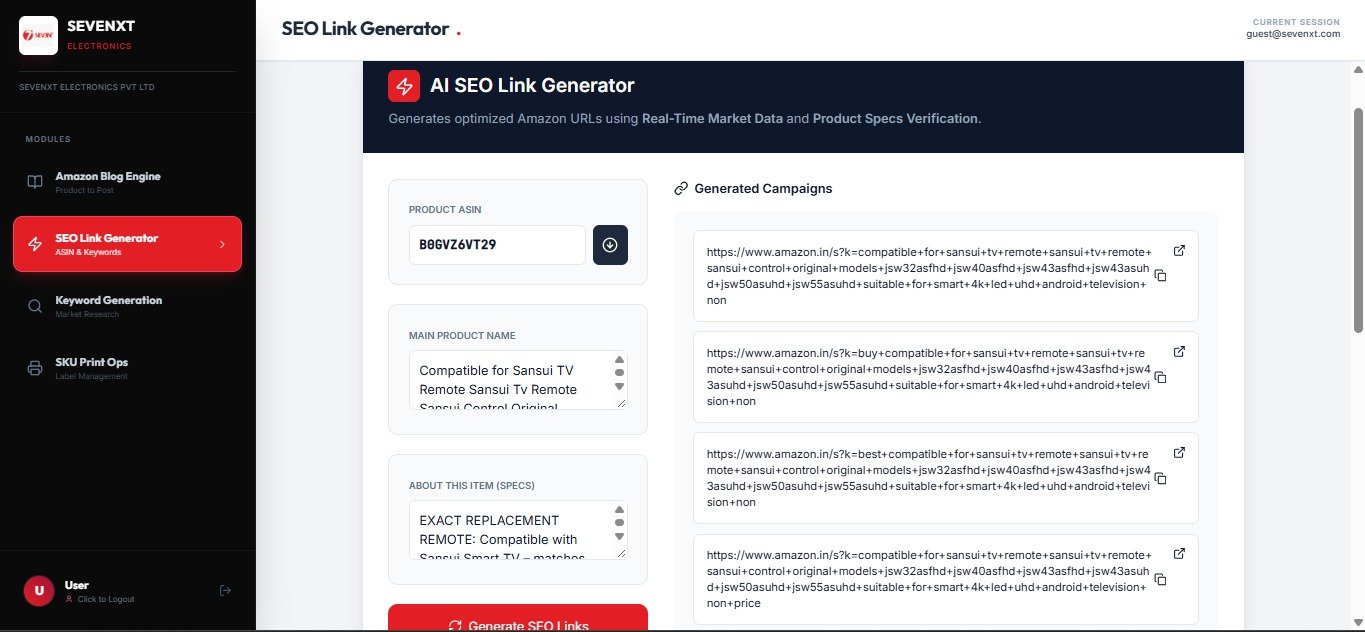
Operational Purpose & Listing Analysis
The ASIN Detail Scraper in features/amazon_details.py extracts structured data from Amazon product pages. This allows brand managers to benchmark competitor listings, analyze pricing structures, and identify gaps in product copy.
Extracted Product Attributes
- ASIN Identifier: Canonical marketplace product ID.
- Product Title: Full listing title analyzed for brand placement and keyword density.
- Bullet Points: Five key feature statements parsed for clarity and benefit orientation.
- Pricing & Availability: Current buy-box price, discount structure, and inventory status.
- Review Metrics: Average star rating and total review counts for competitor benchmarking.
Anti-Bot & Header Management
The extraction pipeline rotates user-agent headers and adds random jitter to request timing, preventing IP rate-limiting during high-volume catalog analysis.
AI Keyword Generation & Intent Strategy Studio
Figure 2: Keyword Strategy Studio showing semantic clustering and intent analysis.
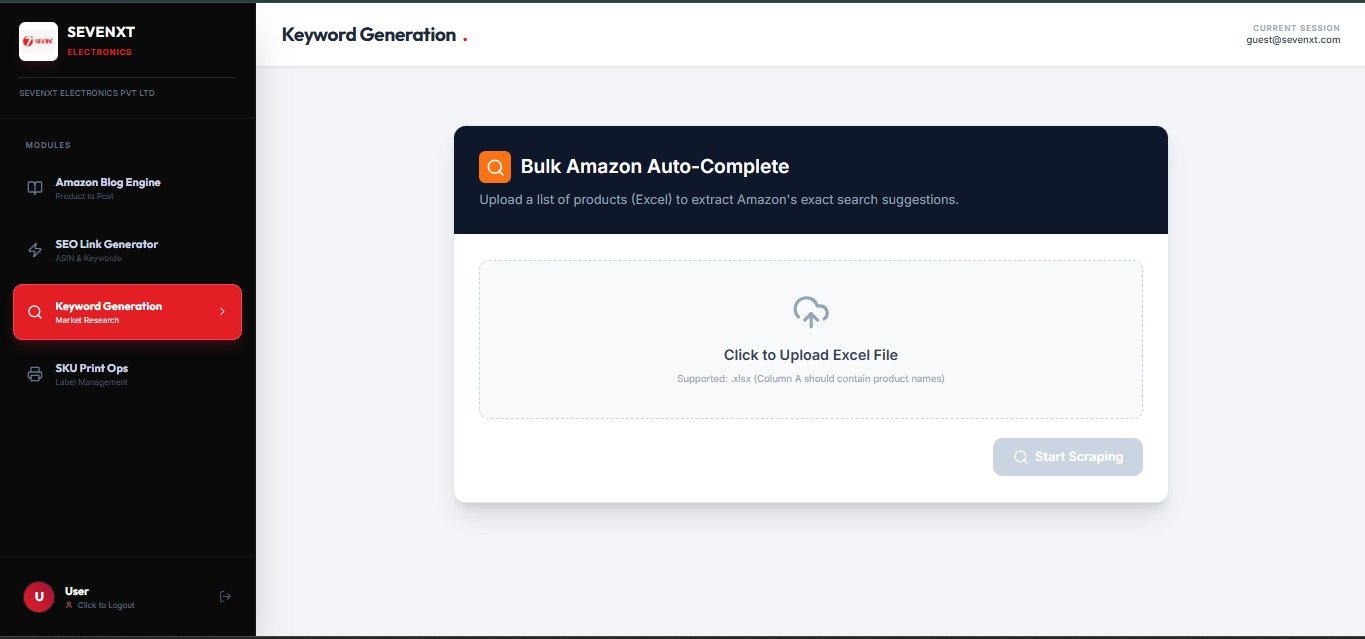
Operational Purpose & Keyword Clustering
The Keyword Generation Studio uses language models to expand seed topics into comprehensive keyword lists, categorizing them by user search intent (Informational, Commercial, or Transactional).
Intent Categorization Framework
- Commercial Intent: Keywords containing purchase modifiers (e.g., 'best price', 'buy online').
- Informational Intent: Queries focused on product use (e.g., 'how to program universal remote').
- Transactional Intent: High-intent queries containing specific brand and model numbers.
Automated Blog Generation & Prompt Engine
log authoring interface with structured draft generation and CMS toggles.
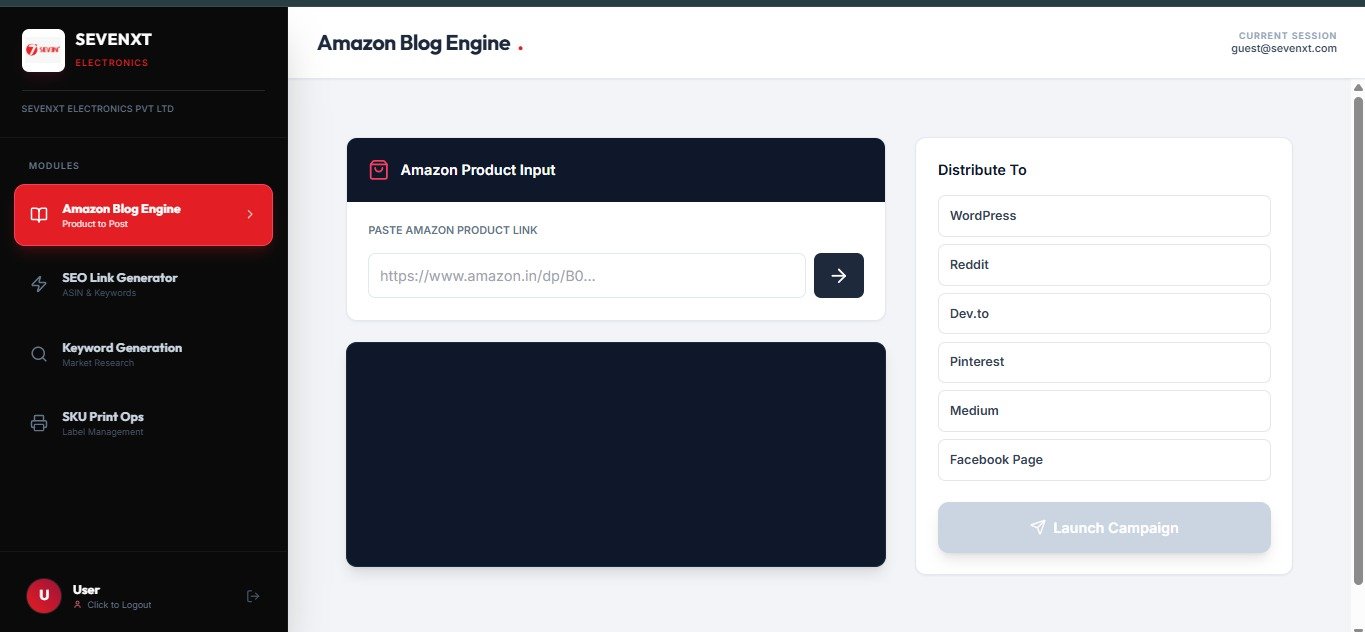
Operational Purpose & Content Synthesis
The Blog Generation Engine in features/blog_posting/core/generate_blog.py automatically creates structured, search-optimized articles based on input keywords, target tone, and desired length.
Prompt Construction Pipeline
- 1. Keyword Ingestion: Incorporates primary and secondary keywords into the prompt context.
- 2. Outline Formatting: Constructs a clear heading hierarchy (H1, H2, H3) for readability and SEO.
- 3. Draft Generation: Generates comprehensive article text with introductory hooks, structured bodies, and conclusions.
- 4. Meta Tag Generation: Produces recommended meta descriptions and URL slugs for search indexation.
Dynamic Royalty-Free Image Retrieval Pipeline
Operational Purpose & Visual Integration
The Image API module in features/blog_posting/core/image_api.py automates the process of sourcing and embedding royalty-free images into generated articles, removing the need for manual image searches.
Image Sourcing Workflow
- Query Generation: Automatically creates targeted search terms based on article heading topics.
- API Communication: Queries royalty-free image repositories (Unsplash / Pexels) for relevant photos.
- Dimension Optimization: Selects landscape images optimized for web display without slowing page loads.
- Accessibility Tagging: Generates descriptive image alt text based on the article context.
Multi-CMS Syndication (WordPress, Blogger, Medium)
Operational Purpose & Cross-Platform Distribution
The CMS Publisher in features/blog_posting/core/cms_publishers.py enables one-click publishing across multiple content platforms, syndicating articles without requiring manual copy-pasting.
Supported Publishing Targets
- WordPress: Connects via the WordPress REST API using application passwords, formatting content as native Gutenberg blocks or HTML.
- Blogger: Publishes to Google Blogger using OAuth 2.0 credentials.
- Medium: Dispatches drafts or published stories via Medium integration tokens.
Warehouse SKU Thermal Barcode Generator
Warehouse thermal SKU label generation console with batch spreadsheet upload.
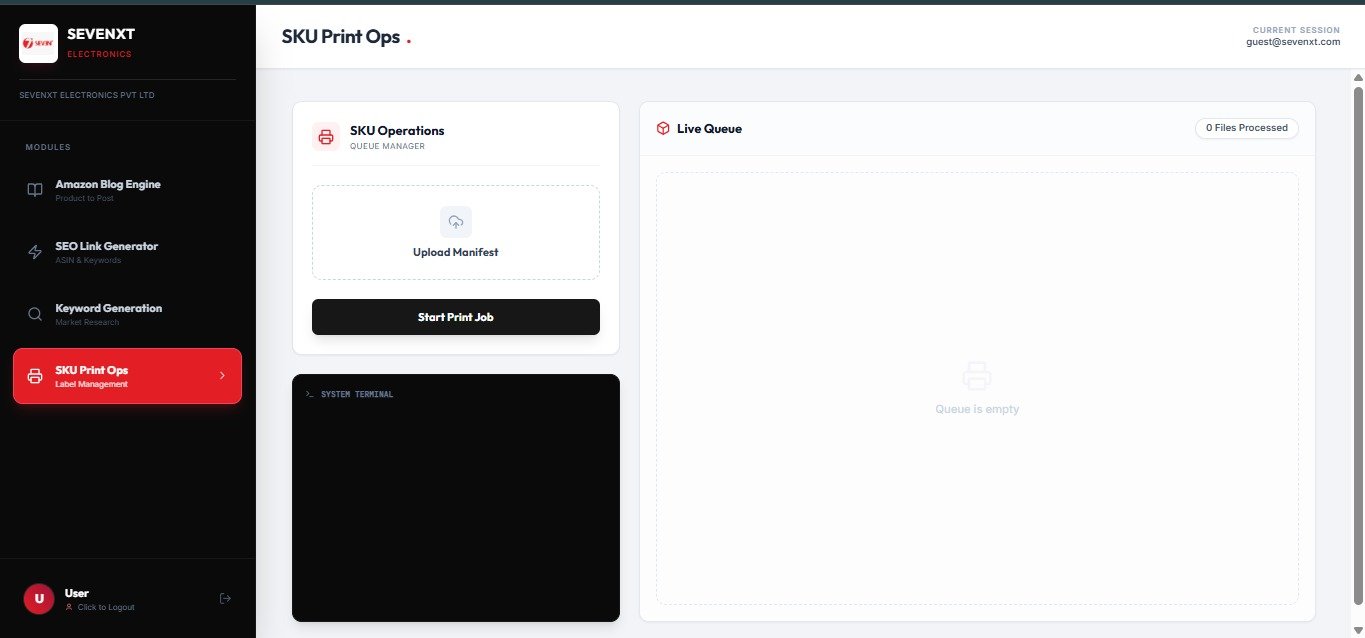
Operational Purpose & Thermal Label Printing
The SKU Printing module in features/sku_printing.py converts inventory spreadsheets into print-ready thermal barcode labels, streamlining warehouse packaging for Amazon FBA and direct fulfillment.
Label Customization Options
- Spreadsheet Parsing: Reads batch files containing SKU, Product Title, MRP, and Barcode numbers.
- Symbology Support: Generates vector-sharp Code 128, EAN-13, and Code 39 barcodes.
- Dimensions: Formats output for standard thermal rolls (50x25mm, 4x2 inch) and multi-label sheets.
Industry Context & Multi-Channel Challenges
Modern e-commerce brands and direct-to-consumer (D2C) manufacturers operate in an increasingly complex and fragmented operational environment. To remain competitive across major marketplaces like Amazon India and Flipkart, brands must continuously optimize organic search discoverability, maintain regular organic blog publishing schedules, and package physical goods with strict compliance barcodes.
The Marketplace Visibility Bottleneck
Marketplace algorithms rely on keyword relevance in titles, bullet points, and backend search terms. Traditional sellers use third-party keyword tools that rely on outdated search databases. Without live autocomplete harvesting directly from marketplace endpoints, sellers miss trending search query shifts and consumer phrasing patterns.
The Fragmented Content Production Loop
Maintaining high organic domain authority requires regular publication of informative articles. Traditionally, this involves an author drafting text, an editor sourcing images, and a webmaster formatting and publishing across multiple content management systems (WordPress, Blogger, Medium). This manual process introduces significant friction and limits an organization's content publishing velocity.
Warehouse Thermal Label Formatting Chaos
In warehouse fulfillment centers, designing and printing physical barcode labels (e.g. for replacement remote controls, consumer electronics, and spare parts) is often handled through manual desktop software. Typing SKUs, MRPs, and descriptions manually leads to scanning errors, mislabeled shipments, and Amazon FBA rejections.
What Is Pro SEO Automation Tool? Purpose, Vision & Scope
Pro SEO Automation Tool is a centralized operational suite designed to streamline e-commerce cataloging, automate content production, and standardize physical warehouse label printing in a single interface.
Architectural Vision
Pro SEO Automation Tool replaces disconnected tools with an integrated system where marketplace search insights directly inform content generation, and inventory spreadsheets seamlessly feed into warehouse fulfillment printing.
Marketplace Autocomplete Scraping
Directly queries Amazon suggestion APIs to extract real-time buyer search terms.
ASIN Product Detail Mining
Scrapes and parses product specifications, bullet points, and pricing for competitor benchmarking.
Autonomous AI Blog Authoring
Generates structured, long-form articles with headings, bullet points, and meta tags based on target keyword seeds.
Contextual Image Enrichment
Connects to royalty-free image APIs to retrieve high-resolution images with automated alt tags.
Multi-Platform CMS Syndication
Directly publishes articles to WordPress, Blogger, and Medium via unified API adapters.
Warehouse SKU Barcode Automation
Parses product spreadsheets and generates vector-accurate Code 128 thermal labels.
Detailed User Personas & Permissions
Pro SEO Automation Tool provides role-based access control across key organizational functions to maintain data security and focus workflows.
1
System Administrator / Founder (admin)
- Scope: User management, third-party API credentials, server configurations, and database backups.
- Core Responsibilities: Configuring CMS authentication tokens, managing OpenAI/Gemini API keys, and monitoring background tasks.
- Permissions: Full administrative access across all endpoints, configuration files, and database tables.
2
Marketplace Operations Lead (marketplace_lead)
- Scope: Amazon keyword harvesting, competitor ASIN analysis, and catalog optimization.
- Core Responsibilities: Scraping real-time suggestions, extracting high-intent search terms, and updating marketplace listings.
- Permissions: Access to Amazon Suggestions, Product Details Scraper, and Keyword Strategy Studio.
3
Content Strategist & Copywriter (content_marketer)
- Scope: Organic search strategy, article authoring, image enrichment, and multi-channel blog syndication.
- Core Responsibilities: Prompting the AI blog generator, reviewing article drafts, sourcing relevant images, and publishing to CMS endpoints.
- Permissions: Access to Blog Generation, Image APIs, and CMS Publishing modules.
4
Warehouse & Logistics Executive (warehouse_operator)
- Scope: Inventory intake, SKU label generation, barcode verification, and thermal printing.
- Core Responsibilities: Ingesting product spreadsheets, validating SKU details, and printing compliant thermal barcode rolls.
- Permissions: Access to SKU Printing and label asset download directories.
Technology Stack & Architectural Topology
The Pro SEO Automation Tool employs a modern decoupled architecture, combining a lightweight Flask API backend with an optimized React Vite frontend.
| Component Layer | Technology / Framework | Operational Functionality |
|---|---|---|
| Frontend Runtime | React 18 + Vite (SPA) | High-performance user interface with component-level state management. |
| Styling & Layout | Tailwind CSS + PostCSS | Responsive utility-first styling for operational dashboards and modals. |
| HTTP Client | Axios Interceptors | Handles authenticated REST calls with automatic JWT header injection. |
| Backend Framework | Flask (Python 3.11.9) | Asynchronous microservices framework exposing modular blueprint routes. |
| Database ORM | Flask-SQLAlchemy | Object-relational mapping managing users, tokens, and system settings. |
| Security & Auth | Flask-Bcrypt + PyJWT | Secure password hashing and stateless token-based authentication. |
| Scraping Engine | Requests + BeautifulSoup4 | HTTP clients for querying Amazon autocomplete and product pages. |
| Barcode Generation | python-barcode + Pillow | Renders high-resolution Code 128 and EAN-13 barcode vectors. |
| Spreadsheet Processing | Pandas + OpenPyXL | Batch parsing of inventory spreadsheets (.xlsx, .csv). |
| Production Server | Gunicorn + Nginx | WSGI production server behind an Nginx reverse proxy. |
Mathematical Search Intent & Keyword Density Scoring
To ensure search discoverability without keyword stuffing, the SEO engine calculates keyword density and relevance scores.
Keyword Density Formulation
The system evaluates article drafts using standard keyword density metrics:
KD = ( K / T ) × 100
where K is the frequency of the target keyword and T is the total word count. The platform recommends a target density between 1.0% and 2.5% for primary terms.
TF-IDF Intent Weighting
Term Frequency-Inverse Document Frequency (TF-IDF) scoring evaluates keyword uniqueness against general language corpora, ensuring specific product attributes are emphasized in generated content.
Thermal Barcode Vector Rendering Mechanics
Thermal printers require clean black-and-white graphics to ensure reliable optical scanning in fulfillment centers.
Rendering Specifications
- Resolution: 203 DPI or 300 DPI vector output matching standard thermal printer heads.
- Quiet Zone Enforcement: Ensures a minimum margin of 10 times the narrow bar width on both sides of the barcode.
- Typography: Renders clear human-readable text beneath the barcode for manual inspection.
Relational Database Schema & Data Models
The database models are implemented using Flask-SQLAlchemy in backend/app/models/user.py to manage user accounts and system state.
| Table Name | Primary / Foreign Keys | Attributes & Field Types |
|---|---|---|
| users | id INT PK | username (VARCHAR UNIQUE), email (VARCHAR UNIQUE), password_hash (VARCHAR), is_active (BOOLEAN), created_at (DATETIME). |
| api_integrations | id INT PK user_id INT FK | platform_name (VARCHAR), api_key_encrypted (TEXT), endpoint_url (VARCHAR), is_enabled (BOOLEAN). |
| search_logs | id INT PK user_id INT FK | seed_keyword (VARCHAR), suggestions_count (INT), marketplace (VARCHAR), created_at (DATETIME). |
| label_batches | id INT PK user_id INT FK | batch_filename (VARCHAR), total_skus (INT), label_dimensions (VARCHAR), created_at (DATETIME). |
REST API Reference: Authentication & Accounts
Authentication endpoints in app/routes/auth_routes.py handle user onboarding, session verification, and token issuance.
| Endpoint Route | Method | Description & Request Body |
|---|---|---|
| /api/auth/register | POST | Creates a new user profile with username, email, and password. |
| /api/auth/login | POST | Validates credentials and returns a signed JWT access token. |
| /api/auth/me | GET | Returns current authenticated user identity and active permissions. |
| /api/auth/logout | POST | Invalidates current session token. |
REST API Reference: Amazon Scraping & Intelligence
Endpoints in app/routes/suggestion_routes.py and amazon_routes.py query marketplace autocomplete and listing endpoints.
| Endpoint Route | Method | Description & Parameters |
|---|---|---|
| /api/suggestions/scrape | GET | Harvests autocomplete queries for a given keyword parameter. |
| /api/amazon/product-details | POST | Extracts listing attributes and bullet points for a target asin. |
| /api/amazon/export-csv | POST | Generates a downloadable CSV containing structured keyword sets. |
REST API Reference: Blog Synthesis & Publishing
Endpoints in app/routes/blog_routes.py handle article generation, image retrieval, and CMS distribution.
| Endpoint Route | Method | Description & Request Body |
|---|---|---|
| /api/blog/generate | POST | Generates an article draft from topic, keywords, and tone settings. |
| /api/blog/fetch-images | POST | Queries royalty-free image APIs for photos matching article themes. |
| /api/blog/publish | POST | Dispatches completed articles to connected WordPress, Blogger, or Medium sites. |
REST API Reference: SEO & SKU Label Engine
Endpoints in app/routes/seo_routes.py handle keyword analysis, while SKU printing routes process spreadsheet label files.
| Endpoint Route | Method | Description & Request Body |
|---|---|---|
| /api/seo/keywords/expand | POST | Expands seed phrases into categorized keyword clusters. |
| /api/sku/upload-sheet | POST | Uploads inventory spreadsheets (.xlsx, .csv) for label processing. |
| /api/sku/generate-pdf | POST | Renders thermal barcode labels and returns a downloadable PDF. |
Standard Operating Procedures (SOPs)
21. Marketplace Listing Optimization Lifecycle
22. Automated Content Production & Distribution
23. Warehouse Batch Thermal Label Generation
21
SOP: Marketplace Listing Optimization Lifecycle
Standard operating procedure for optimizing product listings across Amazon and external marketplaces.
- 1. Open the Amazon Suggestions view and enter the primary product seed phrase.
- 2. Review extracted autocomplete terms, filtering out irrelevant or non-commercial queries.
- 3. Paste the product ASIN into the Listing Analyzer to review current title and bullet point keyword coverage.
- 4. Incorporate high-volume search phrases into listing titles, feature bullets, and backend search terms.
- 5. Export structured keyword variations for use in Amazon Sponsored Products PPC campaigns.
22
SOP: Automated Content Production & Distribution
Standard operating procedure for authoring and distributing SEO-optimized articles.
- 1. Navigate to Blog Posting in the dashboard sidebar.
- 2. Enter the target topic, select primary keywords, and specify desired tone and length.
- 3. Click Generate Blog and review the draft in the editor.
- 4. Fetch and embed royalty-free images using the integrated image API tool.
- 5. Select target platforms (WordPress, Blogger, Medium) and click Publish to syndicate.
23
SOP: Warehouse Batch Thermal Label Generation
Standard operating procedure for generating batch barcode labels for warehouse fulfillment.
- 1. Prepare an inventory spreadsheet (.xlsx or .csv) with required columns: SKU, Title, MRP, Barcode.
- 2. Navigate to SKU Printing and drag the file into the upload zone.
- 3. Select target label roll dimensions (e.g. 50x25mm single label) and barcode symbology (Code 128).
- 4. Click Generate Label PDF to preview the layout.
- 5. Send the PDF directly to the thermal barcode printer for printing.
Cloud DevOps: Gunicorn, Render & Nginx Architecture
Pro SEO Automation Tool is designed for cloud deployment on platforms like Render, AWS EC2, or VPS environments.
| Command Syntax | Operational Function |
|---|---|
| gunicorn --workers 4 --bind 0.0.0.0:5000 server:app | Launches production Flask WSGI server with 4 worker processes. |
| npm run build | Compiles production-optimized React static assets into frontend/dist/. |
| pip install -r requirements_cloud.txt | Installs cloud-optimized Python dependencies. |
Security Architecture: JWT & Credential Vault
Pro SEO Automation Tool protects administrative access and stored API keys using standard authentication and encryption practices.
- Password Security: Passwords are hashed using Bcrypt with salt rounds before database storage.
- Stateless JWT Tokens: API routes authenticate requests using signed JSON Web Tokens passed in the Authorization: Bearer header.
- CMS Credential Protection: External API keys and application passwords are encrypted before storage.
System Troubleshooting & Exception Handling
Diagnostic guide for troubleshooting common system errors and external API exceptions.
| Symptom | Probable Cause | Remediation Procedure |
|---|---|---|
| Amazon suggestions query fails | Marketplace endpoint rate-limiting or anti-bot challenge. | Rotate User-Agent headers in amazon_suggestions.py and add request delays. |
| WordPress publishing returns 401 | Expired or invalid Application Password. | Re-generate the Application Password in WordPress User Settings and update configuration. |
| Barcode scanner cannot read labels | Insufficient quiet zone or low print contrast. | Increase label margins and verify thermal printer darkness settings. |
Frequently Asked Questions (FAQ)
Common questions regarding Pro SEO Automation Tool features, integrations, and operational capabilities.
Q: Can Pro SEO Automation Tool scrape suggestion queries from Amazon regional marketplaces?
A: Yes. The scraper supports regional domain parameters (e.g. amazon.in, amazon.com) to harvest country-specific search queries.
Q: Which thermal barcode printers are supported?
A: The system generates standard PDF vector outputs compatible with thermal printer brands including Zebra, TSC, TVS, and Citizen.
Q: Can articles be reviewed before publishing to external CMS platforms?
A: Yes. Articles are generated into an interactive editor where content, images, and formatting can be reviewed and edited prior to publication.
Operational Glossary & Technical Terminology
| Term | Definition in Pro SEO Automation Tool Context |
|---|---|
| ASIN | Amazon Standard Identification Number; a unique 10-character alphanumeric product identifier. |
| Autocomplete Harvester | Automated tool that queries marketplace search APIs to capture live query suggestions. |
| Code 128 | A high-density linear barcode symbology capable of encoding alphanumeric characters. |
| Thermal Printing | A digital printing process that produces images on heat-sensitive thermal paper without ink. |
| Multi-CMS Syndication | Publishing articles simultaneously across multiple blogging platforms via API integrations. |
| Keyword Density | The percentage of times a keyword appears within a text document relative to total word count. |
| Gutenberg Blocks | Modular content units used in the modern WordPress block editor. |
| TF-IDF | Term Frequency-Inverse Document Frequency; a statistical measure evaluating word relevance in a collection. |
| WSGI | Web Server Gateway Interface; the standard Python interface between web servers and web applications. |
| SheetJS | A JavaScript library for parsing and exporting spreadsheet formats (.xlsx, .csv). |