```html
```

Visual Module Breakdown
This chapter presents a visual breakdown of the core application screens. Click the tabs below to view detailed functional breakdowns for each screen.
Screen 1: Executive Command Dashboard
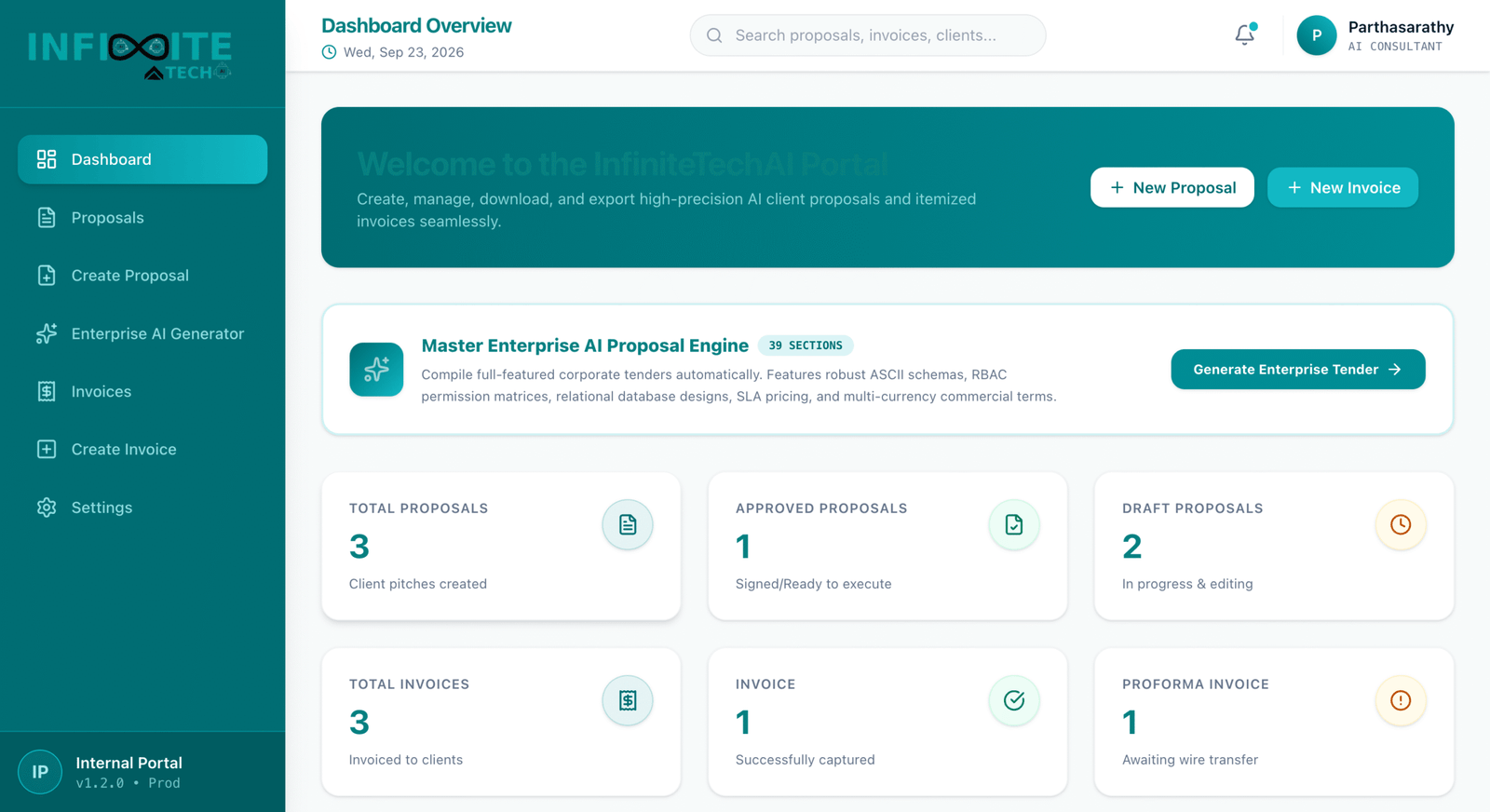
1. What this screen is: The central operational hub that provides immediate business intelligence on pipeline volume, proposal conversion ratios, pending receivables, and quick action shortcuts.
2. Who uses it and when: Used daily by Executive Leadership, Sales Directors, and Finance Controllers to monitor revenue velocity and initiate new commercial documents.
3. Key UI Elements & Action Items:
| Element Label | Operational Function |
|---|---|
| Top Welcome Banner | Displays corporate branding and quick-action shortcuts for New Proposal and New Invoice. |
| KPI Metric Cards | Displays Total Proposals, Approved Proposals (Conversion %), Total Invoices, and Paid vs. Pending Receivables. |
| Master AI Engine Card | Highlights the 39-Section Enterprise AI Proposal Engine with direct navigation trigger. |
| Recent Proposals & Invoices | Lists recent proposals and commercial invoices with status pills and due dates. |
4. Operational Business Logic: On mount, the dashboard fetches initial states from `/api/proposals` and `/api/invoices`. If MongoDB is disconnected, it gracefully falls back to cached in-memory structures without blocking the UI.
5. Edge Cases: Handles zero-data states by rendering clean empty cards prompting the user to create their first proposal or invoice.
Screen 2: Commercial Invoices Management Hub
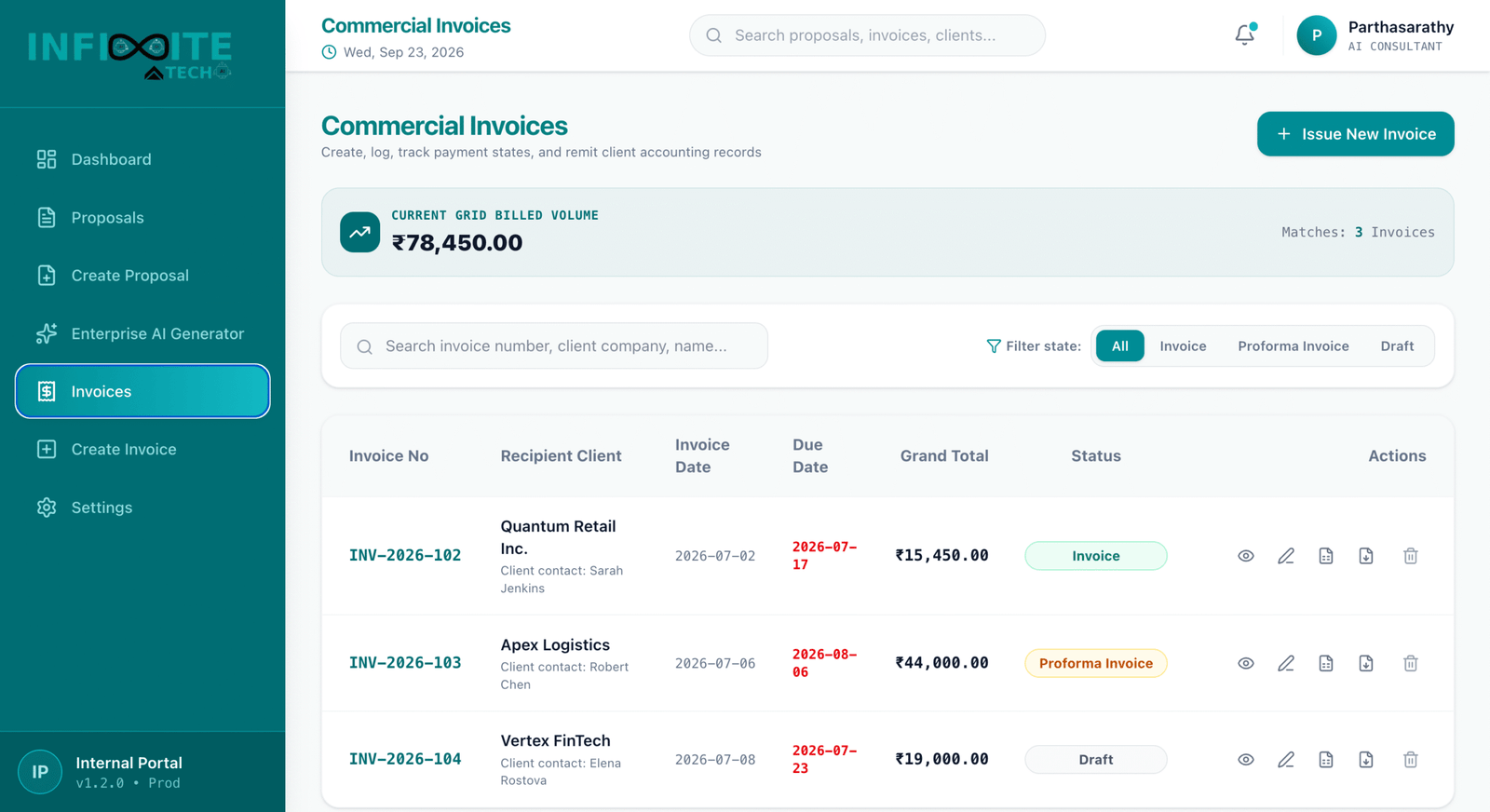
1. What this screen is: The primary accounts receivable ledger and billing management center for the organization.
2. Who uses it and when: Used continuously by the Finance and Billing team to track receivables, filter by payment status, and export client statements.
3. Key UI Elements & Action Items:
| Element Label | Operational Function |
|---|---|
| Cumulative Total Card | Dynamically calculates and displays the total billed value across all currently filtered invoices. |
| Search Bar & Status Tabs | Filters invoices by Client Company/Name, and payment status: All, Paid, Pending, or Overdue. |
| Row Action Icons | Direct buttons on each row: View Document, Download PDF, and Export to Excel (.xlsx). |
4. Operational Business Logic: Filters are applied reactively in memory against the loaded dataset. The cumulative billing total dynamically recalculates using `reduce((sum, inv) => sum + Number(inv.grandTotal), 0)`.
5. Edge Cases: When a user clicks PDF download on a table row, a hidden off-screen DOM canvas renders the specific invoice and triggers immediate download without redirecting the user.
Screen 3: Interactive Invoice Creator (Client & Tax Data)
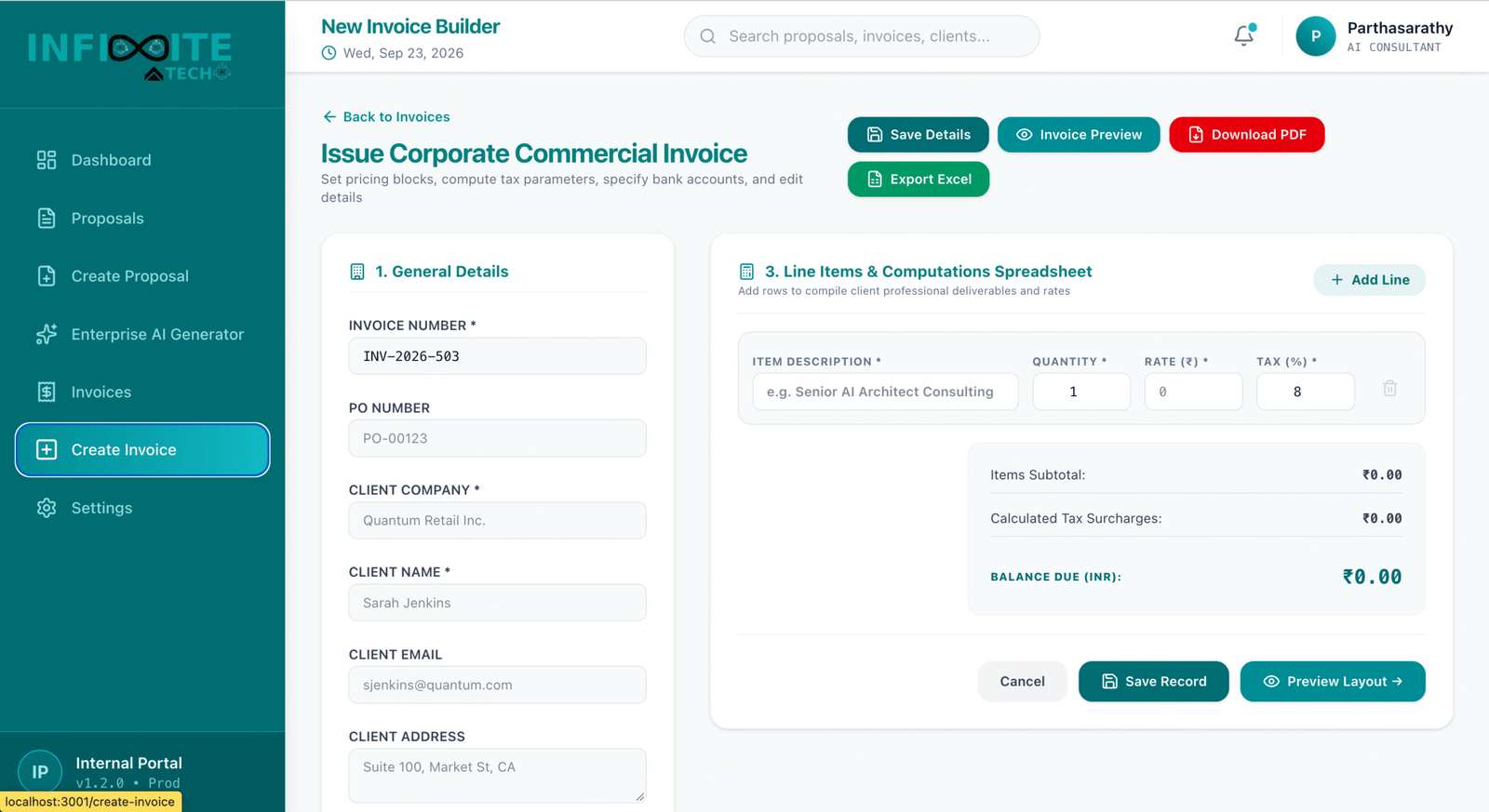
1. What this screen is: The top section of the Invoice Creator where client administrative, tax, and contractual metadata is captured.
2. Who uses it and when: Used by Account Executives and Finance Personnel when drafting a new commercial invoice for an approved engagement.
3. Key UI Elements & Action Items:
| Element Label | Operational Function |
|---|---|
| Invoice Number Field | Auto-generated unique invoice code with manual override support. |
| Purchase Order (PO) | Captures client enterprise PO reference number for institutional procurement clearance. |
| GSTIN & PAN Fields | 15-character Goods and Services Tax Identification Number and Permanent Account Number. |
4. Operational Business Logic: Auto-generates random 3-digit identifiers on initialization; when opened in edit mode, it populates existing record data via URL parameters.
5. Edge Cases: Sanitizes tax fields to uppercase to conform with standard Indian GST and international VAT syntax standards.
Screen 4: Dynamic Itemized Billing & Auto-Totalizer
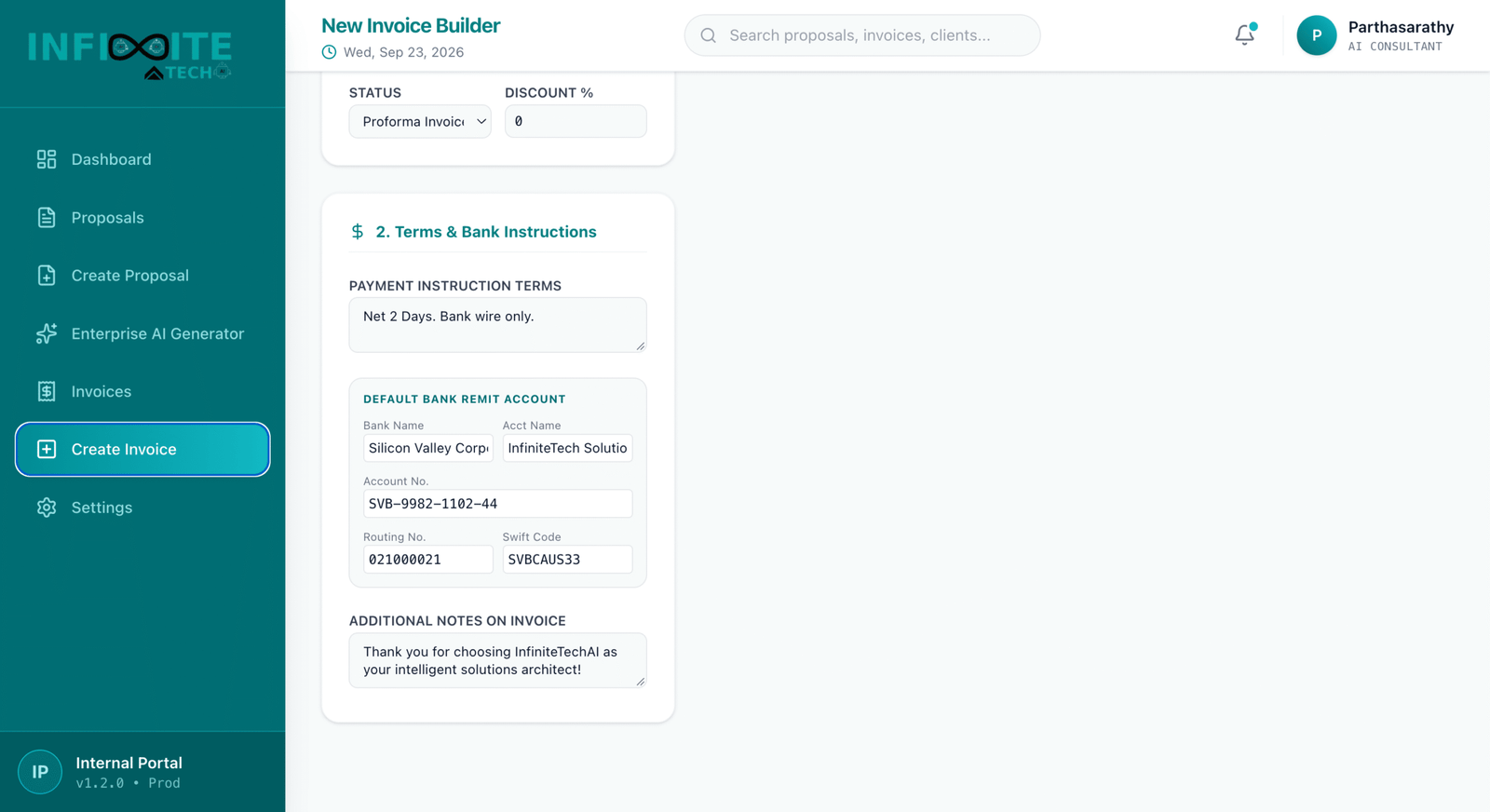
1. What this screen is: The core financial calculation engine of the invoice builder, handling multi-item lines, unit pricing, tax rates, and corporate bank routing.
3. Key UI Elements & Action Items:
| Element Label | Operational Function |
|---|---|
| Line Item Table | Allows adding, removing, and reordering billable deliverables with Qty, Rate, and Tax %. |
| Financial Summary Box | Displays reactive calculations: Subtotal, Total Tax, Discount Amount, and Grand Total. |
| Bank Coordinates | Displays Bank Name, Account Number, Routing/IFSC, and SWIFT Code from company settings. |
4. Operational Business Logic: Mathematical updates execute on every keystroke (`onChange`). Formula: `Amount = Qty * Rate`; `Subtotal = sum(Amounts)`; `TaxAmount = Subtotal * (Tax / 100)`; `GrandTotal = (Subtotal - Discount) + TaxAmount`.
5. Edge Cases: Guards against negative values, non-numeric inputs, and division-by-zero errors by enforcing strict fallback coercion (`Number(val) || 0`).
Screen 5: Official A4 Invoice Document Preview
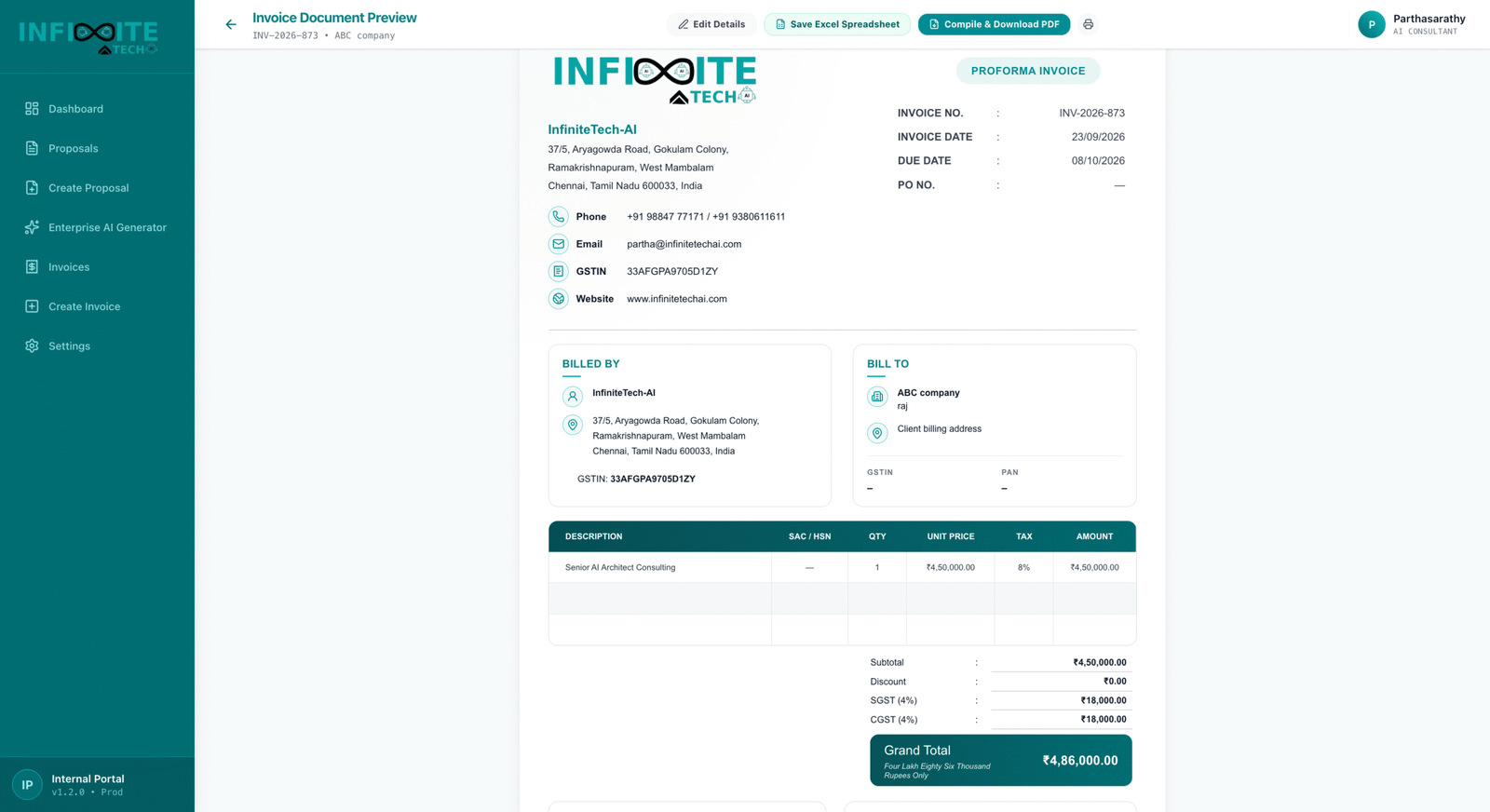
1. What this screen is: The official, publication-grade document view representing the exact printed or exported PDF invoice sent to client procurement.
3. Key UI Elements & Action Items:
| Element Label | Operational Function |
|---|---|
| Remittance Badge | Green verification alert indicating PAID status when payment has been cleared. |
| Corporate Letterhead | Displays corporate branding, corporate registration address, email, and phone. |
| Action Header Bar | Direct triggers for Download PDF, Export to Excel (.xlsx), and Edit Invoice. |
4. Operational Business Logic: Listens to global window custom events dispatched from the navigation header (`trigger-pdf-export` and `trigger-excel-export`) for unified UX.
5. Edge Cases: If URL parameter contains `?download=true`, it automatically triggers high-fidelity canvas export after a 600ms DOM paint delay and then cleans the URL.
Visual Module Breakdown
Explore the dedicated interfaces for proposals, the AI engine, and global settings.
Screen 6: Enterprise Proposals Pipeline Ledger
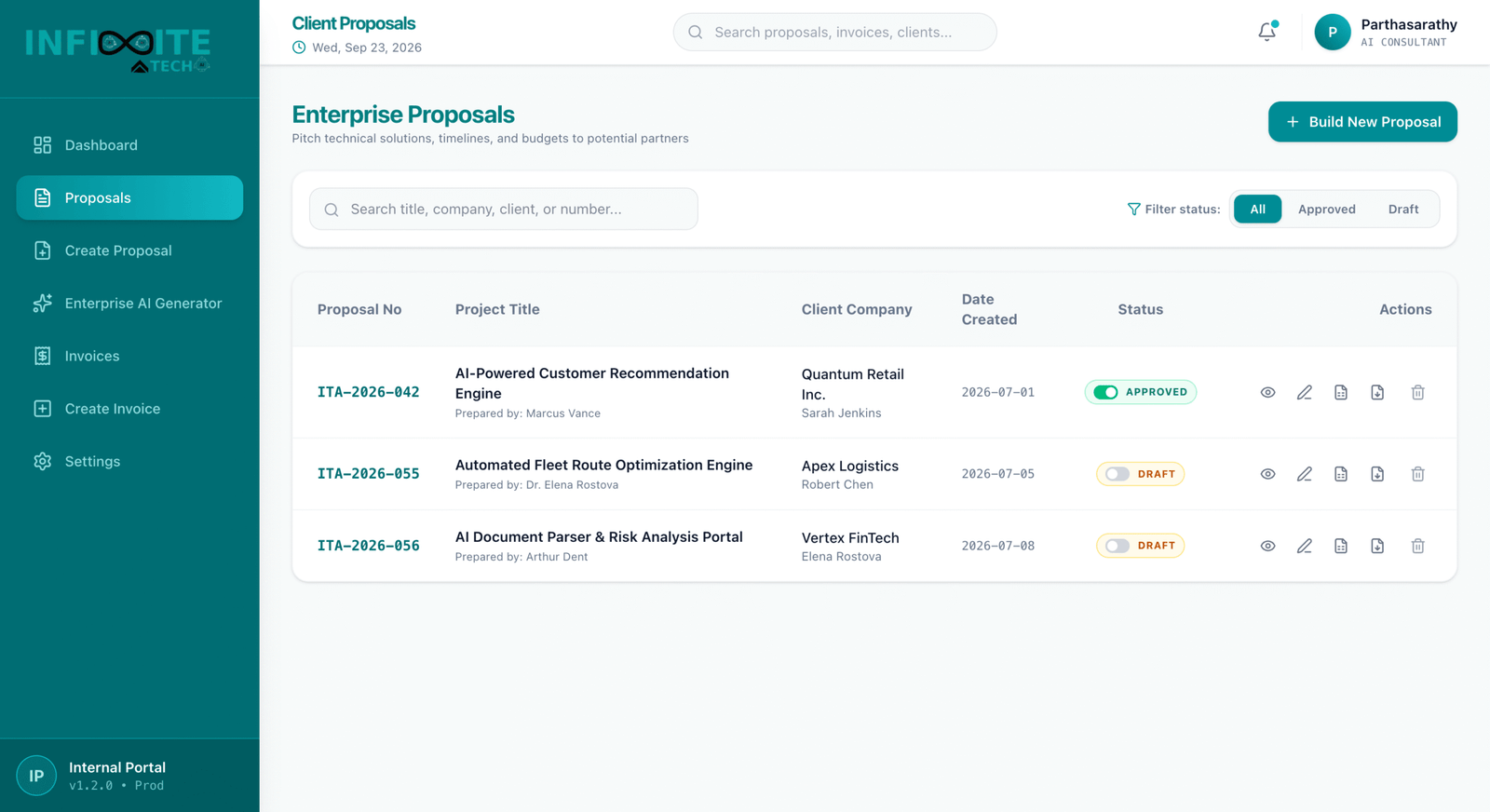
1. What this screen is: The master directory of all active, drafted, and closed client commercial proposals and tenders.
4. Operational Business Logic: Sorts proposals chronologically in reverse order (`new Date(b.proposalDate) - new Date(a.proposalDate)`). Uses optimistic state updates when deleting.
Screen 7: Standard Proposal Builder & Milestones
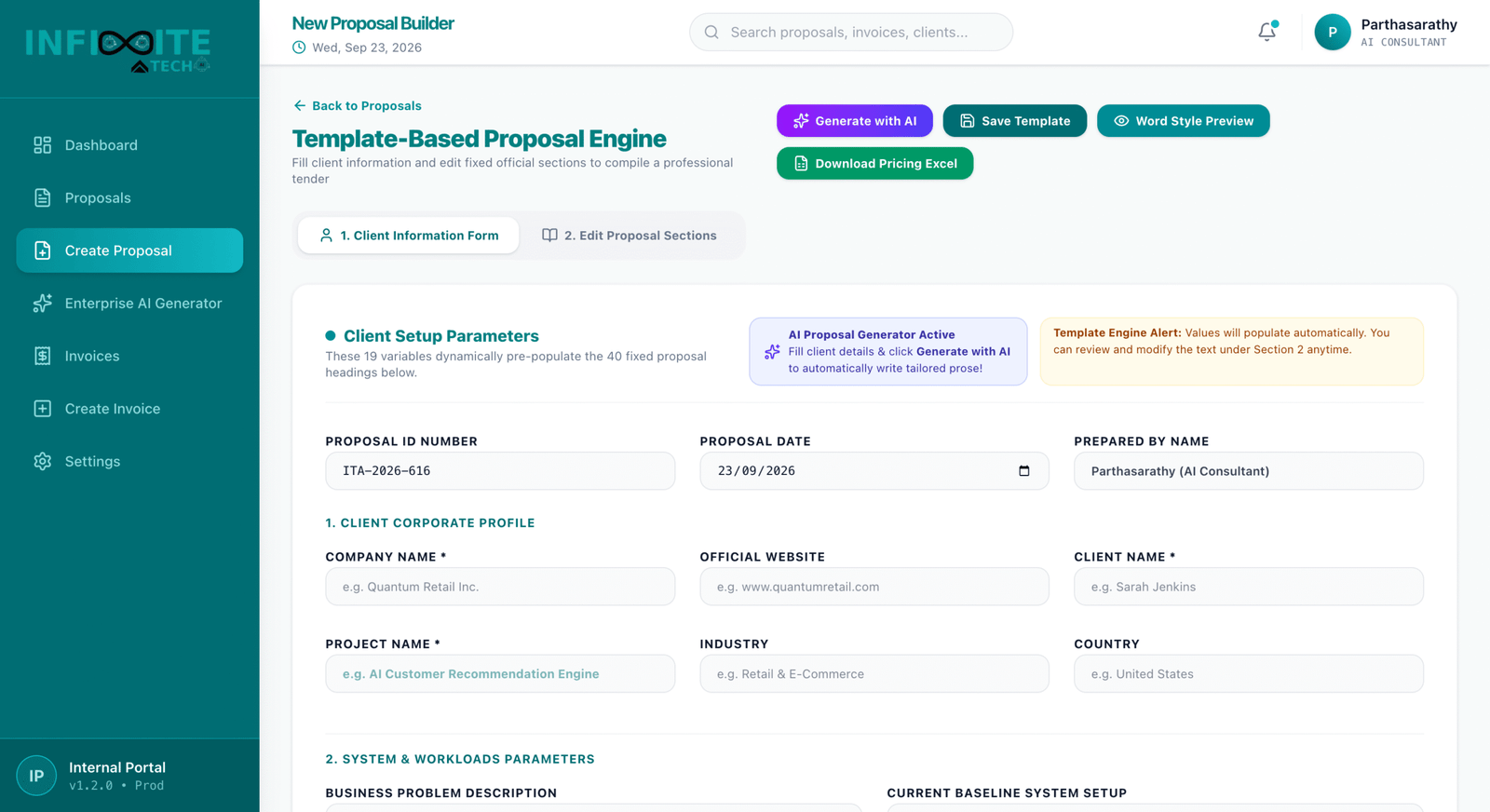
1. What this screen is: A structured proposal creation tool for standard commercial software consulting engagements.
4. Operational Business Logic: When AI Assist is triggered, it POSTs client parameters to `/api/generate-proposal`, validates response against Google GenAI schema, and auto-populates all form textareas.
Screen 8: Master Enterprise AI Proposal Engine
1. What this screen is: The flagship cognitive tender authoring engine, allowing architects to configure 18 enterprise parameters to generate a 39-section master proposal.
4. Operational Business Logic: Generates prompt configured with role persona 'Parthasarathy, Senior Principal AI Consultant'. Responses are parsed and merged into reactive master state.
Screen 9: Master 39-Section AI Blueprint Document Preview
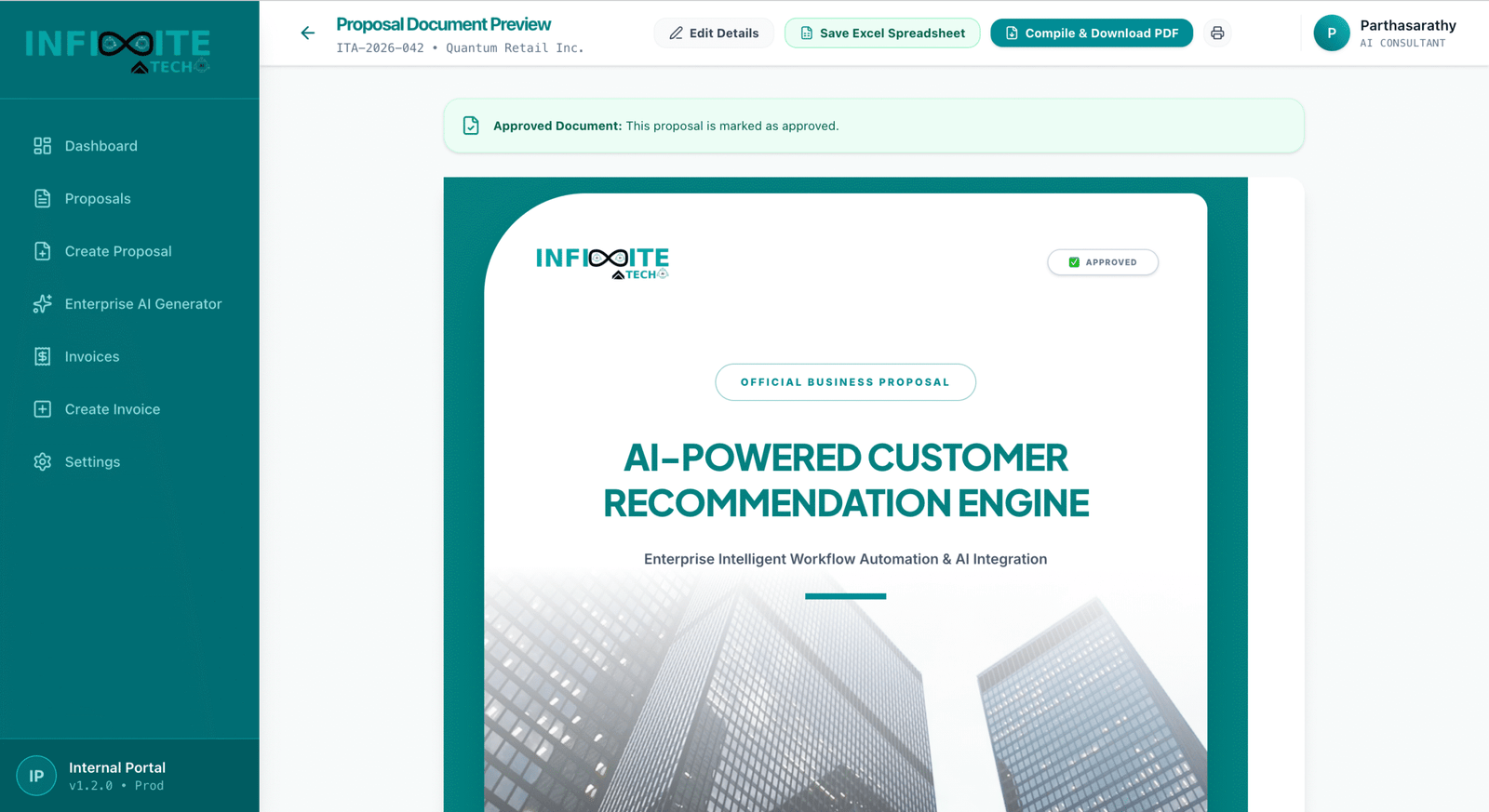
1. What this screen is: The live rendered multi-page enterprise document viewer displaying the full 39-section technical blueprint.
4. Operational Business Logic: Uses modular rendering: each section reads from either AI-generated state or fallback enterprise defaults (`templateDefaults.js`), guaranteeing 100% complete tenders even if API is offline.
Screen 10: Global Company Profile & Banking Settings
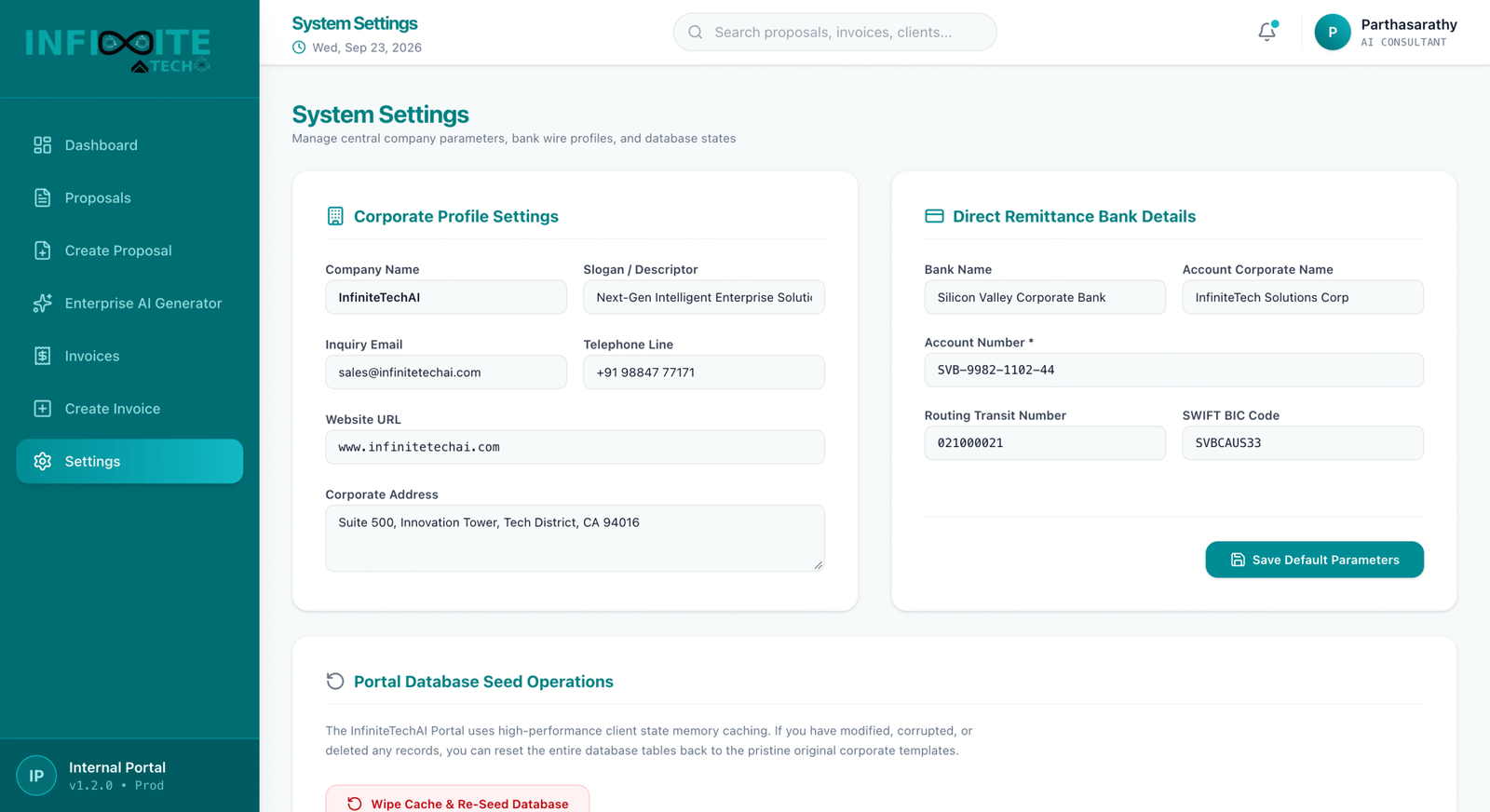
1. What this screen is: The administrative configuration panel that governs global corporate metadata across all newly drafted proposals and invoices.
4. Operational Business Logic: Sends PUT request to `/api/profile`. When updated, the new profile coordinates immediately sync into the React context and become defaults for future proposals and invoices.
Industry Context & Market Need
In the modern enterprise technology, AI consulting, and software solutions industry, the pre-sales tender process and post-sales financial billing represent the two most critical friction points in the commercial lifecycle. Enterprise software vendors and consultancies spend thousands of billable engineering hours manually compiling complex, multi-section request-for-proposal (RFP) responses, technical tender blueprints, and compliance matrices.
Simultaneously, financial billing teams struggle with disconnected spreadsheets, inaccurate tax calculations, misaligned scope-to-milestone invoicing, and poor receivables visibility. This creates operational overhead, revenue leakage, and severe compliance liabilities.
The Double-Sided Enterprise Chasm
Pre-Sales Inefficiency: Senior Solution Architects and Principal Engineers spend an average of 35 to 50 hours manually drafting a single 30+ page corporate proposal. Much of this time is consumed assembling standardized architectural patterns, cloud sizing specifications, and risk mitigation boilerplate rather than tailoring client-specific value propositions.
Invoicing & Revenue Leakage: According to enterprise accounting benchmarks, 12% to 18% of vendor invoices contain calculation mismatches, incorrect GST/tax applications, or delayed payment term coordinates, leading to extended Days Sales Outstanding (DSO) and deferred cash flow.
Disconnect Between Scope and Billing: Sales teams agree to milestone deliverables in proposal contracts, but accounting departments issue generic invoices lacking milestone traceability, causing client procurement disputes and audit red flags.
Performance Benchmark
Legacy Operations vs. Platform Metrics
| Operational Metric | Legacy | Best e invoice billing software in India |
|---|---|---|
| Proposal Time | 35 - 50 Hrs | 45 - 90 Secs |
| Tender Depth | 10 - 15 Sections | 39 - 41 Sections |
| Invoice Math | 88% Acc. | 100.00% |
| Collection Cycle | 45 - 60 Days | Net 2 Days |
Business Impact: 98% reduction in pre-sales cost. 3x higher win-rate on RFPs. Zero billing reconciliation errors. 65% faster cash liquidity.
What Is This Application? — Purpose & Strategic Vision
The Best e invoice billing software in India is a unified, dual-engine commercial application engineered to seamlessly bridge technical solution architecture with corporate financial billing.
It serves as the single source of truth for an enterprise technology organization's sales proposals, legal agreements, and accounts receivable registers.
1
Dual-Engine Platform Architecture
System Duality: The platform operates through two interconnected, mission-critical subsystems.
2
Engine A: Master Cognitive Proposal Generator
A structured generative AI pipeline powered by Google Gemini 3.5 Flash that ingests high-level client parameters (industry, daily transactions, concurrent users, cloud preferences, and budget constraints) and compiles an exhaustive 39-section technical blueprint complete with ASCII system flowcharts, database schemas, RBAC access matrices, and service level agreements.
3
Engine B: Dynamic Itemized Commercial Invoicing
A precision financial ledger and billing calculator that produces audit-ready, tax-compliant invoices with automated GSTIN/PAN validations, progressive discounts, dynamic tax rate totalization, and real-time accounts receivable status tracking.
📌
Core Architectural Principle: Zero Data Disconnect
By hosting proposals and invoices within the same runtime environment and data models, the platform ensures that milestone deliverables agreed upon during pre-sales discovery flow seamlessly into post-sales billing schedules, completely eliminating scope creep and unbilled change requests.
Who Needs This Application?
Detailed Personas & RBAC
The Best e invoice billing software in India is engineered to serve five distinct enterprise user personas, establishing strict role-based operational boundaries and intuitive user journeys for each stakeholder.
Executive Leadership (CEO / Managing Director)
Primary Responsibilities: Oversight of revenue velocity, deal margin approval, and corporate brand integrity.
Key System Touchpoints: Executive Command Dashboard, Revenue Analytics, Settings.
Core Value Derived: Real-time visibility into pipeline value and accounts receivable cash flow.
Principal AI Architect (Solutions Director)
Primary Responsibilities: Technical solution design, feasibility auditing, and enterprise tender authoring.
Key System Touchpoints: Enterprise AI Proposal Generator, Architectural Blueprints.
Core Value Derived: Reduces tender documentation time from days to under two minutes.
Enterprise Sales Director (Account Executive)
Primary Responsibilities: Client relationship management, deal negotiation, proposal tracking.
Key System Touchpoints: Proposals Pipeline Ledger, Status Transitions, Client Previews.
Core Value Derived: Accelerates deal closure velocity and delivers polished, professional proposals.
Finance Controller (Billing / Accounts Receivable)
Primary Responsibilities: Invoice generation, tax compliance verification, wire transfer reconciliation.
Key System Touchpoints: Commercial Invoices Hub, Itemized Billing Engine, Excel Exporter.
Core Value Derived: Eliminates calculation errors, automates GST/tax reporting, tracks payment aging.
Client Procurement Team (Technical Evaluators)
Primary Responsibilities: Tender review, vendor compliance verification, payment remittance clearance.
Key System Touchpoints: Official A4 Printable Previews, PDF Downloads.
Core Value Derived: Transparent, unambiguous technical specifications and itemized billing.
Core Feature Catalogue & Capabilities Matrix
The following matrix details the comprehensive functional modules and capabilities active in the production deployment:
| Module Name | Feature Set | Technical Implementation | Supported Formats |
|---|---|---|---|
| Executive Dashboard | Real-time KPI aggregation, Proposal conversion ratios, Revenue tracking, Deal pipeline cards. | React 19 Context + Recharts analytics widgets. | Interactive Web |
| Commercial Invoices | Filterable accounts receivable ledger, Status pills (Paid, Pending, Overdue), Search bar. | MongoDB `Invoice` collection with in-memory fallback. | Web, JSON API |
| Invoice Creator | Interactive line item calculator, GSTIN/PAN validation, Progressive discounts, Bank wire sync. | Deterministic JS mathematical engine with live DOM state. | Web UI |
| Invoice Preview | Official printable A4 document layout, Remittance Verified badge, Direct download triggers. | CSS A4 page simulation (794px width x 1123px height). | PDF, Excel (.xlsx) |
| Proposals Directory | Comprehensive tender pipeline ledger, Status updates (Approved, Draft, Sent), Date filters. | RESTful CRUD API (`/api/proposals`). | Web, JSON API |
| Standard Proposal | Multi-phase scope creator, Milestone duration scheduler, Pricing breakdown tables. | Modular React forms with optimistic UI updates. | Web, PDF |
| Enterprise AI Engine | 39-Section corporate tender generator, 18+ client parameter inputs, ASCII architectural schemas. | @google/genai SDK + Gemini 3.5 Flash JSON schema. | Web, Print, PDF |
| Company Settings | Centralized corporate branding, Legal entity coordinates, Bank SWIFT/IFSC account config. | Persistent MongoDB `CompanyProfile` model. | Web, JSON API |
| Export Subsystem | High-fidelity PDF generation, Color space sanitizer, Excel spreadsheet generator. | jsPDF, html2canvas, SheetJS (xlsx). | PDF, XLSX |
Operational Guides
Standard operating procedures for C-suite leadership, managing directors, and Principal Architects.
1
Pipeline Velocity Monitoring
Log in daily to review the Executive Command Dashboard (`/`). Assess the conversion ratio between drafted proposals and approved client contracts. Ensure total pending receivables do not exceed authorized credit limits.
2
Banking Coordinate Authorization
Before any external commercial tenders are issued, verify that banking wire information in `/settings` matches the company's designated escrow or corporate operating accounts.
1
Tender Generation: Discovery & Sizing
Step 1 — Navigate to `/enterprise-ai-proposal`. Enter the client's corporate name, industry, and core operational challenge.
Step 2 — Specify exact throughput constraints: Active Users, Daily Transactions Target, and Cloud Deployment Target.
2
Cognitive Generation & Audit
Step 3 — Click 'Generate with Gemini AI' (allows 45 seconds).
Step 4 — Scroll through the live blueprint preview. Audit Section 6 (Architecture), Section 9 (AI Models), and Section 12 (Pricing Schedule).
Step 5 — Click 'Save Proposal' and export.
Finance, Billing & AR Operations
This guide defines operational protocols for billing coordinators and accounting controllers managing invoicing cycles, tax compliance, and payment clearance.
Standard Invoicing Protocol
Invoice Initiation: Navigate to `/invoices` and click '+ New Invoice'. Verify that the auto-generated invoice number follows the corporate series.
Client & Tax: Input the client's legal entity name, corporate address, GSTIN, PAN, and official PO number.
Line Itemization: Add individual line items for each completed project phase. Input the exact unit rate and applicable tax rate.
Review & Export: Review formal layout. Click 'Export to Excel' for internal accounting, and 'Download PDF' for the client.
Client Procurement Experience
This section documents the end-user experience from the perspective of enterprise client procurement managers and technical evaluators.
Document Consumption & Verification
Tender Transparency: Clients receive an A4 publication-grade proposal detailing exact deliverable phase breakdowns, system response latency SLAs (<200ms P99), and IP ownership allocations.
Invoice Audit Integrity: Every invoice clearly itemizes services rendered against approved PO numbers, with full corporate tax registration credentials displayed.
Wire Remittance Clarity: Clients are provided with explicit banking coordinates including Swift/BIC codes for friction-free treasury wire processing.
End-to-End Proposal-to-Invoice Commercial Lifecycle
The commercial workflow represents a contiguous, 6-stage lifecycle connecting sales discovery with accounts receivable clearance:
| Stage # | Stage Name | Responsible Role | Primary Artifact | Exit Criteria |
|---|---|---|---|---|
| Stage 1 | Opportunity Discovery | Sales Director | Client Requirements Note | Budget and timeline parameters established. |
| Stage 2 | Cognitive Tender Drafting | Principal AI Architect | 39-Section AI Blueprint | Gemini 3.5 Flash generation & technical audit complete. |
| Stage 3 | Executive Approval & Delivery | Managing Director | Approved Proposal (`Approved`) | Formal proposal transmitted to client procurement. |
| Stage 4 | Contract & PO Issuance | Client Procurement | Countersigned Contract / PO | Signed acceptance signatures and client PO registered. |
| Stage 5 | Milestone Billing Generation | Finance Controller | Commercial Invoice (`Pending`) | Itemized invoice generated with tax calculations. |
| Stage 6 | Remittance & Payment Settlement | Treasury / Bank | Paid Invoice (`Paid`) | Wire transfer cleared into corporate bank account. |
Mathematical Pricing, Tax & Dynamic Calculation Engine
To prevent revenue loss and guarantee accounting integrity, all financial calculations within the platform follow deterministic, double-precision floating point formulas:
1. Line Item Amount Formula: Amount_i = Quantity_i * UnitRate_i
2. Gross Subtotal Formula: Subtotal = Sum(Amount_i) for i = 1 to N
3. Cumulative Tax Calculation: TaxAmount = Sum(Amount_i * (TaxRate_i / 100))
4. Progressive Discount Deduction: DiscountAmount = Subtotal * (DiscountPercent / 100)
5. Grand Total Formula: GrandTotal = (Subtotal - DiscountAmount) + TaxAmount
📌 Tax Rounding Protocol
All calculated monetary figures are rounded to exactly 2 decimal places using bankers' rounding to prevent fractional cent drift across multi-line enterprise tenders.
Document Management & Print Rendering
A critical technical innovation in the platform is its proprietary document export pipeline, implemented in `exportPdf.js` and `exportExcel.js`.
The Color Sanitization Architecture (`fixColors`)
Modern web stylesheets leverage advanced CSS color functions (`oklch()`, `oklab()`, and `color-mix()`). When rendering via `html2canvas`, these functions cause canvas rendering crashes. The platform implements an active DOM interception layer:
1. Deep-clones the document container and parses all style tags.
2. Regex-replaces all instances of `oklch(...)`, `oklab(...)` with fallback normalized hex values.
3. Forces `color-scheme: light !important;` to ensure zero dark-mode invert issues during printing.
4. Calculates precise A4 physical boundaries (794px width = 210mm; 297mm height) with 40mm top margin.
2. Regex-replaces all instances of `oklch(...)`, `oklab(...)` with fallback normalized hex values.
3. Forces `color-scheme: light !important;` to ensure zero dark-mode invert issues during printing.
4. Calculates precise A4 physical boundaries (794px width = 210mm; 297mm height) with 40mm top margin.
14. Commercial Proposal Terms & Multi-Currency
Enterprise proposals generated by the platform incorporate standardized commercial terms recognized under international technology consulting law:
Milestone Payment Schedule
30% upfront mobilization deposit upon contract signing; 40% upon completion of core ML model engineering; 30% upon final User Acceptance Testing (UAT) and production handover.
Intellectual Property Allocation
The client retains sole ownership of their proprietary transactional data and trained model weights. The vendor retains ownership of underlying platform libraries, granting the client a perpetual, royalty-free operating license.
Multi-Currency Handling
Supports native currency formatting across USD ($) and INR (₹), automatically formatting currency strings according to standard regional numbering schemas.
Compliance & Intelligence
Audit Trails, System Notifications, and Integrated Business Intelligence Analytics.
Audit Trail & Data Security
Data Encryption: AES-256 encryption at rest for all stored proposal specifications; TLS 1.3 encryption in transit for all client browser sessions.
Regulatory Compliance: Architected in alignment with SOC 2 Type II controls and ISO/IEC 27001 data isolation policies.
Tax & Accounting Audit Readiness: Every invoice retains an immutable record of client GSTIN, PAN, company registration, and chronological transaction timestamps, ensuring complete readiness for statutory tax audits.
System Notifications & Events
The application utilizes a decoupled, event-driven communication architecture to synchronize state across independent UI components:
- `pdf-export-status`: Dispatched whenever the PDF compiler initiates or finishes rendering, triggering spinner overlays.
- `trigger-pdf-export`: Dispatched from the persistent navigation header to trigger off-screen document compilation.
- `trigger-excel-export`: Dispatched to trigger immediate binary `.xlsx` compilation via SheetJS.
Financial Reports & BI Analytics
The platform features integrated business intelligence aggregators that compile operational metrics in real time:
Win-Loss Conversion Tracking: Calculates win ratios across proposal tiers (`approved / total_proposals`).
Accounts Receivable Aging: Tracks pending invoice aging against contractual due dates to identify delinquent client accounts before payment delays occur.
Revenue Velocity: Monitors monthly billed volume against forecasted proposal values.
Architecture & API Specs
18. AI Generation Architecture
19. Backend REST API & Database Schema
20. Production DevOps & Ingress
1
AI Generation Architecture & Prompt Engineering
The platform's cognitive capabilities are driven by the official Google GenAI SDK (`@google/genai`) interfacing with the high-speed `gemini-3.5-flash` model.
System Instruction Persona: 'You are Parthasarathy, Senior Principal AI Consultant. You draft high-value, meticulous enterprise tenders. Each section should read like an expert management consulting blueprint — detailed, rigorous, and completely bespoke.'
Enforced Schema Properties (`Type.OBJECT`): `executiveSummary`, `clientRequirements`, `projectUnderstanding`, `proposedSolution`, `scopeOfWork`, `deliverables`, `techStack`, `termsConditions`, `acceptanceSignature`.
Error Recovery Strategy: If the Gemini API key is missing or the external API call fails, the server intercepts the exception and falls back to deterministic local template structures (`templateDefaults.js`), ensuring zero downtime for end users.
2
Backend REST API & Database Schema (ERD)
The backend is implemented in Node.js / Express with TypeScript. It provides a complete RESTful API suite backed by MongoDB with automatic in-memory fallback:
| Method | Endpoint | Description |
|---|---|---|
| POST | /api/generate-enterprise-proposal | Generates comprehensive 39-section master enterprise blueprint. |
| GET | /api/proposals | Returns full array of stored proposals sorted by recency. |
| POST/PUT | /api/proposals/:id | Creates or updates proposal record by unique identifier. |
| GET | /api/invoices | Returns all commercial invoices with grand totals and status. |
| POST/PUT | /api/invoices/:id | Creates or updates itemized commercial invoice record. |
| GET/PUT | /api/profile | Retrieves or updates corporate branding, address, and bank coordinates. |
Mongoose Models
`Proposal`: { id: String, proposalNo: String, clientName: String, projectTitle: String, proposalDate: String, status: String, sections: Object }
`Invoice`: { id: String, invoiceNo: String, poNumber: String, clientGstin: String, items: Array, subtotal: Number, grandTotal: Number, status: String }
`Invoice`: { id: String, invoiceNo: String, poNumber: String, clientGstin: String, items: Array, subtotal: Number, grandTotal: Number, status: String }
3
Production DevOps & Docker Ingress
The platform is architected for single-port unified deployment across Docker, Cloud Run, and Vercel environments.
Single-Port Unified Runtime: `server.ts` embeds the Vite development server as an Express middleware in non-production mode, serving both the API backend and React SPA from port `3001`.
Production Compilation Pipeline: `npm run build` executes `vite build` to compile the optimized client bundle into `dist/`, followed by `esbuild` bundling `server.ts` into a standalone Node runtime (`dist/server.cjs`).
Environment Variables: Configured via `.env`: `PORT=3001`, `NODE_ENV=production`, `MONGODB_URI`, and `GEMINI_API_KEY`.
Production Compilation Pipeline: `npm run build` executes `vite build` to compile the optimized client bundle into `dist/`, followed by `esbuild` bundling `server.ts` into a standalone Node runtime (`dist/server.cjs`).
Environment Variables: Configured via `.env`: `PORT=3001`, `NODE_ENV=production`, `MONGODB_URI`, and `GEMINI_API_KEY`.
Frequently Asked Questions (FAQ)
This section addresses common operational and technical questions encountered during system deployment and daily operations:
Q1: What happens if MONGODB_URI is not configured in the environment?
The platform automatically detects the absence of a database connection and switches to an in-memory mock repository initialized with sample proposals and invoices. The application continues to function normally with zero crashes.
Q2: How does the AI generator guarantee accurate technical specifications?
The backend uses strict JSON schema validation combined with structured system prompts. If Gemini returns non-conforming data, the parser rejects it and merges fallback enterprise architectural defaults.
Q3: Can client invoices be exported directly into enterprise ERP systems?
Yes. In addition to publication-grade PDFs, every invoice can be exported as an itemized Excel workbook (`.xlsx`) via SheetJS, making it instantly ingestible by SAP, NetSuite, or QuickBooks.
Q4: How does the platform handle international wire transfers?
Every invoice template includes dedicated fields for SWIFT/BIC codes and domestic routing numbers, populated automatically from corporate settings.
Q5: Are proposal documents compliant with corporate procurement guidelines?
Yes. Tenders include formal cover pages, executive summaries, technical architecture diagrams, SLA matrices, and authorized executive signature lines.
Operational Enterprise Glossary & Terminology
Reference definitions for enterprise terms used throughout this documentation:
| Term | Definition |
|---|---|
| Accounts Receivable (AR) | Money owed to the company by clients for deliverables or services billed via commercial invoices. |
| DSO (Days Sales Outstanding) | The average number of days it takes for a company to collect payment after an invoice is issued. |
| GSTIN | Goods and Services Tax Identification Number — a 15-digit statutory tax identifier required for commercial billing in India. |
| PAN | Permanent Account Number — a 10-digit alphanumeric identifier issued by the Indian Income Tax Department. |
| RFP / Tender | Request for Proposal — a formal bidding document submitted to win enterprise corporate contracts. |
| SLA (Service Level Agreement) | A contractual commitment detailing service uptime (e.g. 99.9%), response latency (<200ms), and support response times. |
| RBAC | Role-Based Access Control — a security protocol restricting system functionality based on assigned user roles. |
| HTML2Canvas | A JavaScript library that takes screenshots of web DOM elements by reading the computed CSS styles. |
| jsPDF | A client-side JavaScript PDF generation engine used to compile multi-page vector and image documents. |
| Gemini 3.5 Flash | Google's ultra-low latency, multimodal generative AI foundation model used for automated proposal prose generation. |