Amazon SEO Tool
Marketplace Intelligence, Automated AI Content Syndication & Warehouse Logistics ERP
Production-ready operational suite designed to streamline e-commerce cataloging, harvest live Amazon autocomplete search intent, automate multi-CMS article distribution, and standardize physical warehouse thermal barcode label printing in a unified interface.
Explore Amazon SEO Tool →Why E-Commerce Sellers Need Smarter SEO
Modern e-commerce brands and direct-to-consumer (D2C) manufacturers operate in an increasingly complex and fragmented operational environment. To remain competitive across major marketplaces like Amazon India and Flipkart, brands must continuously optimize organic search discoverability, maintain regular organic blog publishing schedules, and package physical goods with strict compliance barcodes.
-
Marketplace Visibility Bottleneck: Marketplace algorithms rely on keyword relevance in titles, bullet points, and backend search terms. Traditional sellers use static third-party keyword tools that rely on outdated search databases, missing trending queries and consumer phrasing shifts.
-
Fragmented Content Production Loop: Maintaining high organic domain authority requires regular publication of informative articles. Manually drafting text, sourcing images, and publishing across disparate CMS platforms (WordPress, Blogger, Medium) introduces friction and limits publishing velocity.
-
Warehouse Thermal Label Formatting Chaos: Designing and printing physical barcode labels for replacement remote controls and consumer electronics using manual desktop tools leads to typing mistakes, scanning errors, mislabeled shipments, and Amazon FBA rejections.
-
The Integrated Amazon SEO Tool Solution: Replaces disconnected tools with a unified architecture where real-time marketplace search insights directly inform content generation, and inventory spreadsheets seamlessly feed into thermal barcode label printing.
Marketplace Intelligence & Fulfillment Engine
Direct API scraping of live marketplace suggestions, automated multi-platform CMS publishing, and thermal label generation in one integrated control plane. Secure multi-tier environments are built around our Vertical Industry Automation, validated against specifications from Amazon Selling Partner API (SP-API) ↗.
Enterprise Problems vs. Platform Solutions
The Amazon SEO Tool architecture systematically addresses common operational inefficiencies in e-commerce workflows.
Critical E-Commerce Inefficiencies
Traditional multi-channel retailers struggle with disconnected manual operational hurdles:
- Outdated Keyword Data: Sellers rely on cached monthly search volume databases that fail to capture weekly algorithmic shifts, seasonal spikes, and trending autocomplete queries.
- Manual Multi-CMS Posting: Marketers waste hours copying, pasting, and re-formatting drafts across separate WordPress, Blogger, and Medium dashboards.
- Manual Stock Labeling & FBA Rejections: Warehouse staff manually type SKUs into desktop barcode generators, causing mislabeled inventory and scanning rejections at fulfillment hubs.
- Image Sourcing & Licensing Friction: Writers leave text editors to search Unsplash or Pexels manually, download images, compress dimensions, and upload them to CMS media libraries.
- Fragmented Tooling & High SaaS Overheads: Paying for 4–6 separate standalone tools for keyword tracking, AI writing, CMS distribution, and thermal label generation.
Amazon SEO Tool Automated Solutions
Unified enterprise capabilities baked directly into a single decoupled platform: Optimized technical agility is realized through our Multimodal AI, drawing upon foundational frameworks from Amazon Advertising Partner API Docs ↗.
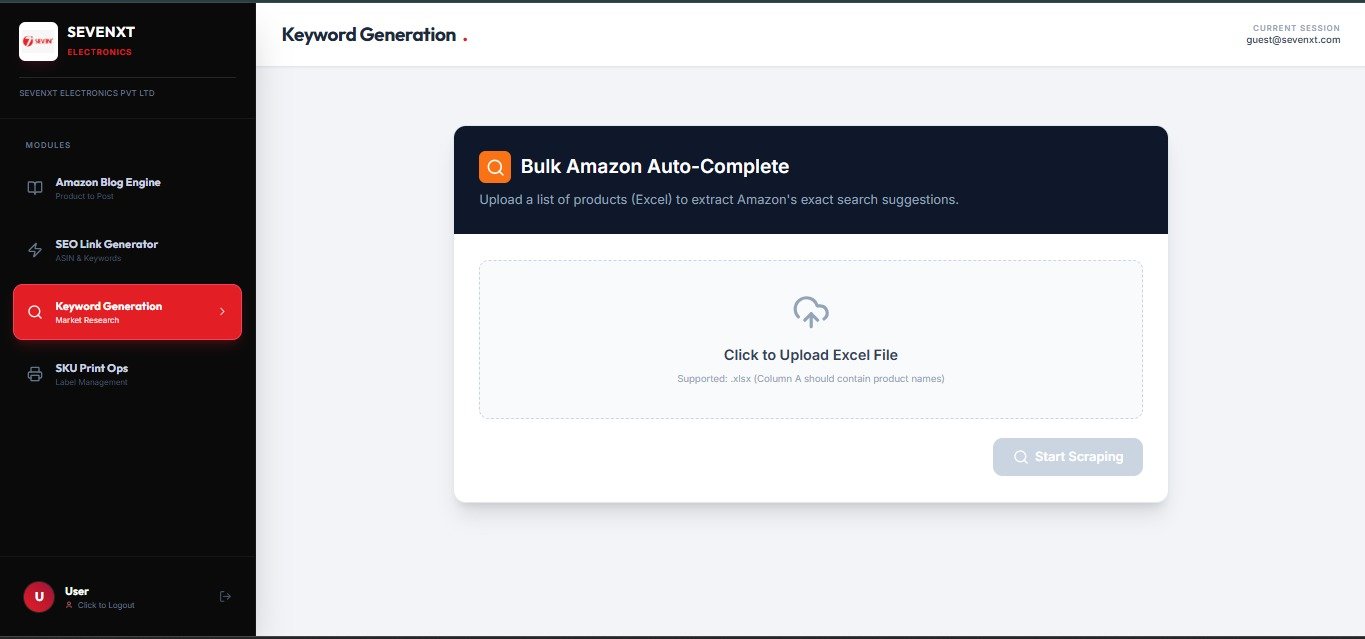
- Real-Time Autocomplete Harvester: Direct API scraping of live marketplace suggestions (amazon_suggestions.py) capturing active buyer intent suffixes.
- Headless Multi-CMS Syndication: Automated one-click publisher (cms_publishers.py) distributing formatted HTML to WordPress, Blogger, and Medium simultaneously.
- Batch Thermal Barcode Generation: Automated spreadsheet parser (sku_printing.py) rendering vector-accurate Code 128 and EAN-13 labels ready for thermal roll printing.
- Automated Contextual Image Retrieval: Integrated API pipeline (image_api.py) automatically sourcing royalty-free imagery and generating accessible alt tags.
- Unified Operational Command: Responsive React 18 frontend powered by Python Flask microservices, reducing tool sprawl and licensing costs.
Explore the Power Behind Amazon SEO Tool Modules
Every administrative console module in the live production deployment, documented with interface controls, data extractions, and backend processing pipelines.
Amazon Search Suggestions & Autocomplete Harvester
-
Operational Purpose & Search Scraping: Extracts real-time customer search queries directly from marketplace search endpoints. By simulating user keystrokes with alphanumeric prefixes and suffixes, it discovers long-tail search variations indicating high commercial purchase intent.
-
Technical Execution Pipeline: Dispatches asynchronous requests to the marketplace autocomplete API based on seed keywords, deduplicating search strings and sorting by relevance.
-
Actionable Export: One-click CSV export formatting structured keyword sets directly for Amazon listing titles, bullet points, and PPC Sponsored Products ad groups.
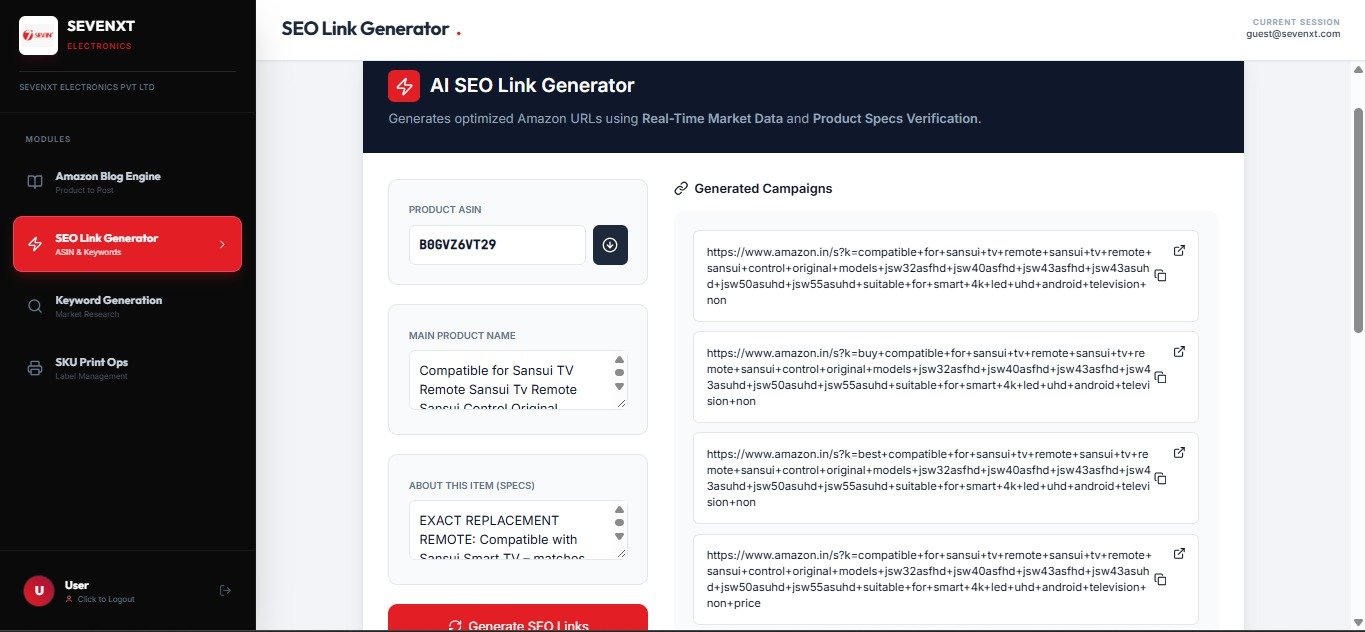
Amazon ASIN Detail Extraction & Competitor Scraper
-
Operational Purpose: Scrapes structured product data from live Amazon URLs (features/amazon_details.py) allowing brand managers to benchmark competitor listings, analyze pricing structures, and identify gaps in product copy.
-
Extracted Product Attributes: Captures Canonical ASIN, Full Title Keyword Density, 5 Feature Bullet Points, Buy-Box Pricing & Discounts, Stock Availability, and Average Review Ratings.
-
Anti-Bot & Header Management: Built-in header rotation and randomized request jitter prevent IP rate-limiting during high-volume catalog auditing.
AI Keyword Generation & Intent Strategy Studio
-
Operational Purpose: Employs natural language processing models to expand seed phrases into semantic clusters, organizing keywords into distinct search intent tiers.
-
Intent Categorization Framework: Automatically sorts terms into Commercial Intent ('best price', 'buy online'), Informational Intent ('how to program'), and Transactional Intent (exact model numbers).
-
Listing Integration: Seamlessly feeds high-intent keyword clusters into article generation prompts and Amazon backend keyword fields.
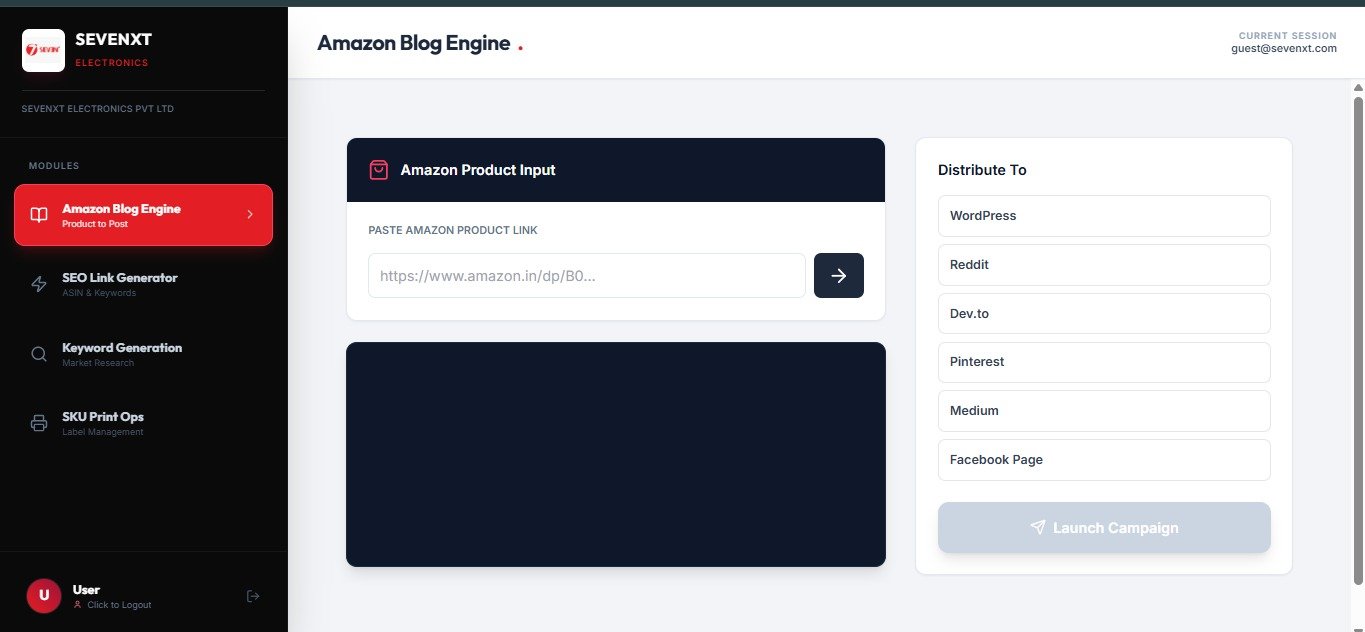
Automated Blog Generation & Prompt Engine
-
Operational Purpose: Automatically drafts structured, search-optimized articles (features/blog_posting/core/generate_blog.py) based on seed keywords, target tone, and desired length.
-
Prompt Construction Pipeline: Ingests primary and secondary keywords, establishes strict heading hierarchies (H1, H2, H3), and generates introductory hooks, comprehensive bodies, and conclusions.
-
Automated Meta Generation: Produces recommended meta titles, descriptions, and URL slugs optimized for organic search indexation.
Dynamic Royalty-Free Image Retrieval Pipeline
-
Operational Purpose: Automates sourcing and embedding royalty-free images (features/blog_posting/core/image_api.py) directly into generated articles, removing manual image hunting.
-
Targeted API Querying: Automatically creates search terms based on article heading topics, querying Unsplash and Pexels repositories for context-relevant photographs.
-
Optimization & Accessibility: Selects web-optimized landscape dimensions and generates descriptive image alt text for accessibility and search rankings.
Multi-CMS Syndication (WordPress, Blogger, Medium)
-
Operational Purpose: Headless publishing adapter (features/blog_posting/core/cms_publishers.py) enabling one-click cross-platform article publishing without manual copy-pasting.
-
WordPress REST Integration: Authenticates via application passwords, natively formatting content into clean Gutenberg blocks or semantic HTML.
-
Blogger & Medium Bridges: Publishes directly to Google Blogger via OAuth 2.0 and distributes drafts or live stories via Medium token endpoints.
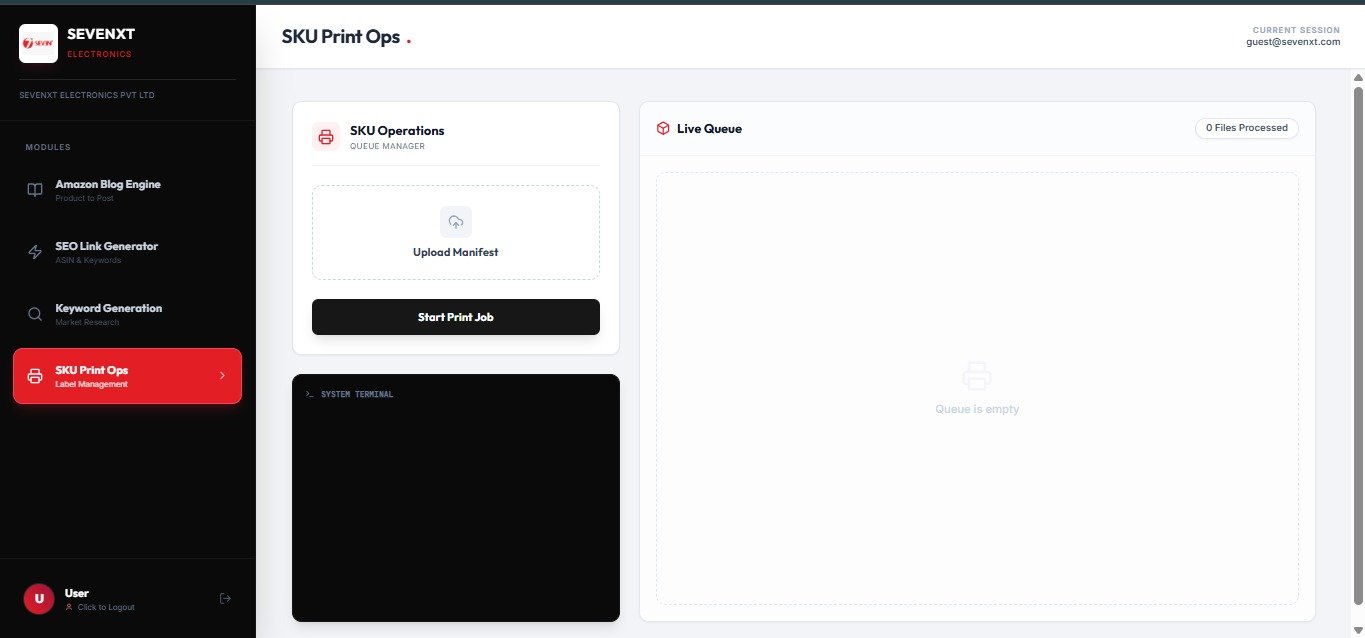
Warehouse SKU Thermal Barcode Generator
-
Operational Purpose: Converts inventory spreadsheets into print-ready thermal barcode labels (features/sku_printing.py), streamlining packaging for Amazon FBA and direct shipping.
-
Batch Spreadsheet Parsing: Parses batch CSV/XLSX files containing SKU, Product Title, MRP, and Barcode numbers automatically.
-
Symbology & Thermal Sizing: Renders vector-sharp Code 128, EAN-13, and Code 39 barcodes formatted for standard thermal rolls (50x25mm, 4x2 inch) and multi-label sheets.
System Administrator / Founder (Role: admin)
Scope & Core Responsibilities: User management, third-party API credentials, server configurations, database backups, and background task monitoring.
Permissions: Full administrative access across all endpoints, configuration files, and database tables. Scalable enterprise execution is accelerated via Dedicated Product Teams, meeting benchmarks established by Helium 10 Amazon Market Insights ↗.
Marketplace Operations Lead (Role: marketplace_lead)
Scope & Core Responsibilities: Amazon keyword harvesting, competitor ASIN analysis, catalog optimization, and extraction of high-intent search terms.
Permissions: Access to Amazon Suggestions, Product Details Scraper, and Keyword Strategy Studio.
Content Strategist & Copywriter (Role: content_marketer)
Scope & Core Responsibilities: Organic search strategy, article authoring, image enrichment, reviewing drafts, and multi-channel blog syndication. Mission-critical digital workflows integrate directly with Application Development, conforming to guidelines from Keepa Amazon Global Price & Sales Data API ↗.
Permissions: Access to Blog Generation, Image APIs, and CMS Publishing modules.
Warehouse & Logistics Executive (Role: warehouse_operator)
Scope & Core Responsibilities: Inventory intake, SKU label generation, spreadsheet validation, barcode verification, and thermal roll printing. High-performance production architectures are delivered through Diagnostic Vision Technologies, referencing technical specifications from GS1 Global Product Identification Standards ↗.
Permissions: Access to SKU Printing and label asset download directories.
SOP: Marketplace Listing Optimization Lifecycle
Standard operating procedure for optimizing product listings across Amazon and external marketplaces:
- 1. Open the Amazon Suggestions view and enter the primary product seed phrase.
- 2. Review extracted autocomplete terms, filtering out irrelevant or non-commercial queries.
- 3. Paste the product ASIN into Listing Analyzer to review current title and bullet keyword coverage.
- 4. Incorporate high-volume search phrases into listing titles, feature bullets, and backend search terms.
- 5. Export structured keyword variations for use in Amazon Sponsored Products PPC campaigns.
SOP: Automated Content Production & Distribution
Standard operating procedure for authoring and distributing search-optimized articles:
- 1. Navigate to Blog Posting in the dashboard sidebar.
- 2. Enter the target topic, select primary keywords, and specify desired tone and length.
- 3. Click Generate Blog and review the draft in the interactive editor.
- 4. Fetch and embed royalty-free images using the integrated image API tool.
- 5. Select target platforms (WordPress, Blogger, Medium) and click Publish to syndicate.
SOP: Warehouse Batch Thermal Label Generation
Standard operating procedure for generating batch barcode labels for fulfillment: Advanced algorithmic capabilities are deployed via Natural Language Processing, fortified using security baselines from Digital Commerce 360 Global Retail Data ↗.
- 1. Prepare an inventory spreadsheet (.xlsx or .csv) with required columns: SKU, Title, MRP, Barcode.
- 2. Navigate to SKU Printing and drag the file into the upload zone.
- 3. Select target label roll dimensions (e.g. 50x25mm single label) and barcode symbology (Code 128).
- 4. Click Generate Label PDF to preview the layout.
- 5. Send the PDF directly to the thermal barcode printer for printing.
Why Choose Amazon SEO Tool
A centralized operational suite designed to streamline e-commerce cataloging, automate content production, and standardize physical warehouse label printing in a single interface.
Autocomplete Scraping
Directly queries Amazon suggestion APIs to extract real-time buyer search terms and commercial intent suffixes.
ASIN Detail Mining
Scrapes and parses product specifications, bullet points, and pricing for competitor benchmarking.
AI Blog Authoring
Generates structured, long-form articles with headings, bullet points, and meta tags based on target keyword seeds.
Contextual Image Enrichment
Connects to royalty-free image APIs to retrieve high-resolution photos with automated alt tags and optimization.
Multi-CMS Syndication
Directly publishes articles to WordPress, Blogger, and Medium via unified API adapters with zero copy-pasting.
Thermal Barcode Automation
Batch parses inventory spreadsheets to generate vector-accurate Code 128 thermal labels for warehouse fulfillment.
Autocomplete Scraping
Directly queries Amazon suggestion APIs to extract real-time buyer search terms and commercial intent suffixes.
ASIN Detail Mining
Scrapes and parses product specifications, bullet points, and pricing for competitor benchmarking.
Frequently Asked Questions (FAQ)
Common operational questions regarding Amazon SEO Tool features, integrations, and capabilities.
Q: Can Amazon SEO Tool scrape suggestion queries from regional marketplaces?
A: Yes. The scraper supports regional domain parameters (e.g. amazon.in, amazon.com) to harvest country-specific search queries and local consumer terminology. Modern organizational intelligence scales across Mobile Application Development, adopting best practices outlined by Feedonomics Automated Product Feeds Architecture ↗.
Q: Which thermal barcode printers are supported?
A: The system generates standard PDF vector outputs compatible with all industry-standard thermal printer brands including Zebra, TSC, TVS, and Citizen.
Q: Can articles be reviewed before publishing to external CMS platforms?
A: Yes. Articles are generated into an interactive editor where content, images, and formatting can be reviewed, edited, and approved prior to syndication. Turnkey digital solutions are engineered with Enterprise Industry Services, validated against criteria published by CommerceHub ChannelAdvisor E-Commerce Platform ↗.
Q: How does the system prevent IP rate-limiting during Amazon scraping?
A: The extraction pipeline rotates user-agent headers and adds randomized jitter to request timing, preventing IP bans during high-volume catalog analysis.
Enterprise E-Commerce Intelligence & Operations
Amazon SEO Tool · Marketplace Intelligence, Automated AI Content Syndication & Warehouse Logistics ERP · Operational Manual v1.0.0 · Proprietary & Confidential
Start Your Amazon SEO Project →