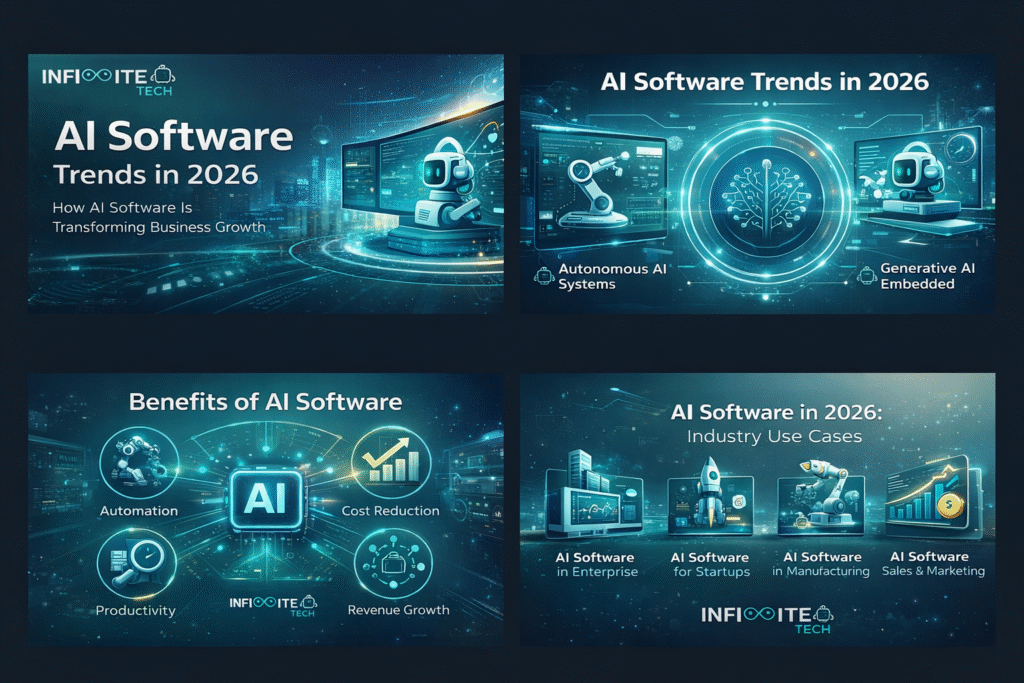
Artificial intelligence has moved far beyond experimentation. As we enter 2026, AI software has become a foundational layer for modern businesses, powering decision-making, automation, personalization, and large-scale operational efficiency. Organizations that once viewed AI as optional now consider AI software essential for survival and growth.
This blog explores the key AI software trends in 2026, the business benefits of AI software, and why enterprises, startups, and SMBs are rapidly increasing investment in AI-driven platforms.
The Evolution of AI Software in 2026
In 2026, AI software is no longer limited to chatbots or analytics dashboards. It has evolved into intelligent systems that learn continuously, adapt in real time, and operate across departments without heavy human intervention. Unlike earlier generations, modern AI software is built with composable architectures, API-first models, and domain-specific intelligence.
What makes 2026 unique is the convergence of generative AI, automation engines, and predictive intelligence into unified AI software platforms. These systems are not just supporting teams—they are acting as digital co-workers.
Top AI Software Trends in 2026
1. Autonomous AI Software Systems
One of the biggest AI software trends in 2026 is autonomy. Businesses are deploying AI software that can execute workflows end-to-end without constant supervision. From lead qualification to invoice reconciliation, autonomous AI software reduces manual dependency and accelerates execution.
These systems monitor outcomes, learn from feedback, and self-optimize. Autonomous AI software is now common in sales operations, finance, supply chain, and customer support.
2. Vertical-Specific AI Software Solutions
Generic tools are being replaced by industry-focused AI software. In 2026, we see tailored AI solutions for healthcare, manufacturing, fintech, retail, logistics, and education. This shift allows AI software to understand industry terminology, compliance rules, and operational nuances.
Vertical AI software delivers faster ROI because it requires less customization and integrates deeply into existing business processes.
3. Generative AI Embedded into AI Software
Generative models are now native components of enterprise AI software. In 2026, AI software can generate reports, code, designs, marketing content, and even business strategies. Unlike standalone generative tools, embedded AI software ensures outputs are aligned with company data, policies, and goals.
This trend enables faster innovation cycles and reduces dependency on large teams.
4. AI Software for Decision Intelligence
Another major AI software trend is decision intelligence. Businesses are using AI software to combine data analytics, forecasting, and scenario modeling into a single decision layer. Instead of static dashboards, AI software provides recommendations, risk alerts, and outcome predictions.
Decision-driven AI software is now a core tool for executives and leadership teams.
5. AI Software as a Revenue Engine
In 2026, AI software is not just reducing costs—it is generating revenue. Companies are embedding AI software into products to deliver personalization, dynamic pricing, recommendation engines, and predictive upselling.
SaaS companies, in particular, are monetizing AI software as premium features or standalone offerings.
Benefits of AI Software in 2026
1. Operational Efficiency at Scale
The primary benefit of AI software is efficiency. Automation powered by AI software eliminates repetitive tasks, reduces errors, and accelerates workflows. Teams can focus on strategic work while AI software handles execution.
This efficiency translates into lower operating costs and faster time-to-market.
2. Data-Driven Decision Making
AI software enables real-time insights across massive datasets. Unlike traditional BI tools, AI software learns patterns, identifies anomalies, and predicts outcomes. Businesses can act proactively instead of reactively.
With AI software, decision-making becomes faster, smarter, and more accurate.
3. Enhanced Customer Experience
Customer-facing AI software in 2026 delivers hyper-personalized experiences. From AI-powered support systems to recommendation engines, businesses use AI software to understand customer behavior and respond instantly.
This results in higher satisfaction, improved retention, and increased lifetime value.
4. Workforce Productivity and Augmentation
AI software does not replace employees—it augments them. In 2026, professionals across marketing, sales, finance, HR, and engineering rely on AI software as a productivity partner.
Employees complete tasks faster, make fewer mistakes, and produce higher-quality outcomes with AI software assistance.
5. Cost Optimization and Profitability
AI software continuously analyzes spending, resource allocation, and performance metrics. This allows businesses to optimize budgets, reduce waste, and improve margins. Finance teams increasingly depend on AI software for forecasting, cost control, and profitability analysis.
AI Software Use Cases Across Industries
AI Software in Enterprises
Large enterprises deploy AI software for intelligent automation, cybersecurity, compliance monitoring, and enterprise analytics. In 2026, enterprise AI Trends software integrates seamlessly with ERP, CRM, and cloud platforms.
AI Software for Startups and SaaS Companies
Startups leverage AI software to scale faster with lean teams. From automated onboarding to AI-driven customer insights, AI software gives startups enterprise-grade capabilities without enterprise costs.
AI Software in Manufacturing and Supply Chain
Manufacturers use AI software for predictive maintenance, quality control, demand forecasting, and process optimization. In 2026, AI Trends software significantly reduces downtime and operational risk.
AI Software in Sales and Marketing
Sales and marketing teams rely heavily on AI software for lead scoring, personalization, campaign optimization, and conversion prediction. AI software identifies high-intent prospects and recommends next-best actions.
Challenges in AI Software Adoption
Despite its benefits, implementing AI software comes with challenges. Data quality, integration complexity, governance, and ethical considerations remain critical. In 2026, successful companies address these challenges by adopting responsible AI practices and strong data foundations.
Choosing scalable, secure, and explainable AI software is essential for long-term success.
The Future of AI Software Beyond 2026
Looking ahead, AI software will become more conversational, autonomous, and context-aware. Multi-agent AI software systems will collaborate across departments, while continuous learning models will adapt in real time.
Businesses that invest early in AI software strategy will gain a long-term competitive advantage.
Why Businesses Must Invest in AI Software Now
AI software is no longer a future technology—it is a present-day necessity. In 2026, organizations that fail to adopt AI software risk falling behind competitors who operate faster, smarter, and more efficiently.
Investing in AI software today ensures scalability, resilience, and sustained growth tomorrow.
Conclusion
The AI software trends of 2026 clearly show that AI is becoming the backbone of digital transformation. From autonomous operations to intelligent decision-making, AI software is redefining how businesses operate and compete.
Organizations that embrace AI software will unlock productivity, innovation, and profitability at unprecedented levels. As adoption accelerates, AI software will continue to shape the future of work, technology, and business success.
Want to build or implement AI software for your business?
Now is the perfect time to align strategy, technology, and talent to stay ahead in 2026 and beyond.